Hey everyone,
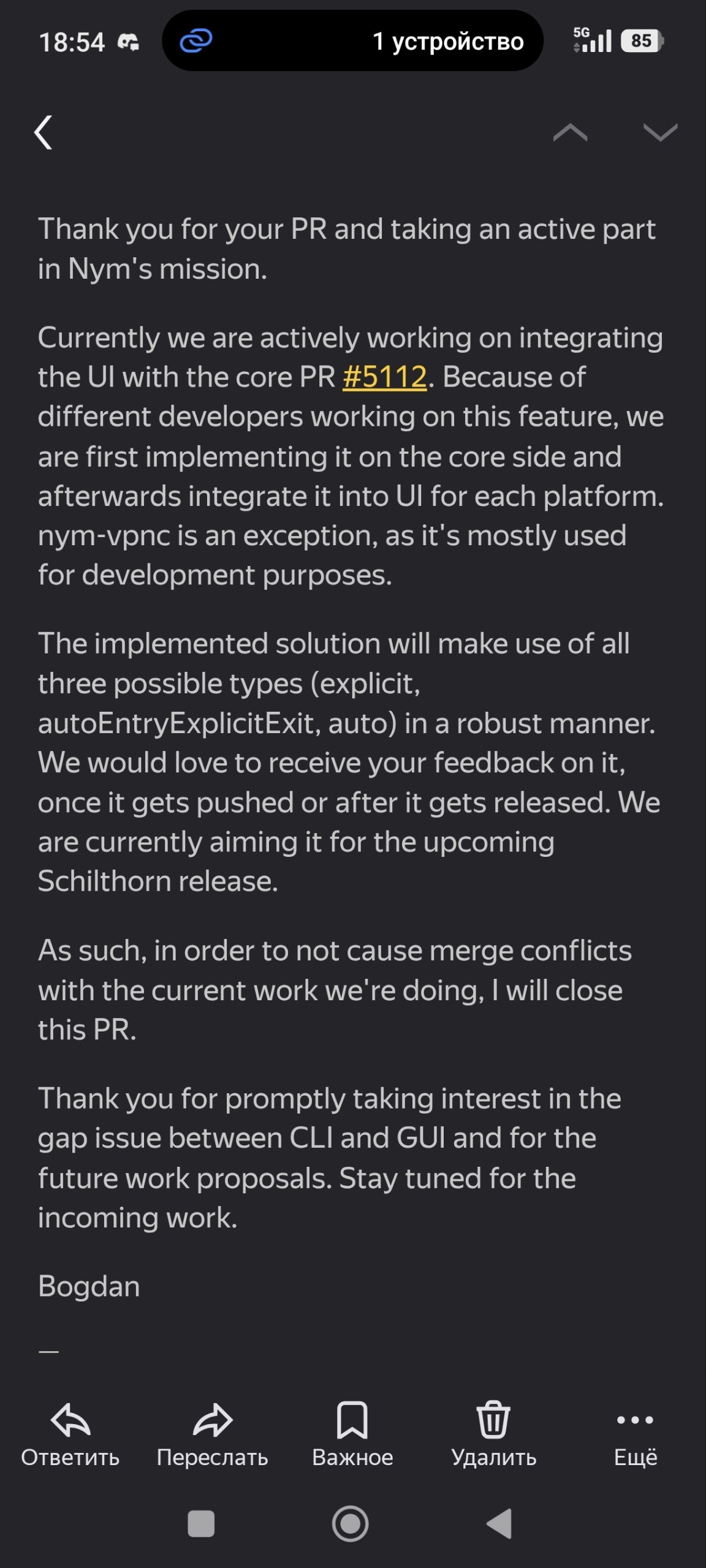
Following #5112 (Quick connect algorithm) which landed in core and the nym-vpnc CLI on the develop branch, the Linux/Windows Tauri desktop app didn’t yet expose this feature. I’ve put together a small PR that fills that gap, plus a couple of thoughts on how the algorithm could evolve. Wanted to share here for visibility and discussion alongside the PR review.
PR: nymtech/nym-vpn-client#5185
What the PR does
Core selection logic is unchanged. The PR is purely the desktop UI wiring layer:
- A new Tauri command (
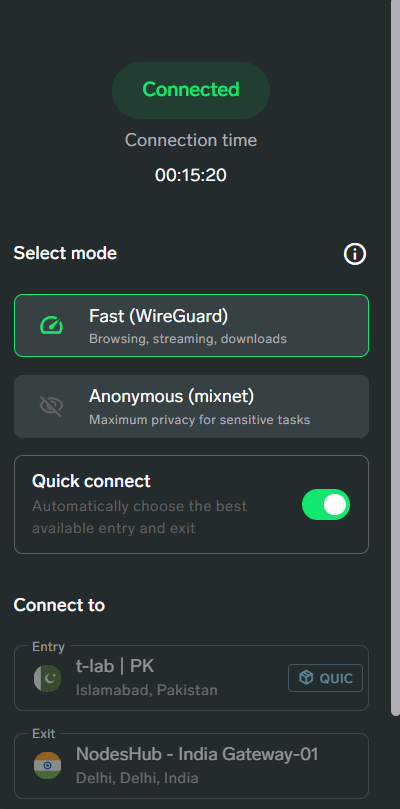
set_gateway_selection_algorithm) that mirrors the CLI pattern innym-vpnc/src/commands/tunnel.rs - A Quick connect toggle on the Home screen (Fast / WireGuard mode only - hidden in Anonymous / mixnet so the algorithm semantics stay clean)
- HopSelect cards show the actually-picked gateway info once a connection starts, so users see which gateways got selected instead of a flat “Auto” placeholder
- State hydrates from daemon config at startup and stays in sync if the user changes algorithm via CLI or config
- Generated TS bindings checked in; the
tsgenscript now formats bothtauri.tsandbindings.ts
Two preliminary cleanups also went in:
- 1-line lib-types fix:
use ts_rs::TS;was missing under thetypescript-bindingscfg innym-vpn-lib-types/src/gateway_selection_algorithm.rs(mirrors the pattern already inservice.rsof the same crate) - ts-rs version bump 11.0 → 12.0.1 in
nym-vpn-app/src-taurito align with the core workspace; otherwise twots_rs::TStrait impls collide in the graph oncetypescript-bindingsis enabled
Tested end-to-end against an installed nightly 1.30.0-beta daemon (commit de7d981). Toggling Quick connect ON in the UI updates the daemon’s gateway_selection_algorithm_config.gateway_selection_algorithm from Explicit to Auto (verified via daemon log and config persistence on disk); a subsequent Connect succeeds with auto-selected gateways and the cards reflect the actual entry/exit names.
Where I’d value team / community input
- UX in Anonymous mode: Auto requires WireGuard / 2-hop. The toggle is currently hidden in Anonymous mode and the algorithm auto-resets to Explicit with a toast. Alternatives considered: (a) keep visible but disabled with tooltip, (b) clicking it auto-switches the user to Fast. Going with hide-and-toast for v1; happy to change if there’s a different preference.
- Toggle placement: currently between the mode selector and the Entry card. Settings could also work - Home felt like the right place for a quick-action but I’d defer to the desktop team.
enable_geo_locationexposure: left at backend default (true) and not surfaced in UI v1. Worth exposing now or in a follow-up?- Generated bindings checkin policy: the auto-generated
bindings.tsis checked in with the PR. Some projects keep generated files out of git; happy to gitignore if that’s the preference.
Two follow-up ideas (separate PRs, scoping interest welcomed)
While testing Quick connect locally I ran into one situation where the deterministic Auto pick led to repeat handshake timeouts on the same gateway pair (turned out to be a foreground-daemon-mode permission issue on Windows; the proper service-mode test connected fine). It still pointed at two improvements worth thinking about:
1. Top-N randomization within the best tier
Auto today picks the single closest non-jurisdiction gateway by Haversine distance. If that gateway is unreachable for any reason - firewall, transient outage, ISP route weirdness, gateway under unrelated load - retries deterministically pick the same gateway and keep timing out.
A small change - pick uniformly at random from the top-N closest within a small distance window (say N=5) - converts “stuck on bad pick” into “next try gets a different candidate”. No new data needed, doesn’t change the algorithm shape, fits in the existing selector.
2. Richer scoring beyond filter + Haversine
Auto today: filter (same jurisdiction) + sort (closest by Haversine).
Factors that could be added, each independent and opt-in / weighted:
- Saturation penalty - penalize gateways in over-concentrated countries / ASNs to spread the network
- Exit quality signals - SMTP egress clean, IPv6 default, residential vs hosting tier
- Jurisdiction tier - avoid “extreme operator-risk” jurisdictions for entry/exit even if geographically optimal
- Per-client recent-latency cache - fast-path pre-selection based on actually-measured RTTs to candidates
- Entry-close-to-user / exit-far-from-entry tradeoff - as a tunable rather than fixed
Each would need either new fields in nym-api (gateway metadata) or an auxiliary curated dataset shipped with the daemon. I’ve been experimenting with similar scoring in a separate gateway-scoring tool (used today by node operators for deployment recommendations) - happy to draft a scoping issue if the core team is interested.
Why this matters
Quick connect is the kind of feature that lowers the activation cost for new users - they don’t need to know what entry/exit to pick or what jurisdictions trade off against what. CLI users are already getting this via nym-vpnc. Bringing the same thing to the desktop seems like a natural completion of #5112 for the upcoming v2026.9 (Schilthorn) release.
Open to revising the PR as the desktop and core teams see fit.
Cheers!