 Operator Town Hall - Node Families: Real Decentralization for Multi-Node Operators
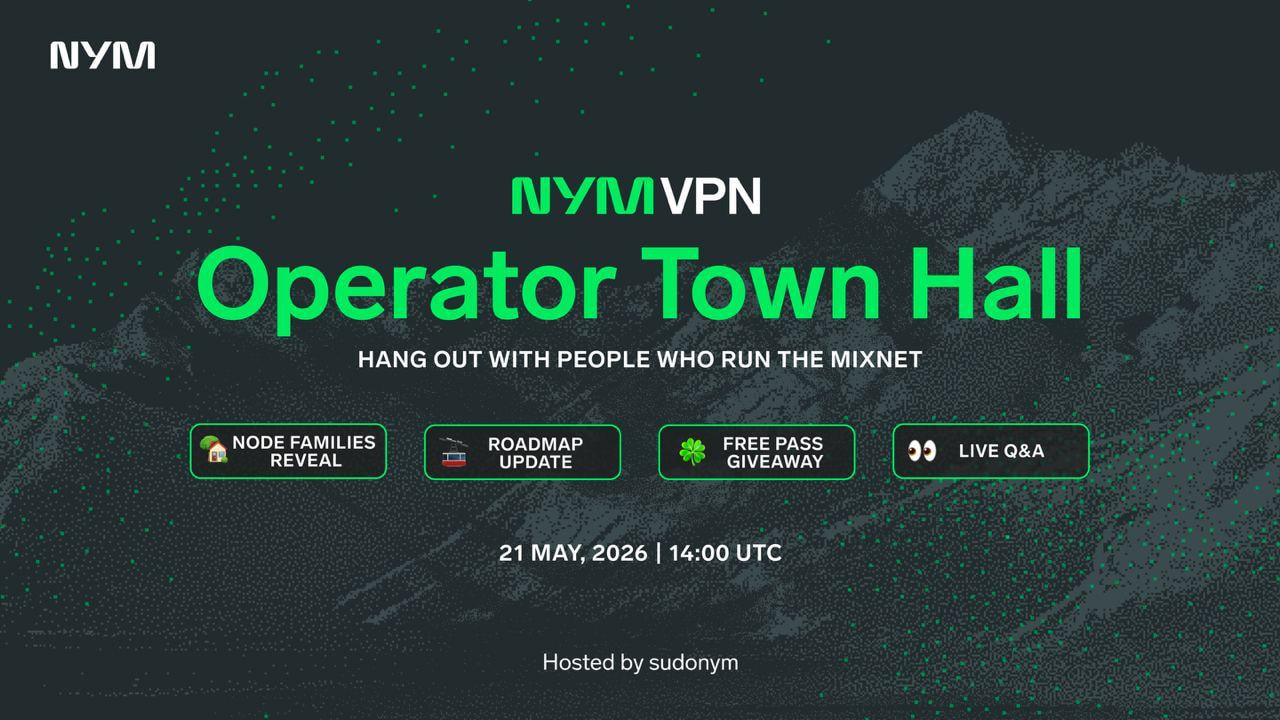
The first Operator Town Hall in a while, hijacking the Noise Signal Radio stream. @sudonym stepped aside to let the team deliver an important technical update: Node Families are coming - a way for operators to cryptographically declare which nodes they control, so the routing layer can guarantee decentralization even as the network grows.
Hosted by @jayapapaya (CSO), with @serinko (DevRel), @claudianym (Chief Scientist), Hux (Wallet), and Mark (CTO) presenting.
Big thanks to everyone who joined live - and apologies for the slide deck mishap, genuinely never broke before.
 The Elephant in the Room - and the Roadmap
Jaya opened candidly:
“We’re going through a really rough patch in the team, in the community, in the operator community in terms of the performance of the token right now.”
She framed it as a mix of broader crypto market difficulties and Nym-specific issues - rogue investors dumping, and a deliberate “change of guard” in the investor base. New aligned investors are being courted in the background.
The technical roadmap stays on track: wallet integrations (Edge Wallet already live), LUIS protocol with post-quantum keys, and split tunneling + ad blocks landing in the next NymVPN release.
 The Operator Community Grew Up Quietly
Serinko’s retrospective deserves to land louder than it usually does:
- 11 NYM Improvement Proposals are now fully governed by node operators - exit policy, governance, protocol direction
- His quick script counts 23 entities running 5+ nodes each, accounting for 47% of the entire 750-node network
He pointed at Spectre’s decentralization tab in the explorer and dropped the gist of his counting script for anyone who wants to play with the data themselves.
Why are operators clustering into squads? Workload distribution, shared knowledge, brand reputation, and scaling. Two scaling patterns are now mainstream:
- Virtualization of dedicated or bare-metal servers for cost-per-bandwidth efficiency
- Ansible orchestration - one playbook to upgrade, bond, mitigate vulnerabilities across all nodes
“You have this one tool which rules overall.”
For operators ready to take this step, the Nym orchestration docs cover the setup.
 The Routing Problem
Claudia laid out the security case. Nym’s value is decentralization through multiple independent intermediaries - 2 in WireGuard mode, 5 in MixNet. But if the same operator runs entry and exit:
“You basically revert to what would be like a centralized VPN where you have one intermediary even though it’s multiple - is logically one because it’s the same entity controlling all of them.”
Today nothing encodes that two nodes belong to the same operator. Same problem with co-location: two nodes from different operators in the same hosting provider give that provider full-path visibility.
And it’s not just bad for users - it’s bad for operators too:
“If you have the full route from source to destination, you can also be compelled to provide this information. This information might make you a target as well.”
 Node Families - Cryptographically Bound
A Node Family = nodes controlled by the same operator, certified by a cryptographic family key.
Guarantees:
- No fake family members. Today anyone can name their node “Expected DAO 5” and squat on someone’s reputation. With family keys, joining requires proving control.
- Cryptographic link between siblings. Same family = verifiable same operator.
Two automatic exclusion rules when selecting entry/exit:
- Entry and exit must not belong to the same family
- Entry and exit must not be co-located (same ASN/hosting provider)
Automatic mode always respects these. Manual override possible with a clear warning for users with legitimate reasons.
Honest admission:
“Did we solve all the problems? No.”
Residual risk: operators who refuse to declare. The proposed next iteration is verified operator reputation - additional rule that at least one of entry or exit must be a verified operator, so an anonymous sock-puppet on the other end can’t reconstruct the path.
 Family ≠ Squad
Claudia drew the line:
“Node family declarations are introduced for security reasons, not for social purposes.”
A family is whoever makes operational decisions. Friends each independently running their own nodes? Different families, even if they’re in the same squad. A solo operator with 10 nodes? Valid family of one. A DAO with shared multisig? Family of many.
The key test, added in Q&A: “Are they operationally independent?”
 The Wallet UI
Hux walked through the upcoming UI (shipping next or very soon):
- Account summary shows your family at a glance (name, member count, total bonded)
- Creating a family requires naming it and a 100 NYM bond to prevent spam
- Invitations sent by node ID; receiver sees who’s already in the family before accepting
- Accepting = delegating partial control on-chain - treat the click accordingly
- Rage quit anytime as a member, kick as owner, dissolve only when family has zero nodes
 Naming Matters More Than You Think
Serinko’s segment that surprised me. Family names will be a separate endpoint from node descriptions, surfaced in the user-facing UI - so they’re the first thing potential users see.
Principles:
- Brevity - readable at a glance
- Human-related - not jargon, not memes, not in-jokes, definitely not offensive
- Build trust with outsiders who don’t know the community
- Useful metadata - location, index, role
Existing names show the pattern: “Kotaku Home” works because residential-IP-seekers type it directly; “Indonesia gateway” buries the actual operator brand. Bad names lose users before they ever connect.
 Mark’s Implementation Roadmap
Mark broke the rollout into phases:
- Wallet first - operators declare families, manage invites
- Gateway routing policy - NymVPN app enforces no-same-family and no-same-ASN for entry/exit gateways
- MixNet-wide rollout - more complex because layer selection has to change
- Decentralized geolocation agents via governance - because “blockchains don’t really let you do network requests”
The policy checks three signals: same family, same ASN, same subnet. The subnet check catches the common case of EC2 instances in the same availability zone.
 Q&A Highlights
Q: Will operators be compelled to declare all nodes in a family? Jaya: Yes. Family stake will act as a global cap on ticket-based rewards - so undeclared nodes don’t escape the cap by hiding.
Q: CLI for older macOS users? Mark: Family management is landing in the NYM CLI - automation-friendly.
Q: Is the Delegations program still open for new operators? Serinko: Yes - the Nym Delegations program takes applications with rules posted there.
Q: Can governance voting use a family-based model? Cool idea, but Claudia flagged the trap: if a 10-node operator goes from 10 votes to 1, that’s a disincentive to declare. Family weight would need to be stake-based.
Q: How does verification preserve anonymity? First phase has no verification - just declared families and ASN checks. When verification arrives, it’s pseudonymous reputation, not identity. Claudia: “Your reputation might be tied to a Telegram account that you use and maybe nobody knows your real name.” Skin in the game, not KYC.
Q: Can a family key claim someone else’s node? Mark: No - the receiving node has to confirm the claim. Hux’s warning: invites are on-chain actions, treat them seriously.
Q: iOS split tunneling? Mark: Soon™. iOS sandbox is the hardest of any platform - very few VPNs do it at all. Active work, not abandoned.
Q: Will the Nym team have an official Node Family? Serinko: “We already are a node family.” The nymtech.ch nodes on mainnet will be bonded like anyone else’s.
 Timestamps
- 00:03:44 - Token situation and roadmap update
- 00:06:27 - Operator community evolution: 23 squads, 47% of network
- 00:15:35 - Scaling: virtualization and Ansible
- 00:18:08 - The decentralization problem
- 00:22:42 - Node Families introduced
- 00:31:39 - Wallet UI demo
- 00:37:51 - Naming guidelines
- 00:44:32 - Implementation roadmap
- 00:48:25 - Q&A starts
- 01:05:09 - Will the Nym team have an official family?
Watch the full recording: YouTube Link
Thanks to Jaya, Serinko, Claudia, Hux, and Mark for the deep dive. Serinko’s closing line captures the moment:
“Squads became a thing two-three years ago - league, first… compared to that, we came a super long way and the network has matured a lot. This is now also a maturing point.”
