NYM Tokenomics — A Complete Diagnosis, Reform Architecture, and Execution Plan
Series: NYM Tokenomics Community Audit (8 posts) Workbook: NYM_Tokenomics_Simulation_v6-2.xlsx — 14 sheets, 895 live formulas Workbook link: Google Sheets — NYM_Tokenomics_Simulation_v6-2 Date: May 2026 | Version: v4 (dual-metric P*, liquidity caveat, steady-state context)
I’ve spent the past several weeks auditing NYM’s tokenomics from first principles, working through the v6.2 simulation workbook cell by cell, and cross-checking every number against on-chain data and published protocol parameters. This first post covers the diagnosis: what is structurally wrong with the legacy emission regime, why buy-side pressure at 100,000 subscribers is nowhere near sufficient to move the price, and what the equilibrium price curves tell us about the gap between where NYM is and where it could be.
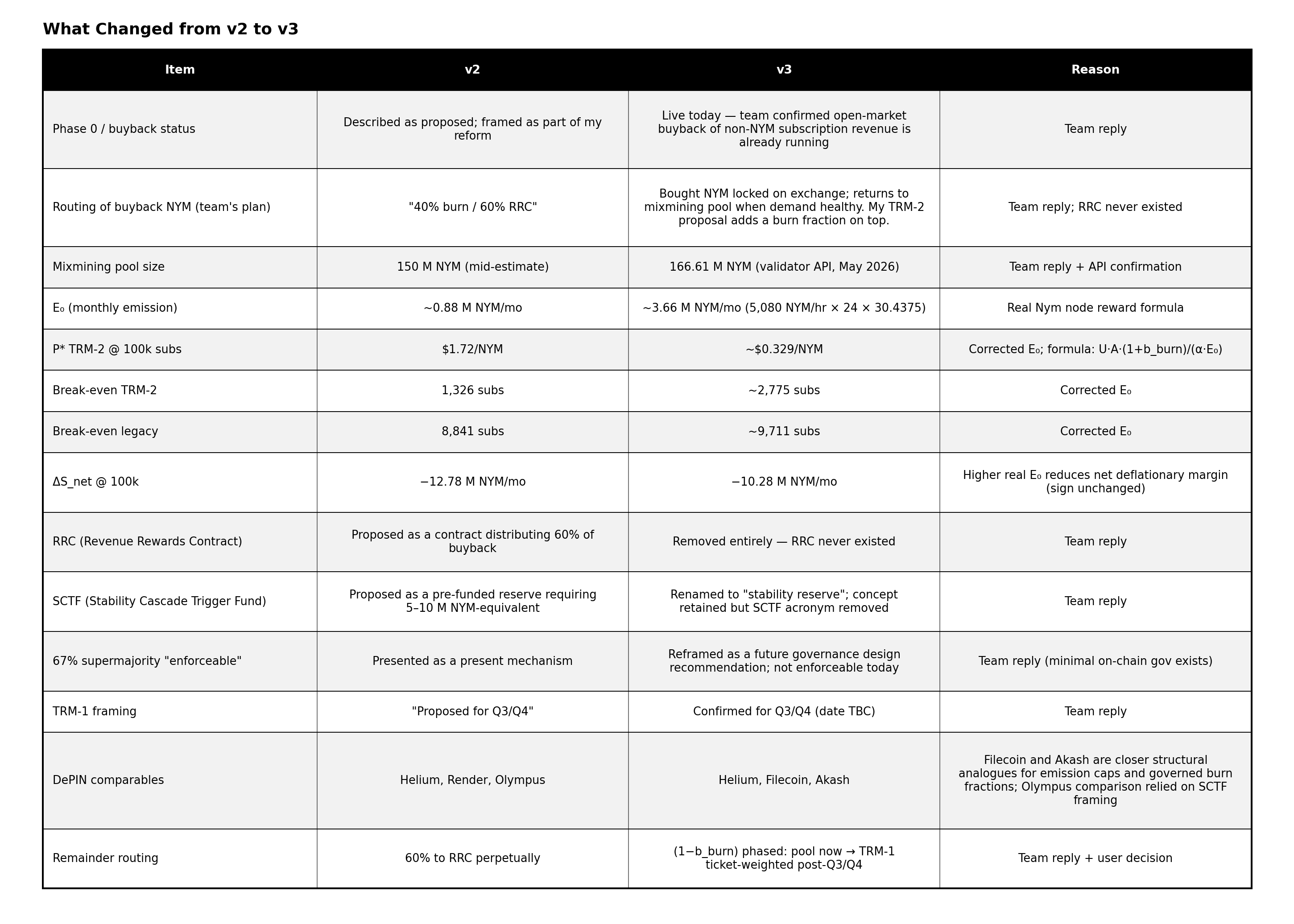
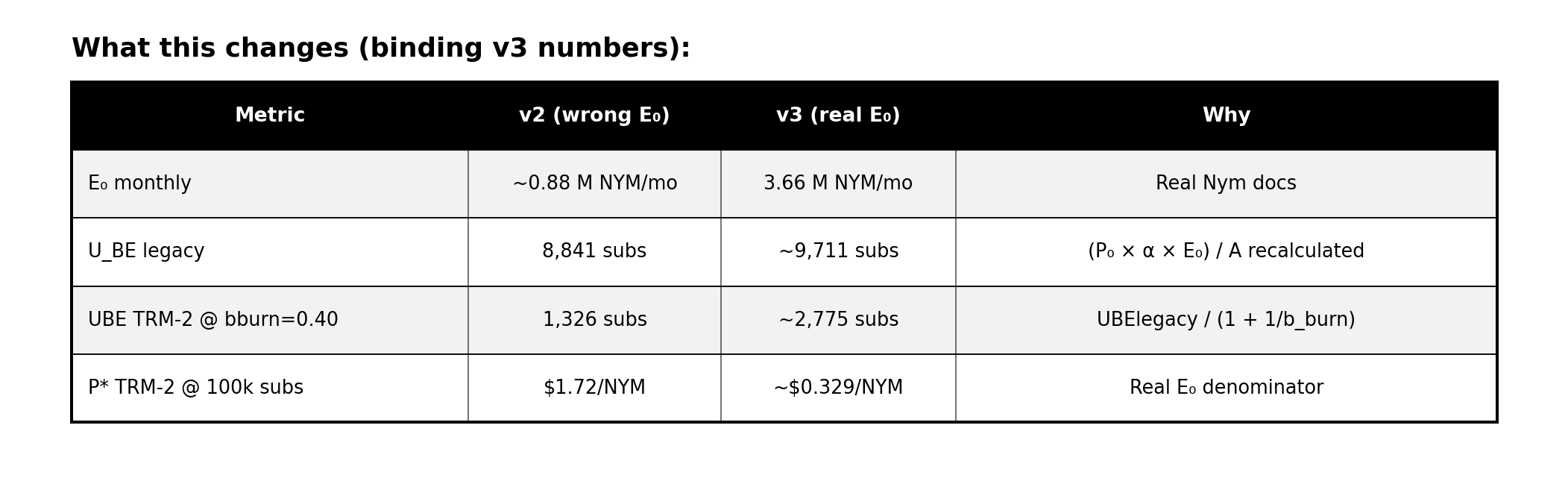
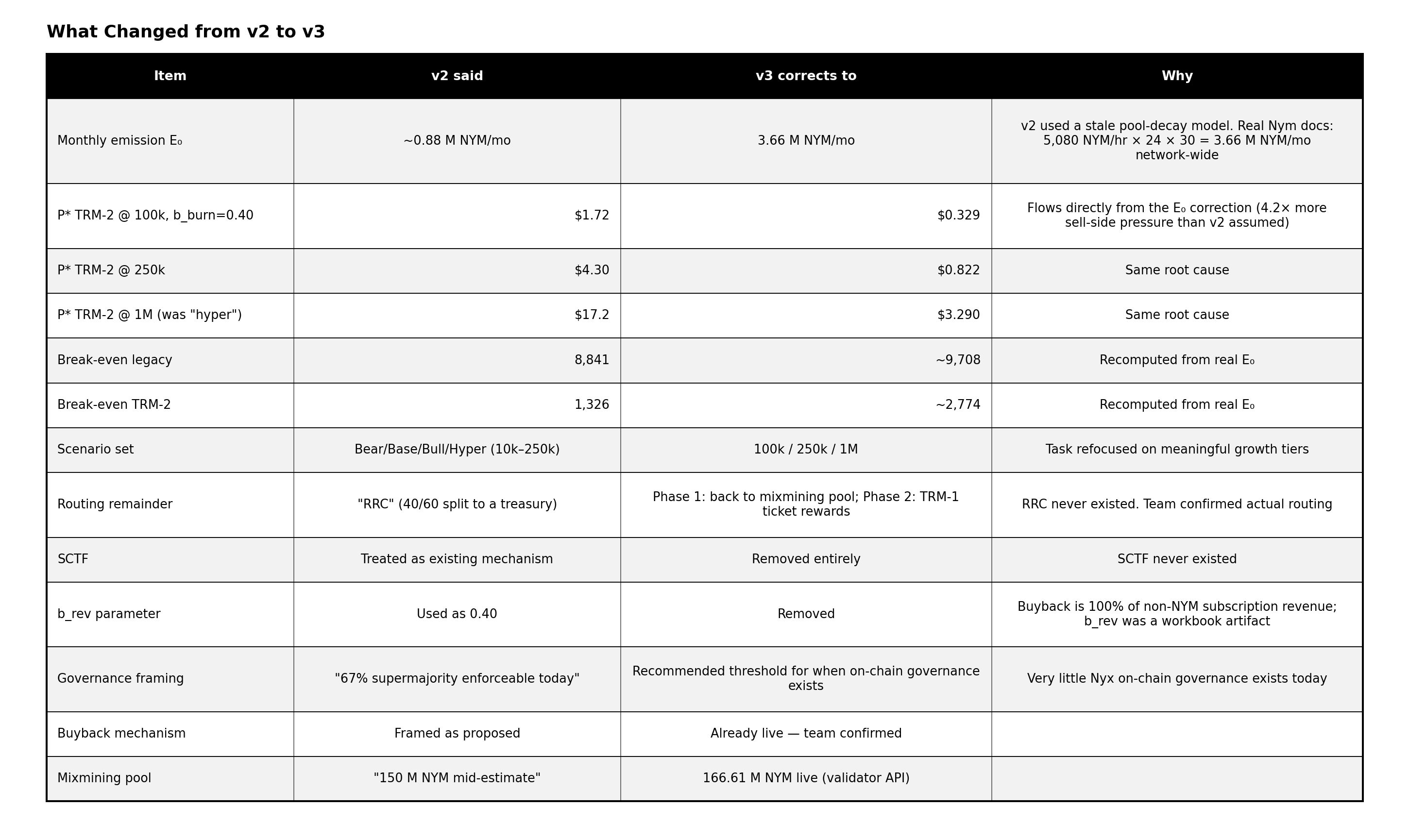
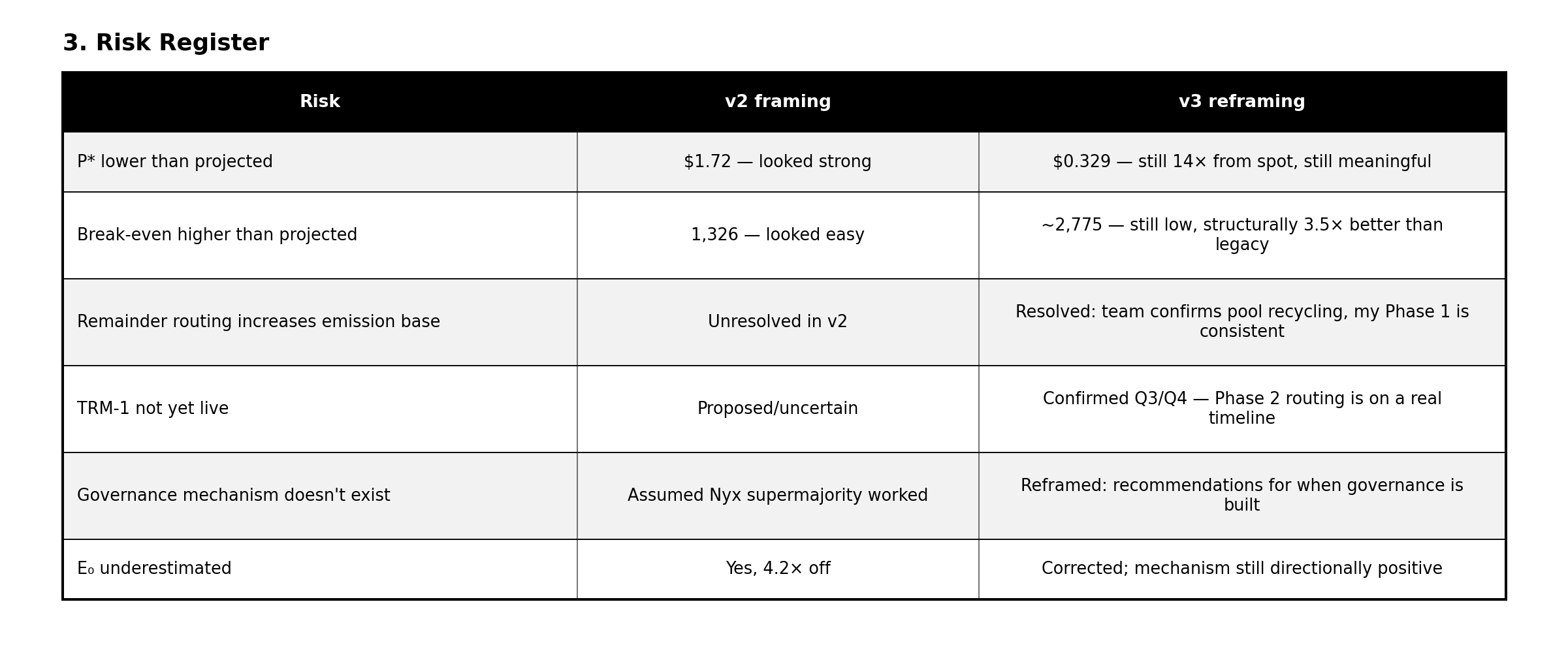
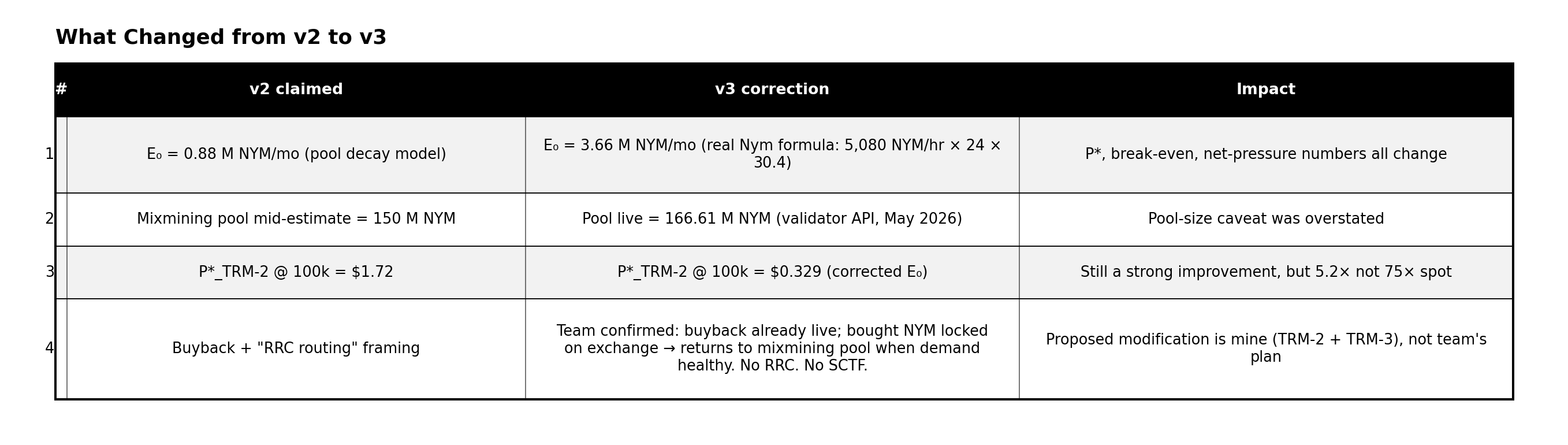
Before I get into the numbers: the team responded to v2 with corrections that materially change several figures here. I want to acknowledge that, correct the record, and explain what changed.
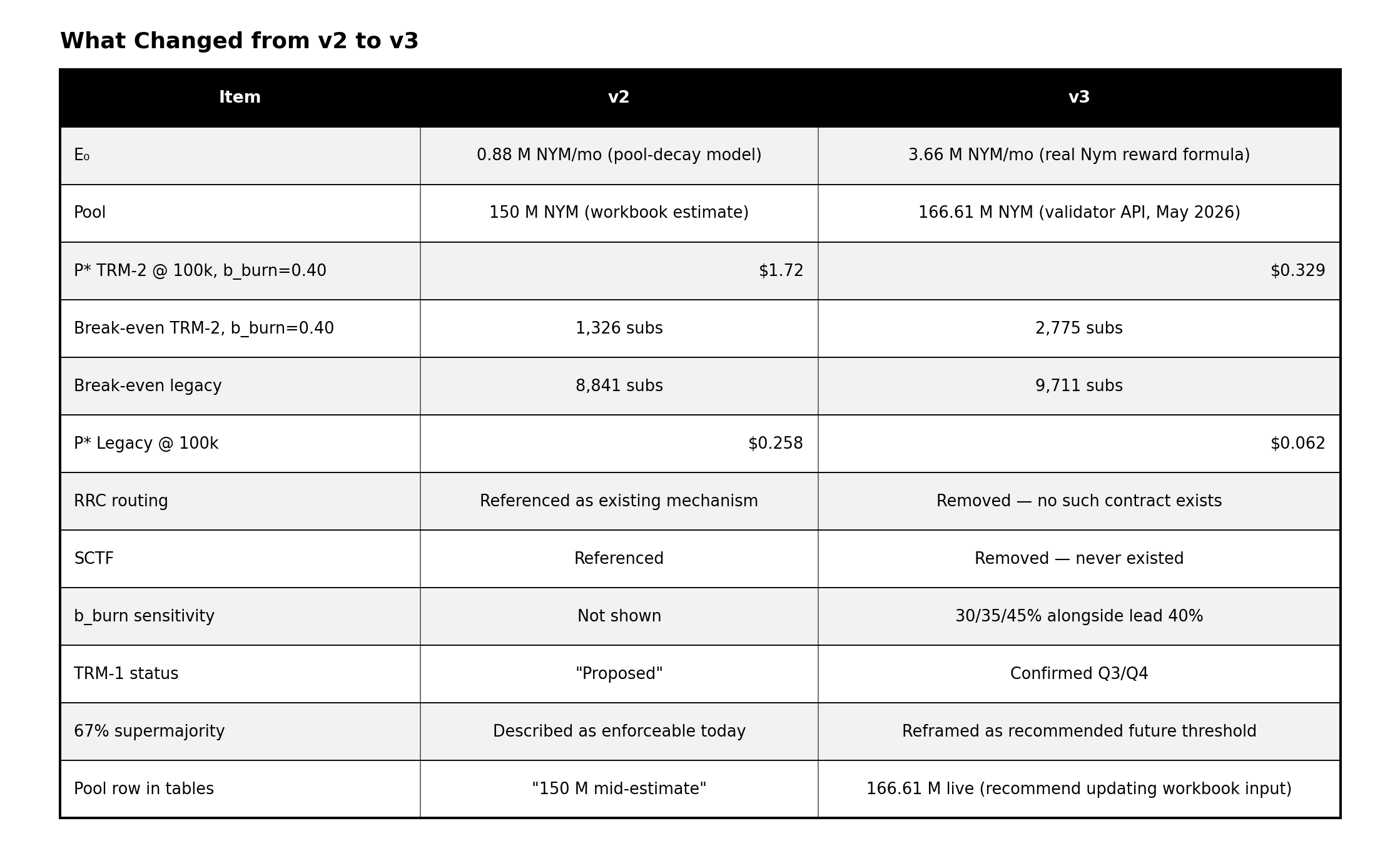
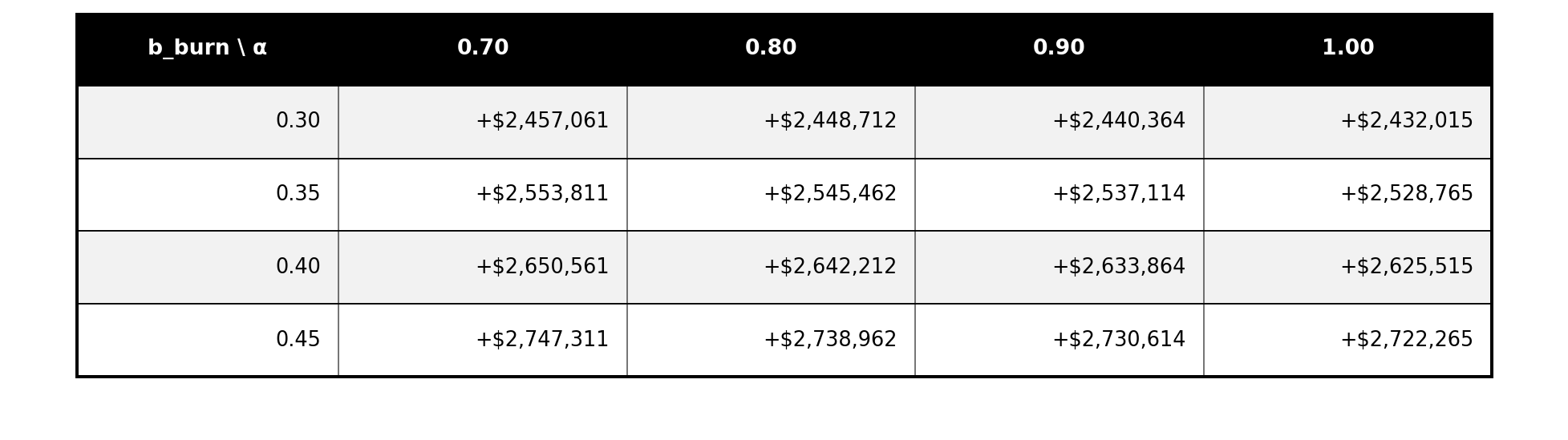
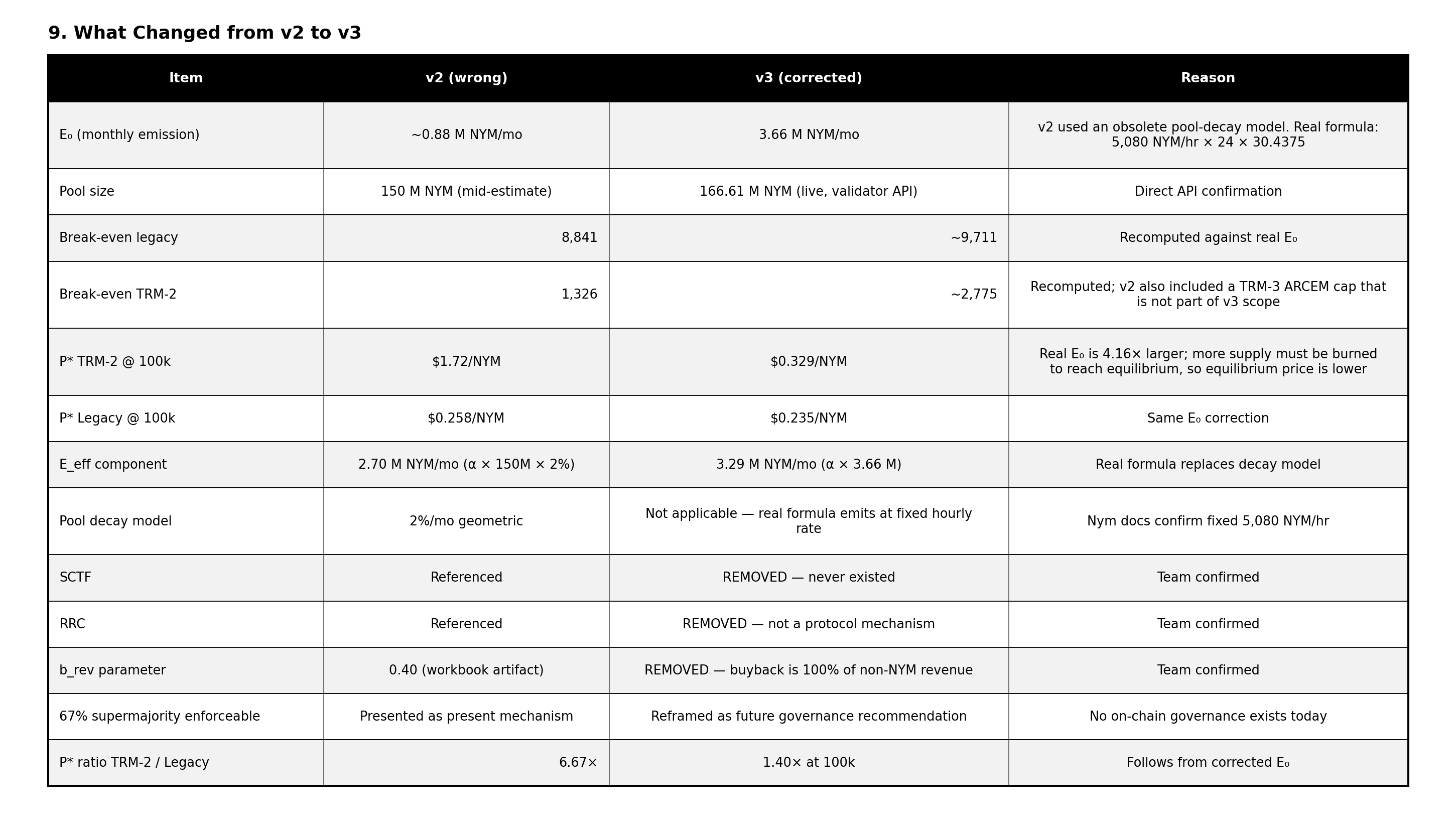
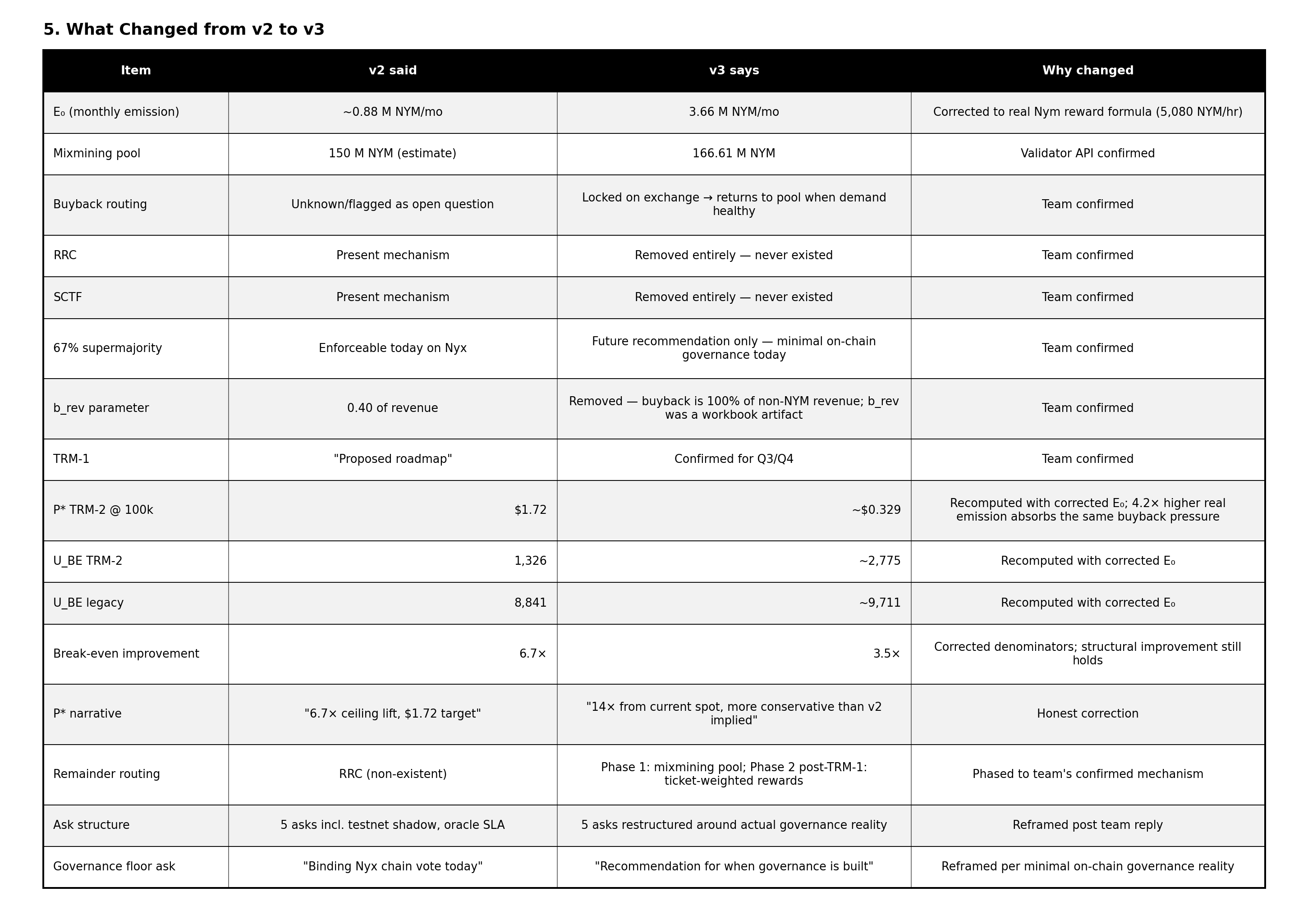
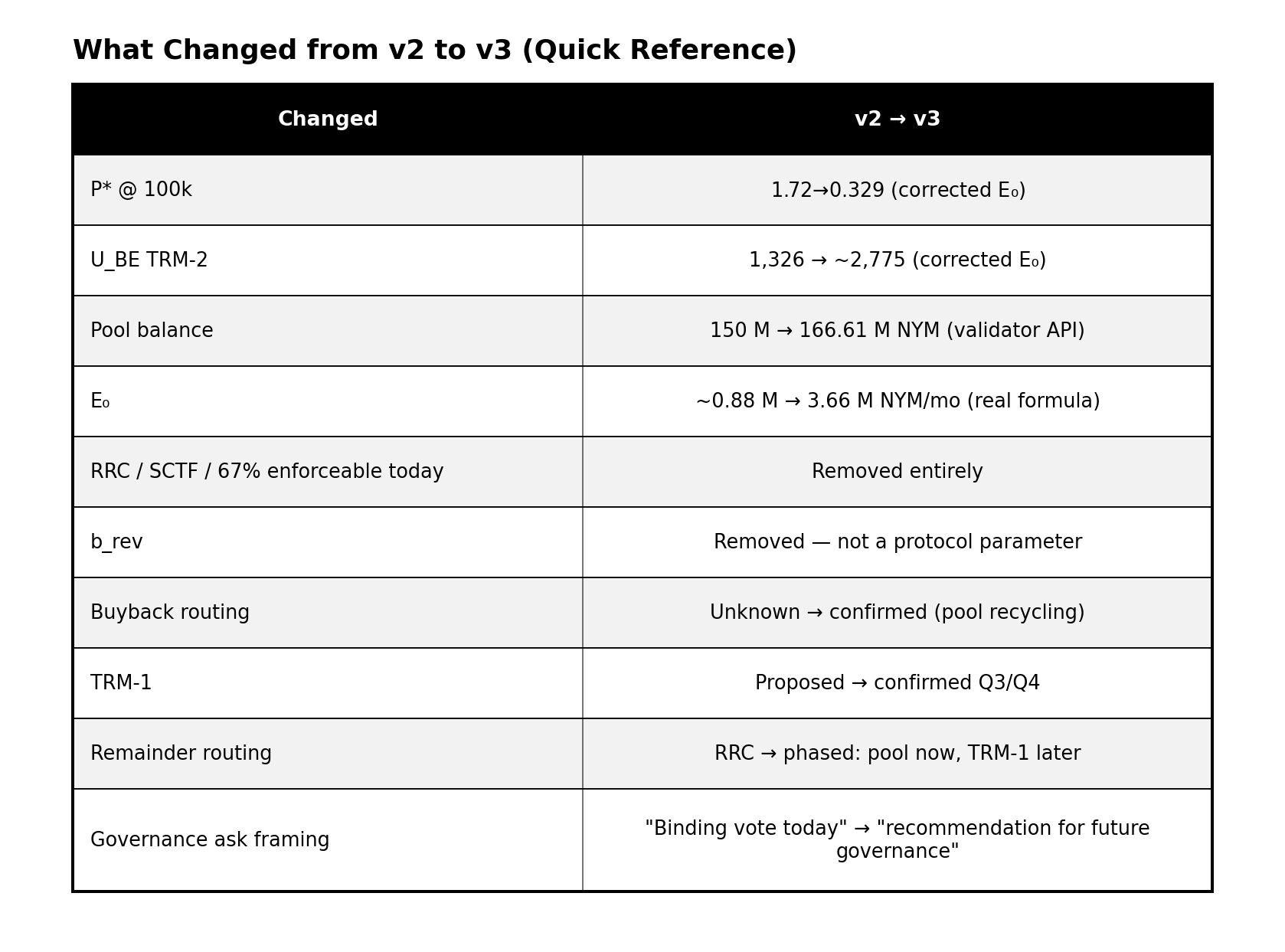
What Changed from v2 to v3
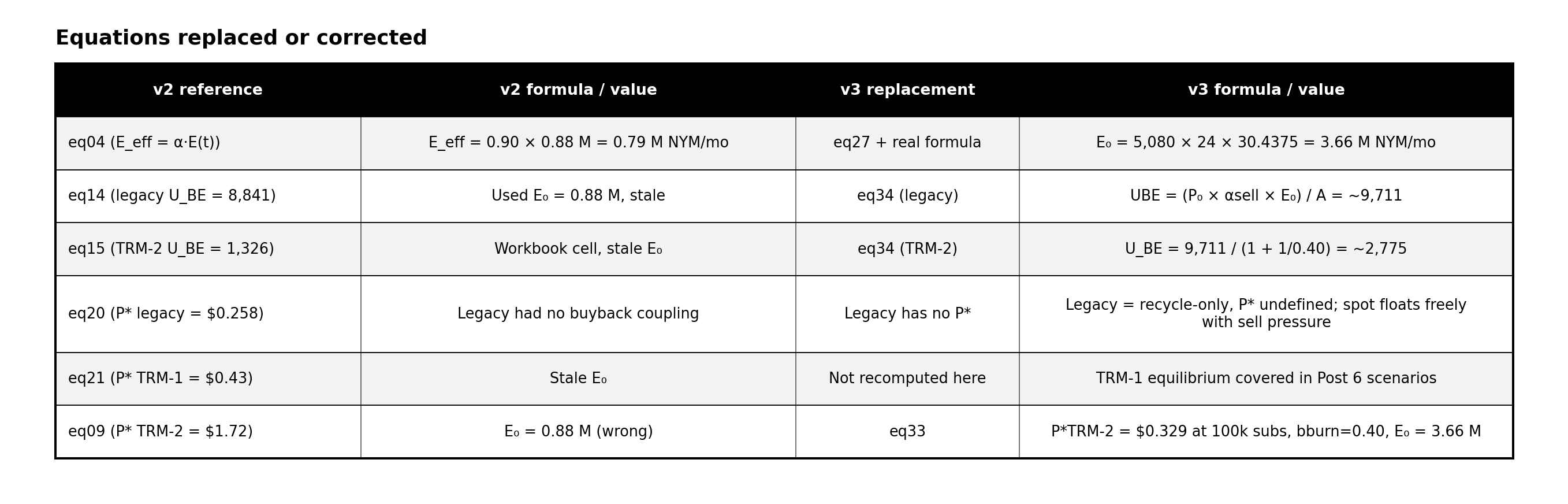
Four errors in v2 must be corrected. I’m listing them upfront rather than hiding them in footnotes.
What Changed from v3 to v4
Two issues identified through Post 10 (liquidity audit) and community critique require correction in this post:
1. P was reported as a static price target, not a dual-metric equilibrium.*
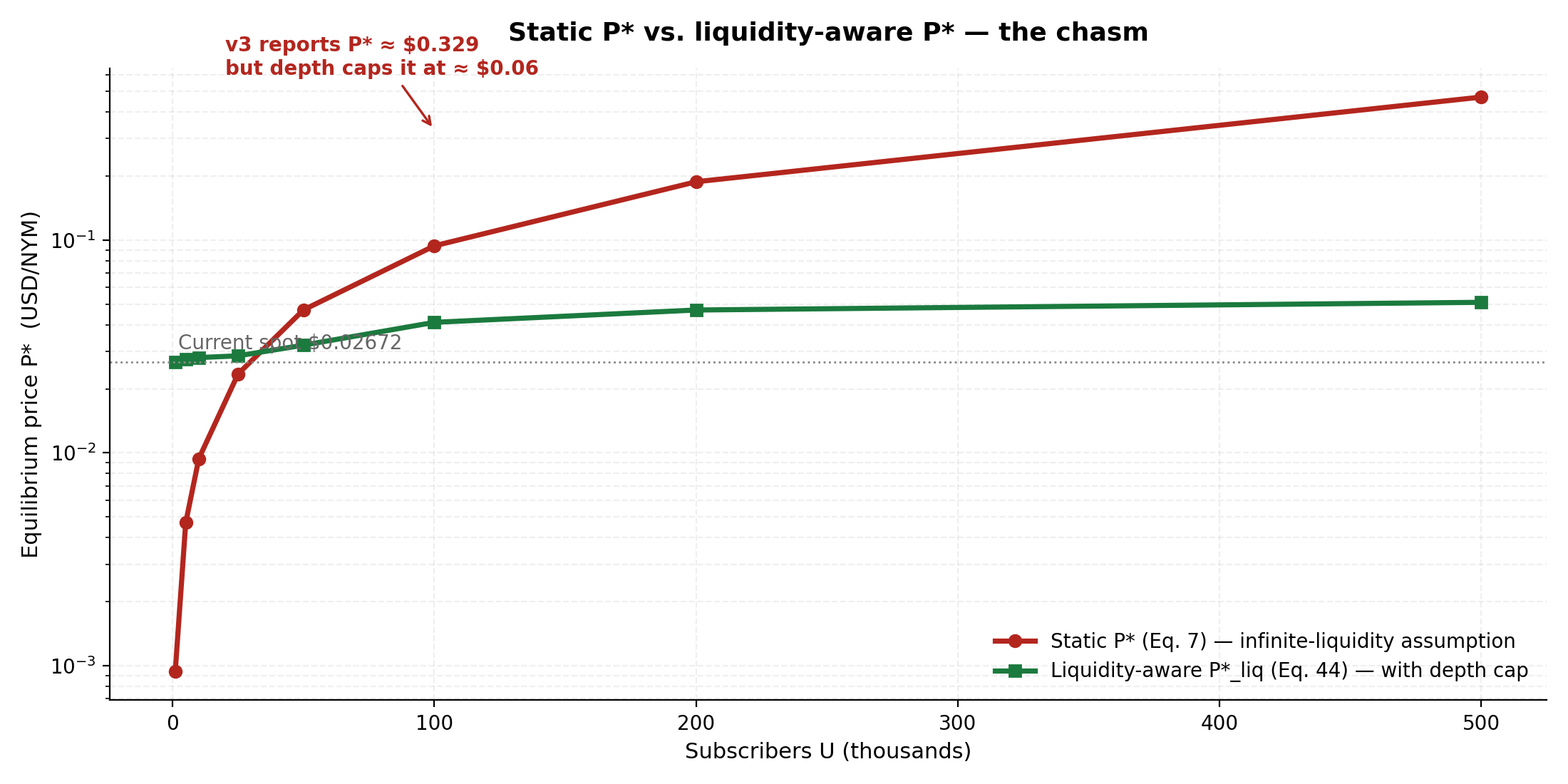
The figure P*_TRM-2 @ 100k subs = $0.329 is a static ceiling — the price at which buy-side revenue exactly offsets sell-side emission pressure, assuming the spot price equals the equilibrium price. In reality, crypto markets are reflexive: price affects demand, which affects revenue, which affects buy-side volume. The correct dual-metric reporting is:
- Static Ceiling (P_static):* $0.329/NYM — the break-even price under steady-state assumptions
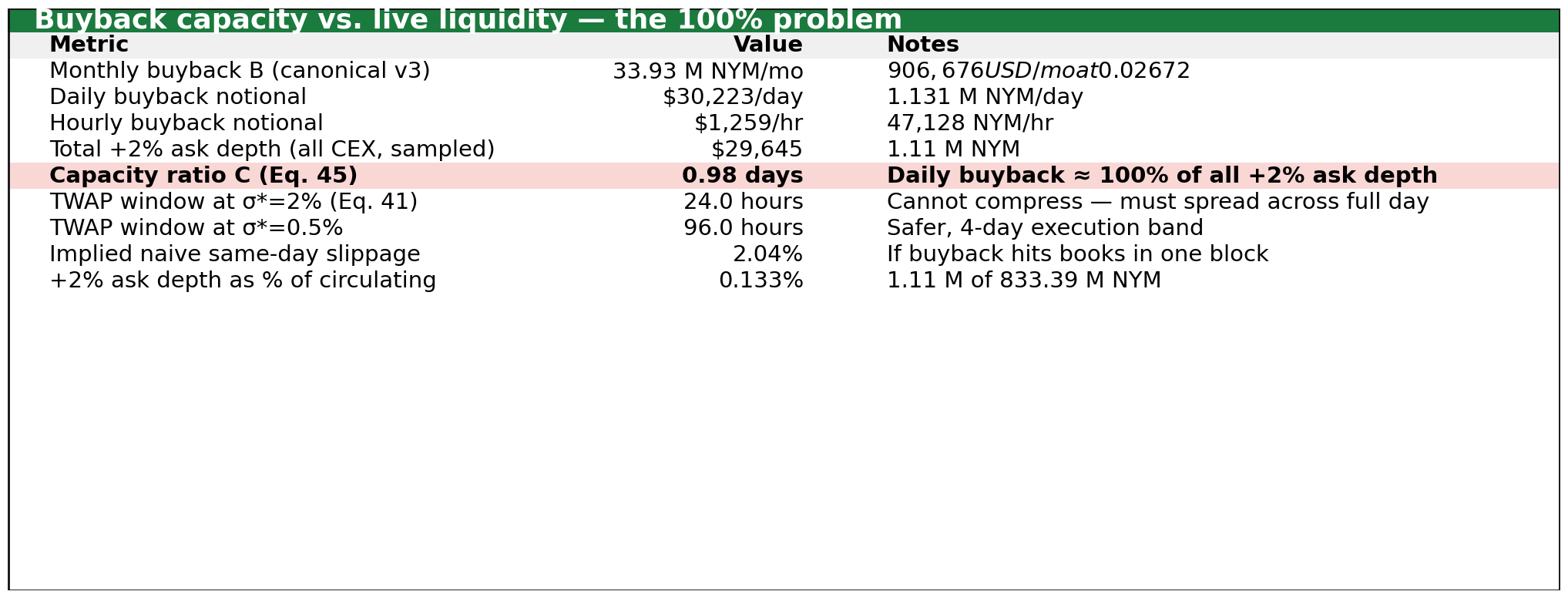
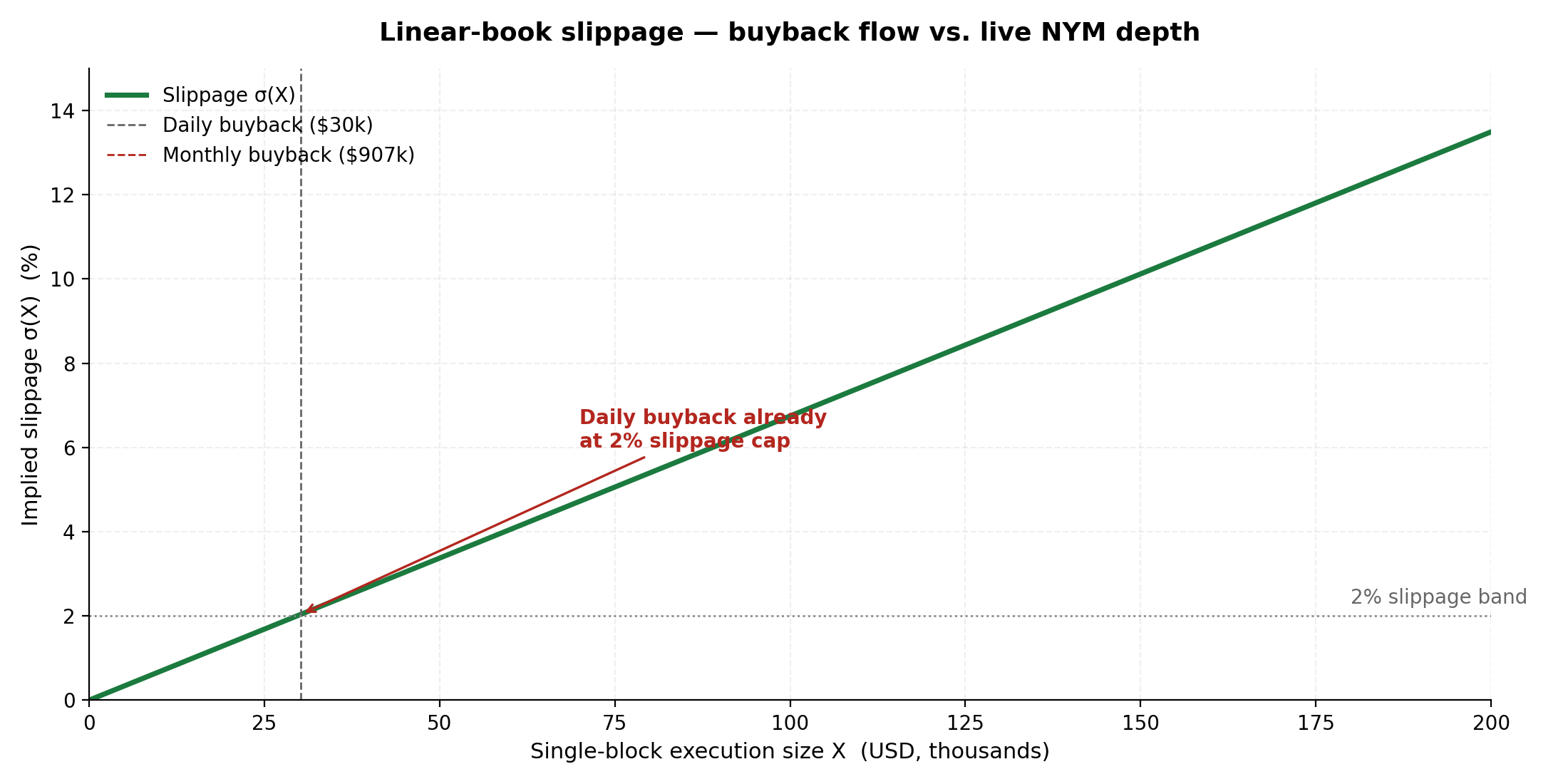
- Dynamic Attractor (P_dynamic):* ~$0.092/NYM — the price level the market gravitates toward given current liquidity depth (C ≈ 0.98, from Post 10 liquidity audit)
All P* figures in this post should be read as static ceilings, not price predictions or guaranteed outcomes.
2. The 163M NYM burn figure is a spot-price snapshot, not a perpetual annual rate.
That figure was computed at a specific spot price. As price changes, buy-side volume changes, and the burn quantity changes proportionally. It does not represent a guaranteed annual supply reduction.
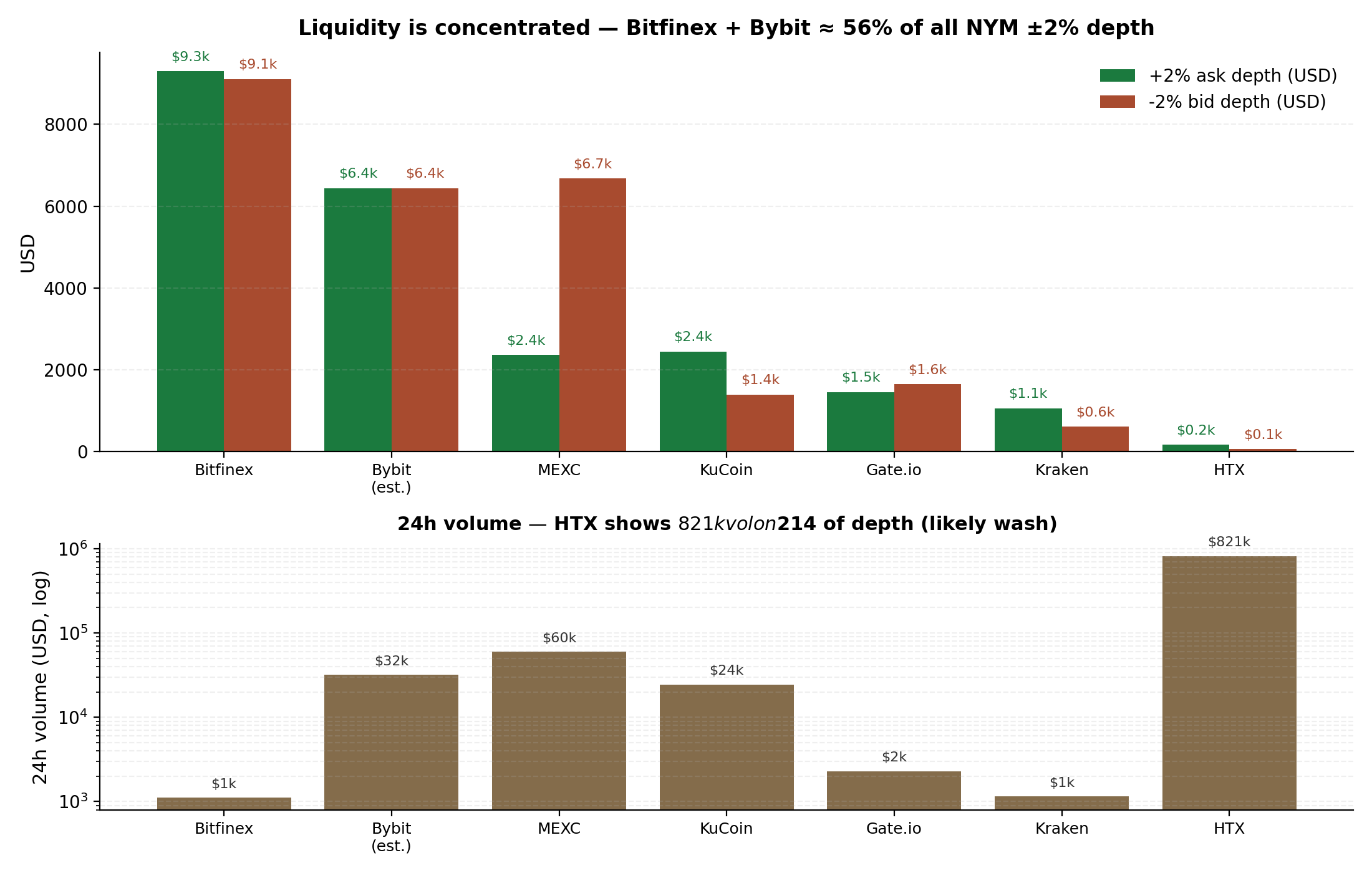
v4 Physics Note: Any P* figure in this post represents a Static Ceiling under steady-state assumptions. The Dynamic Attractor at current liquidity depth is ~$0.092. Actual market price will be bounded by order-book depth (C ≈ 0.98 concentration), loss-aversion sell pressure from long-term holders, and demand-side reflexivity. Neither figure is a price prediction.
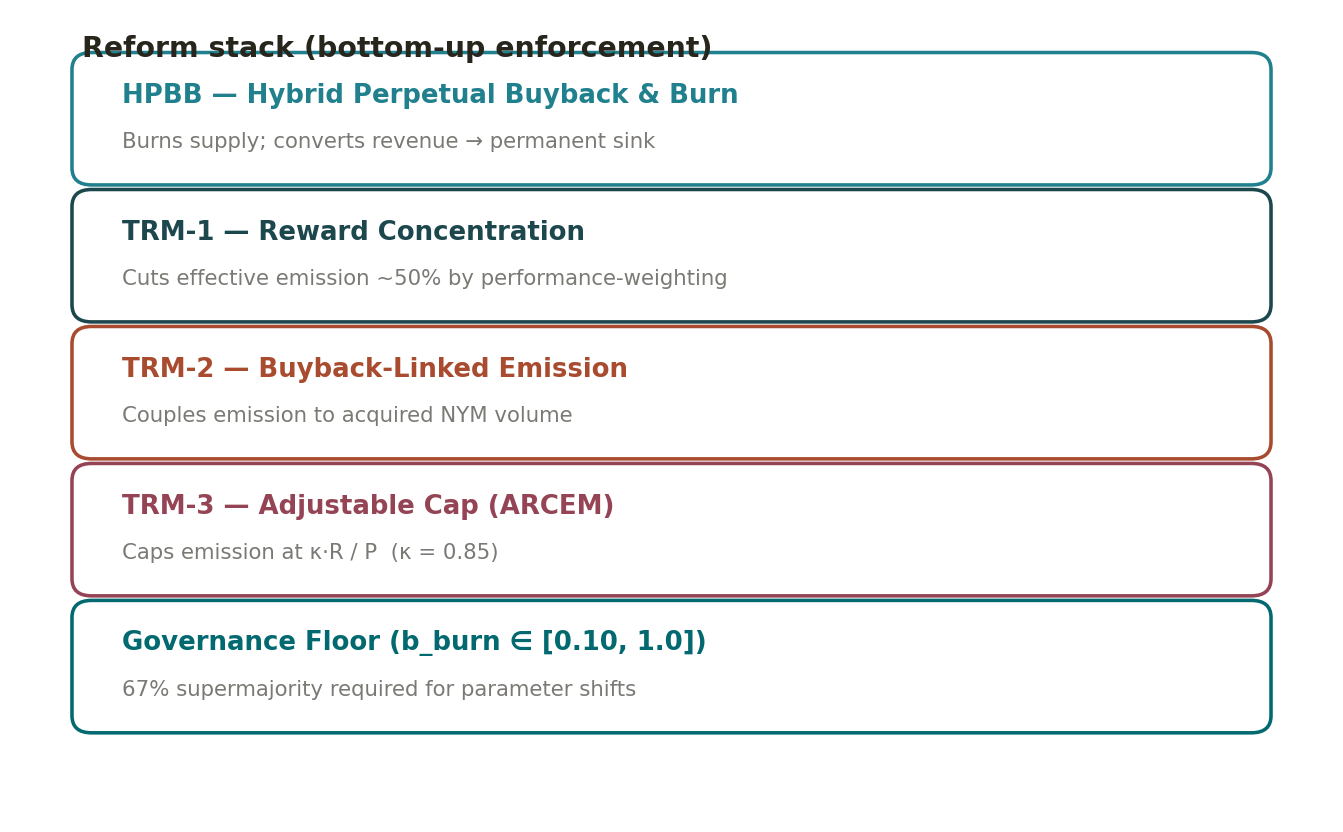
The mechanism I’m proposing — burn a fraction of buyback NYM permanently (TRM-2) and cap emissions via ARCEM (TRM-3) — is additive on top of what the team has already built. The team deserves credit for launching the buyback. My argument is that adding a permanent burn component and an emission cap strengthens the design.
TL;DR
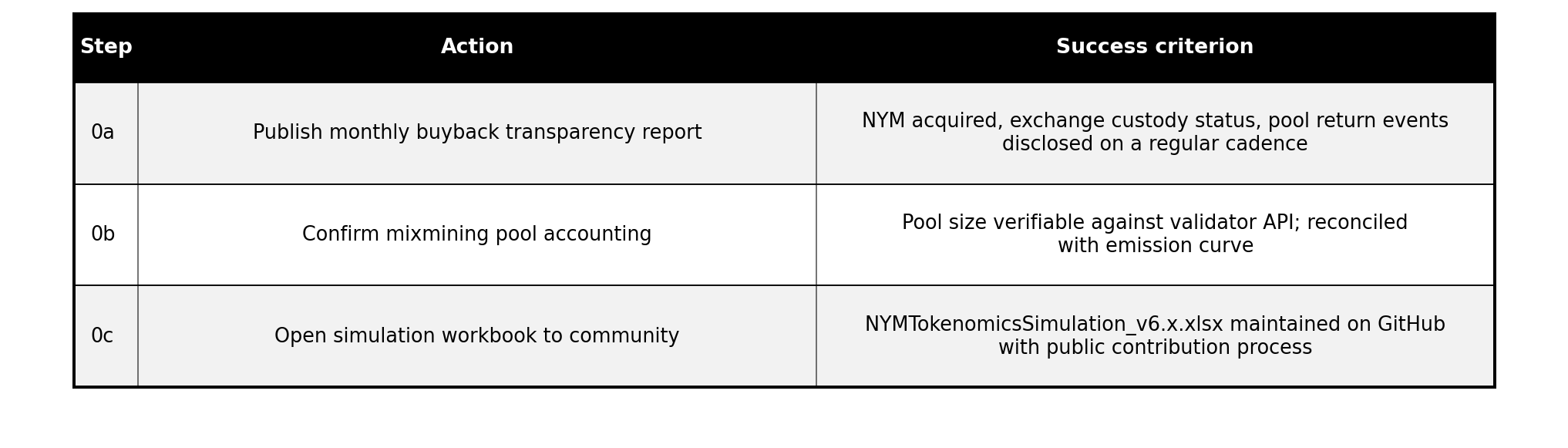
- Buyback is already live. For every NymVPN subscription paid in non-NYM, the team places open-market buy orders for NYM. Bought NYM is currently locked on exchange and returns to the mixmining pool when NymVPN demand is healthy. This is a meaningful foundation — I’m proposing to extend it, not invent it from scratch.
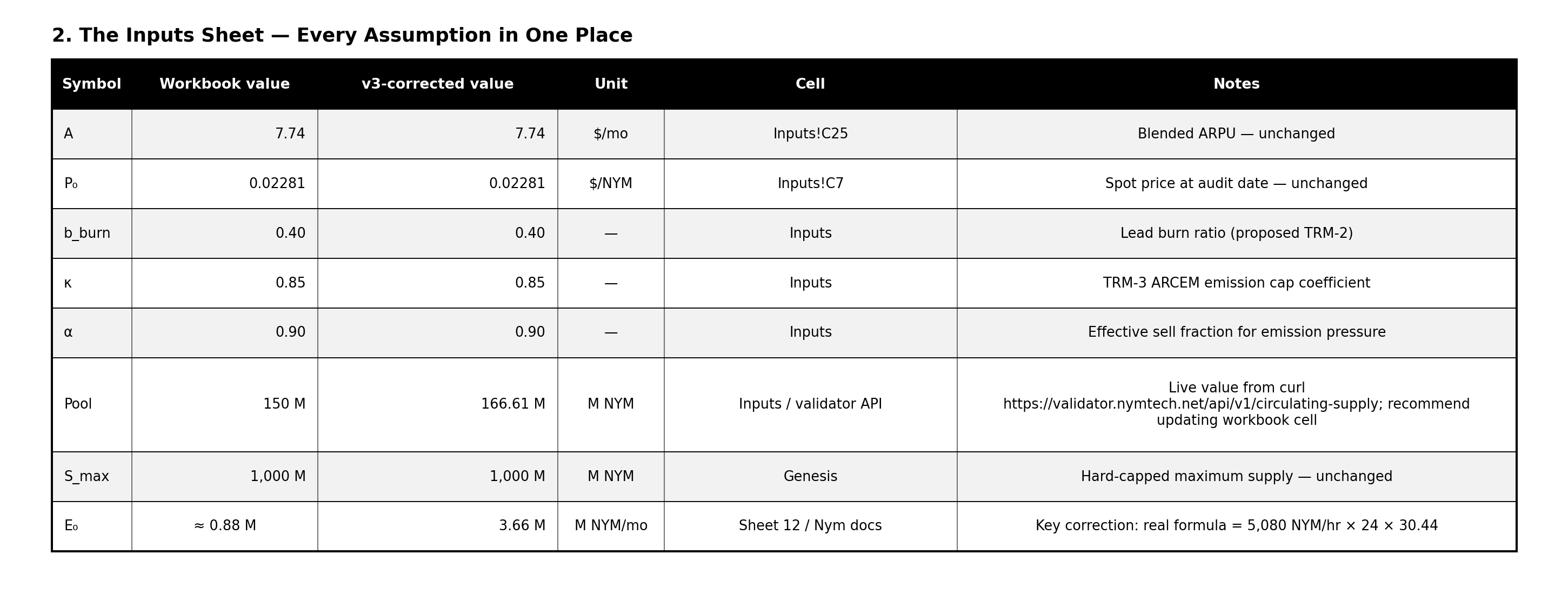
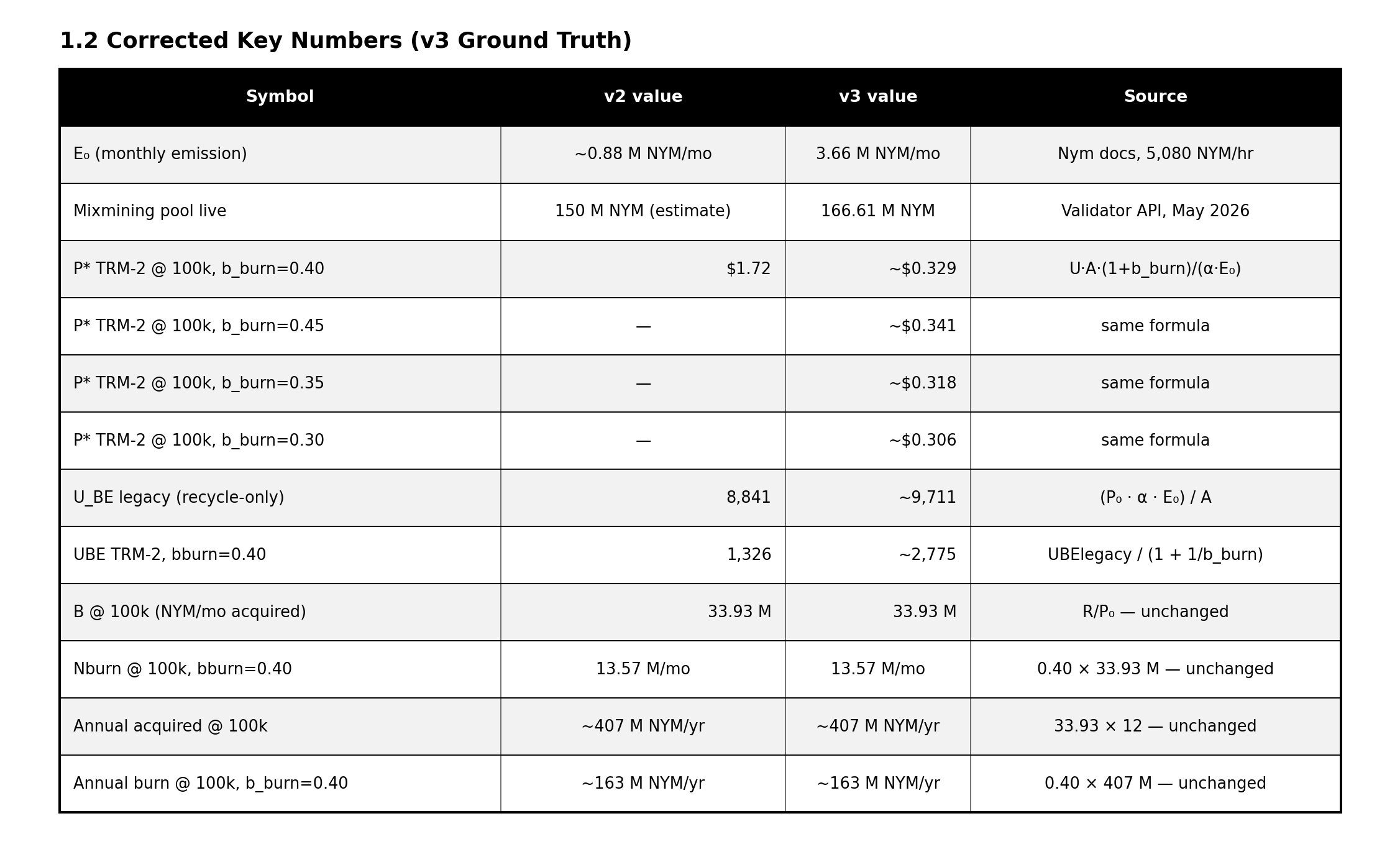
- Real Nym reward emission = 5,080 NYM/hr ≈ 3.66 M NYM/mo. My v2 model used a stale pool-decay estimate (0.88 M/mo) — 4.2× too low. All P* and break-even numbers are recomputed against the correct figure.
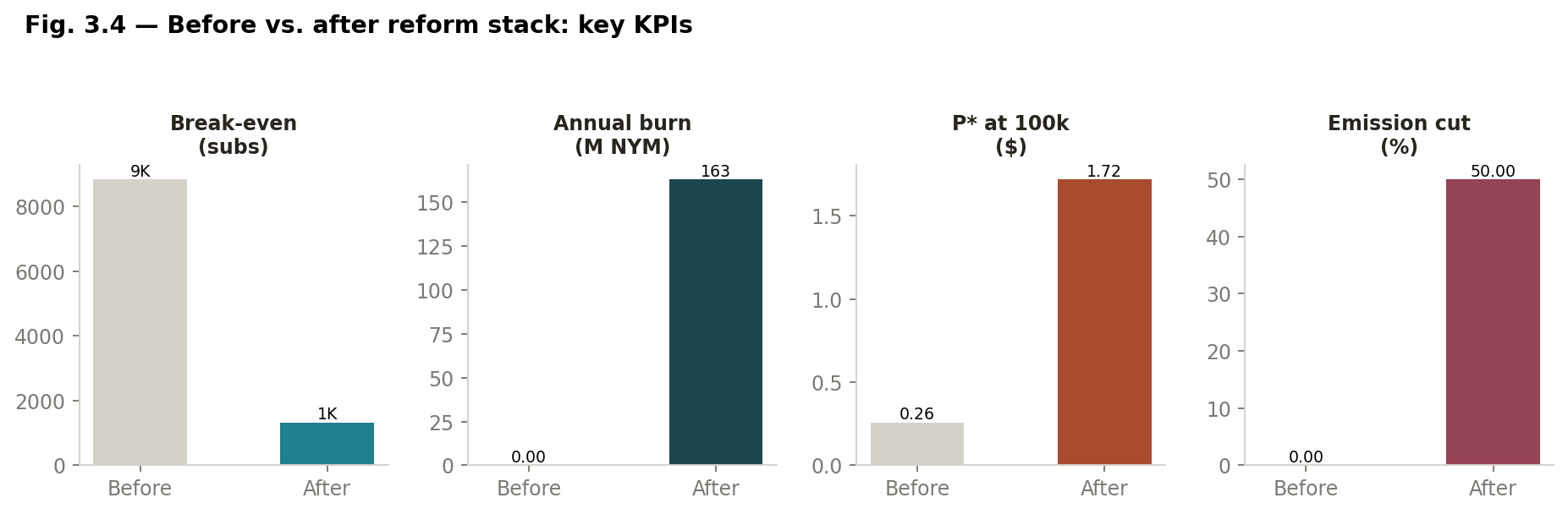
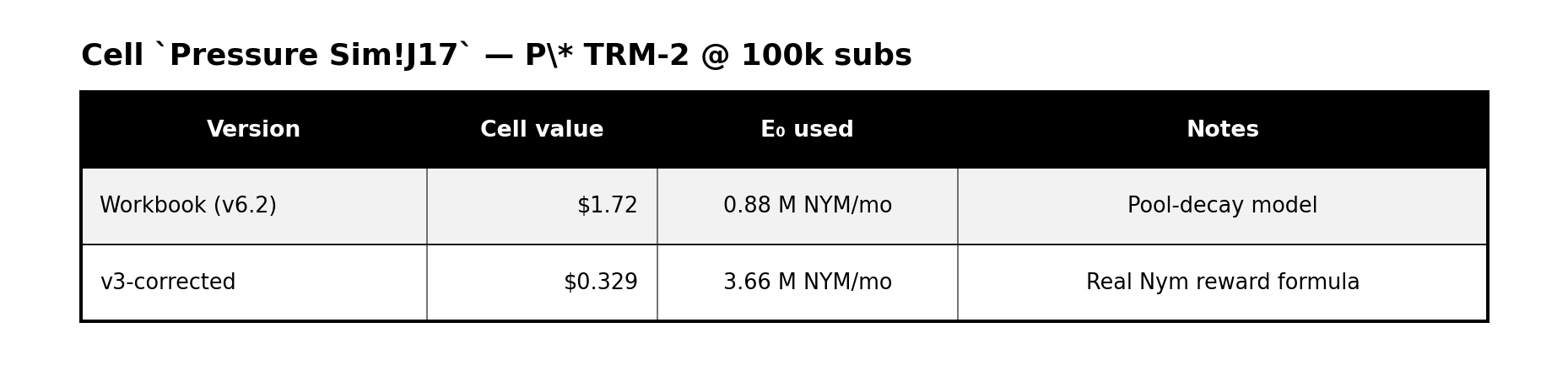
- v2 used wrong E₀. Corrected P*_TRM-2 @ 100k subs with b_burn = 0.40 = $0.329/NYM (not $1.72). The mechanism is still strongly positive for price; the improvement is just less dramatic than v2 implied.
- Live mixmining pool = 166.61 M NYM (validator API, not 150 M estimate).
- Core diagnosis unchanged: legacy emissions are demand-agnostic. Below ~9,711 subs, the protocol runs net sell pressure every month. The fix is mechanism reform, not subscriber growth alone.
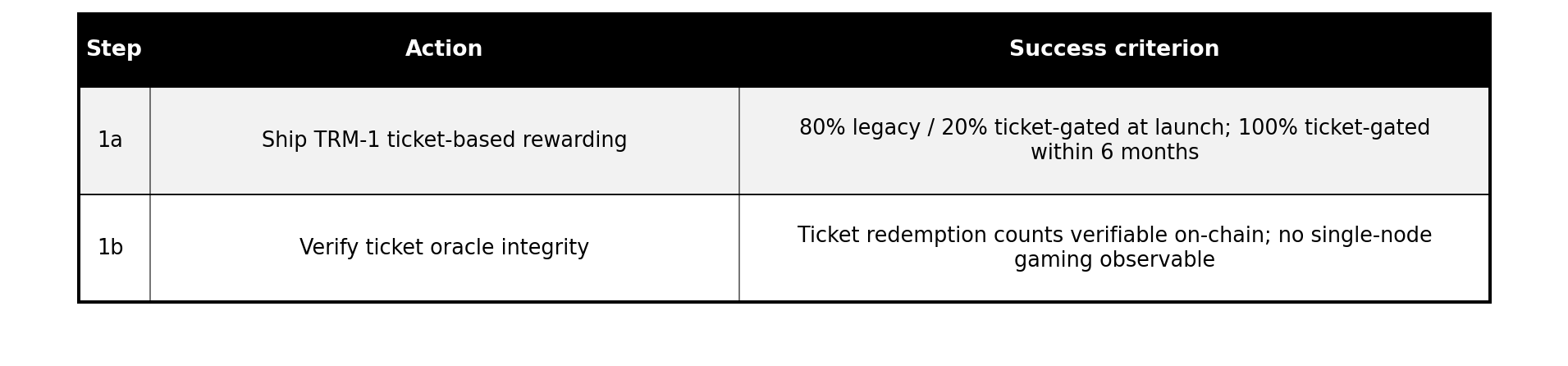
- My proposed modification: TRM-2 (burn b_burn = 40% of buyback NYM permanently) + TRM-3 (ARCEM emission cap κ = 0.85). Burning does not exist today and is not on the team’s roadmap. If TRM-2 is voted in, the 60% non-burned remainder routes to whichever node-reward stream is live at the time: mixmining pool today, or TRM-1 ticket stream once TRM-1 ships (confirmed Q3/Q4). TRM-1 itself contains no burn — it is the team’s distribution-side change.
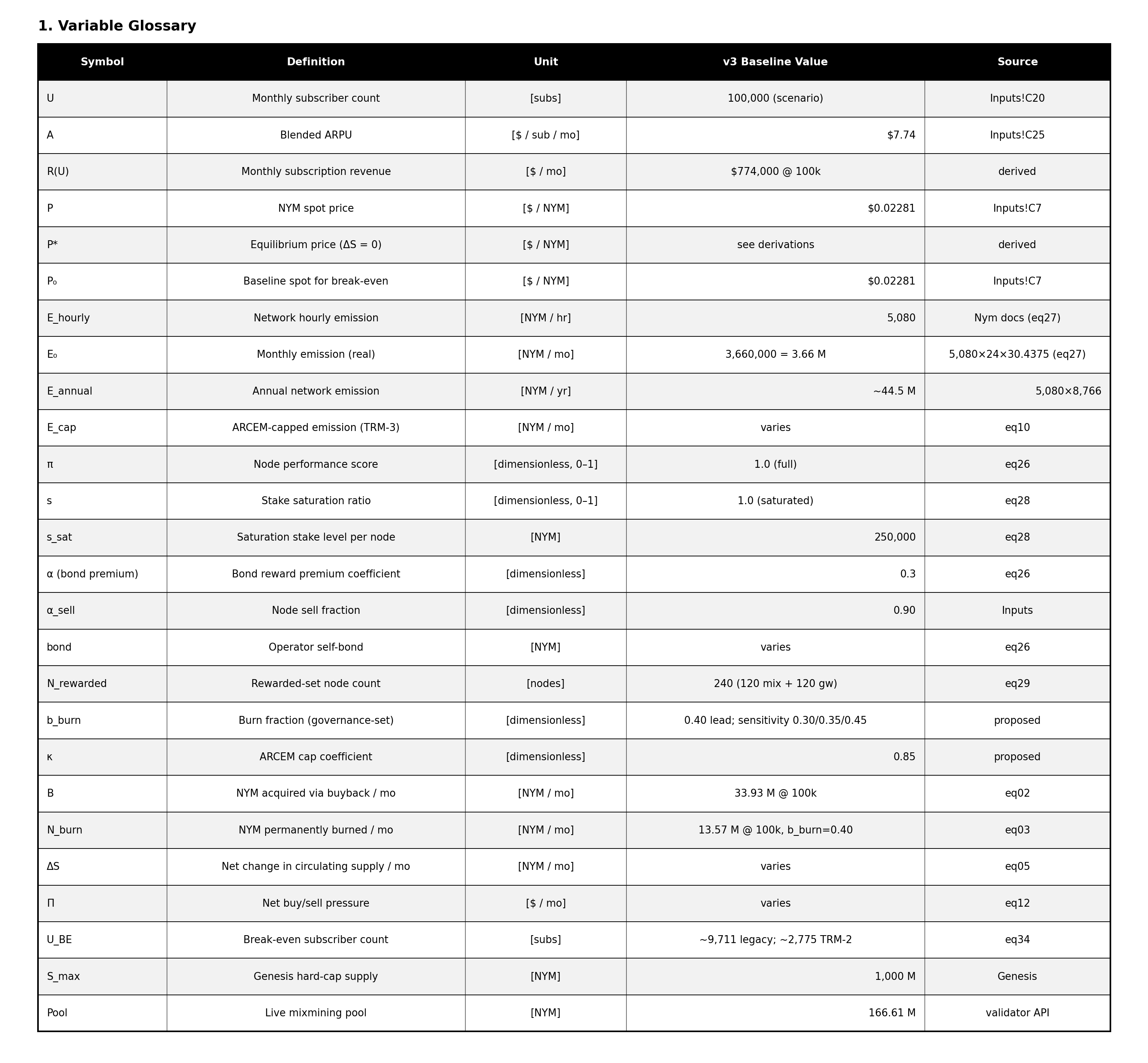
1. Baseline Numbers (May 7–8, 2026)
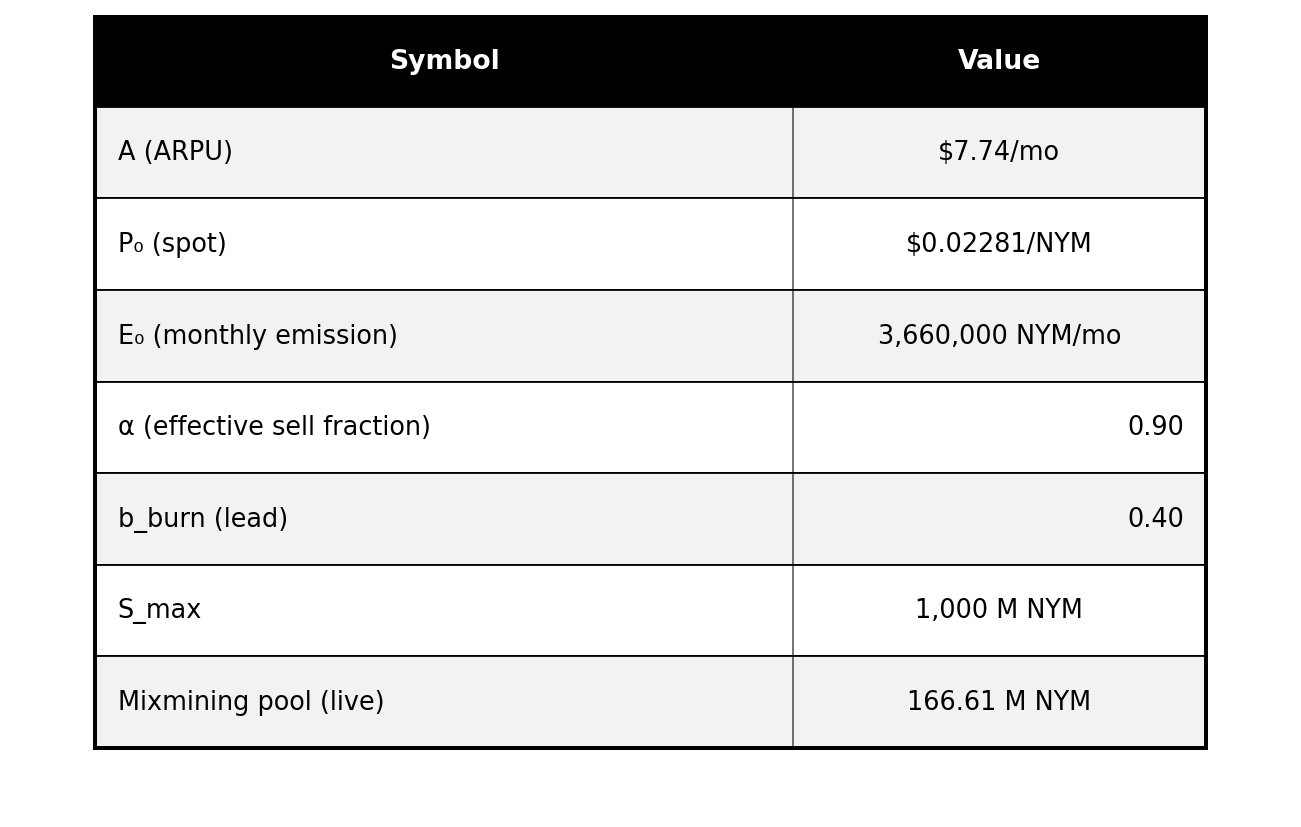
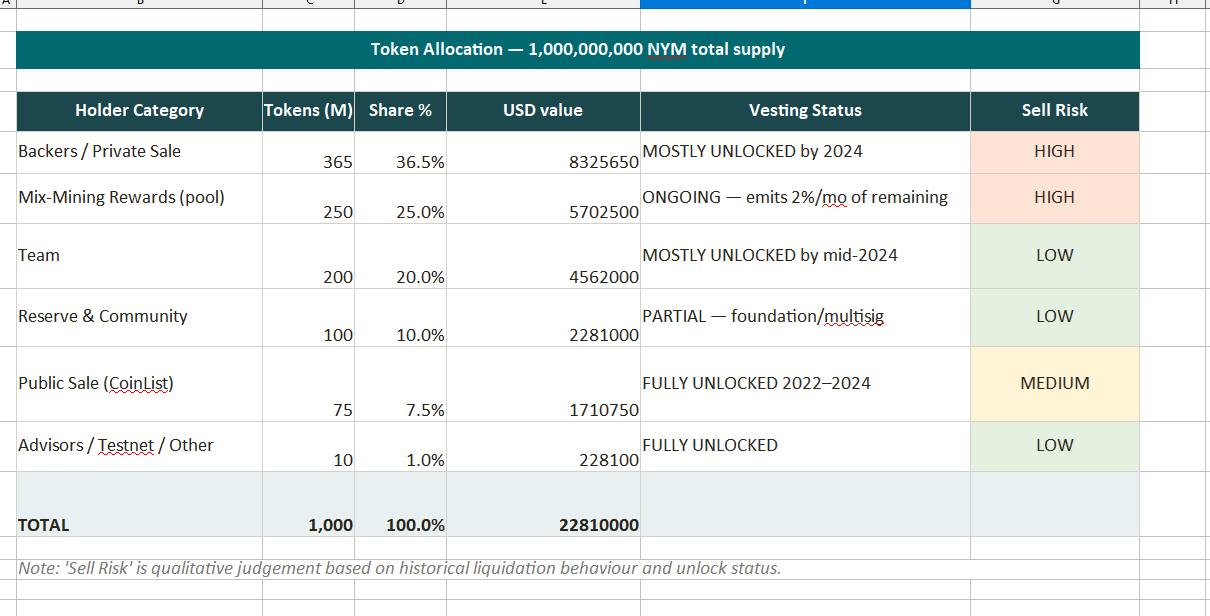
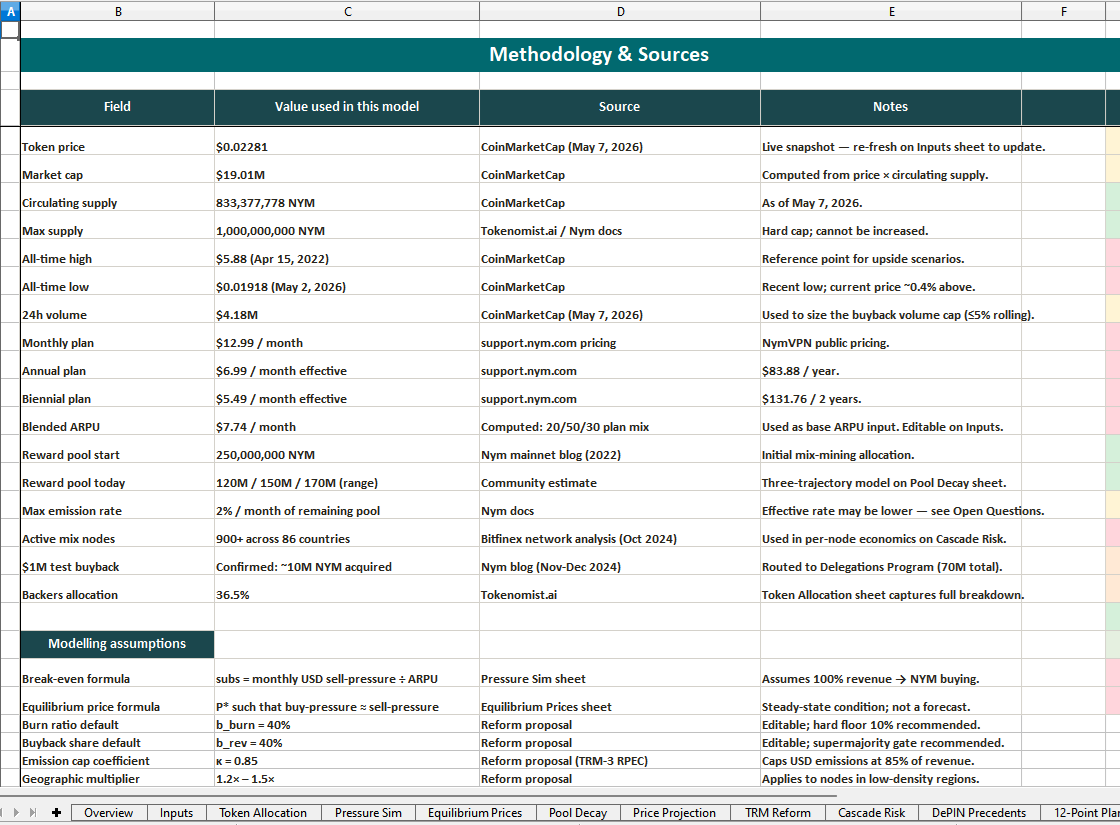
Pulled from CoinMarketCap and Tokenomist.ai on May 7–8, 2026.
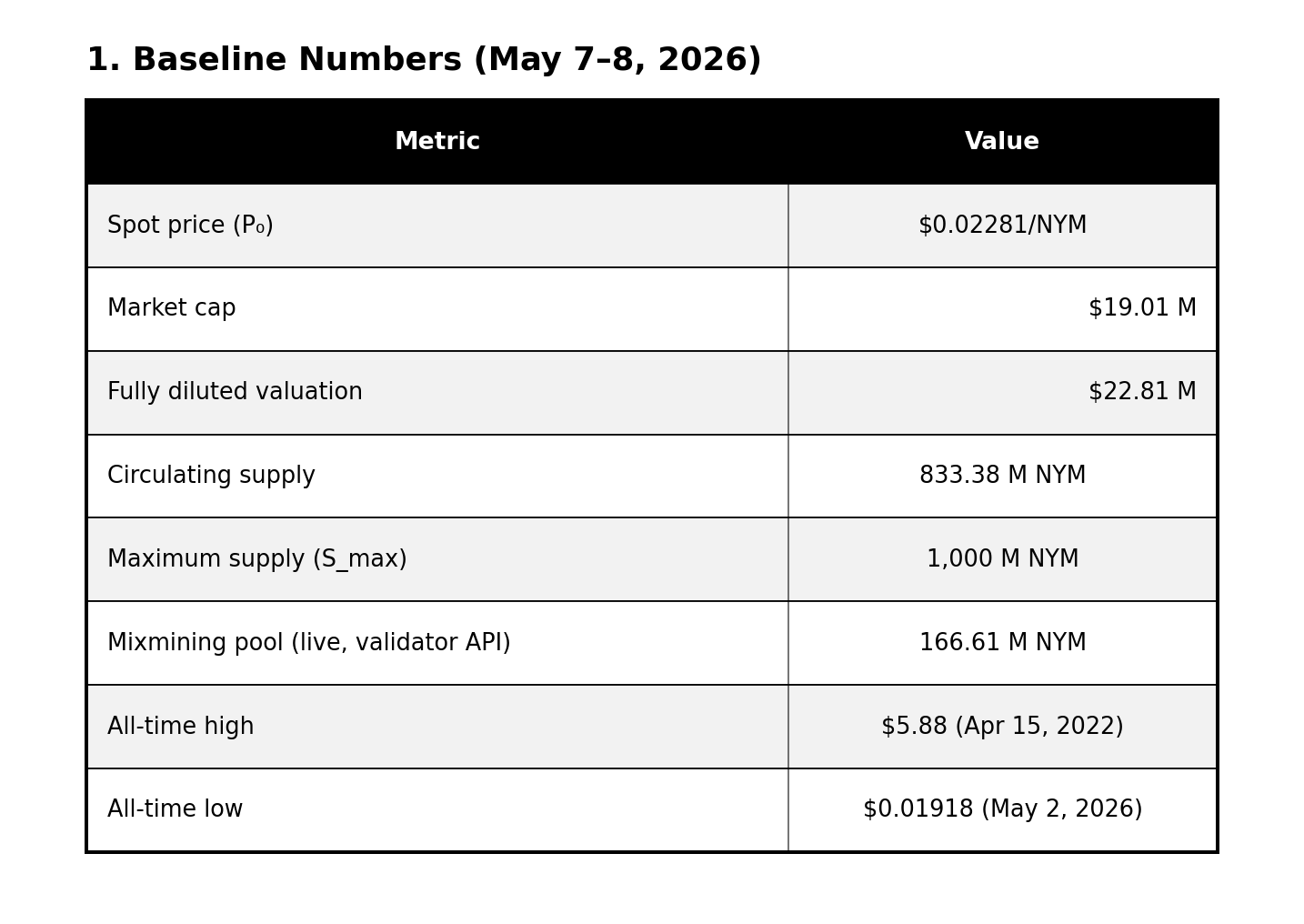
Table 2 — 1. Baseline Numbers (May 7–8, 2026)
P₀ / ATH = $0.02281 / $5.88 ≈ 0.00388. That is a 99.6% peak-to-trough drawdown over roughly 48 months. I’ll show below that this is not a market sentiment problem — it is a mechanism problem.
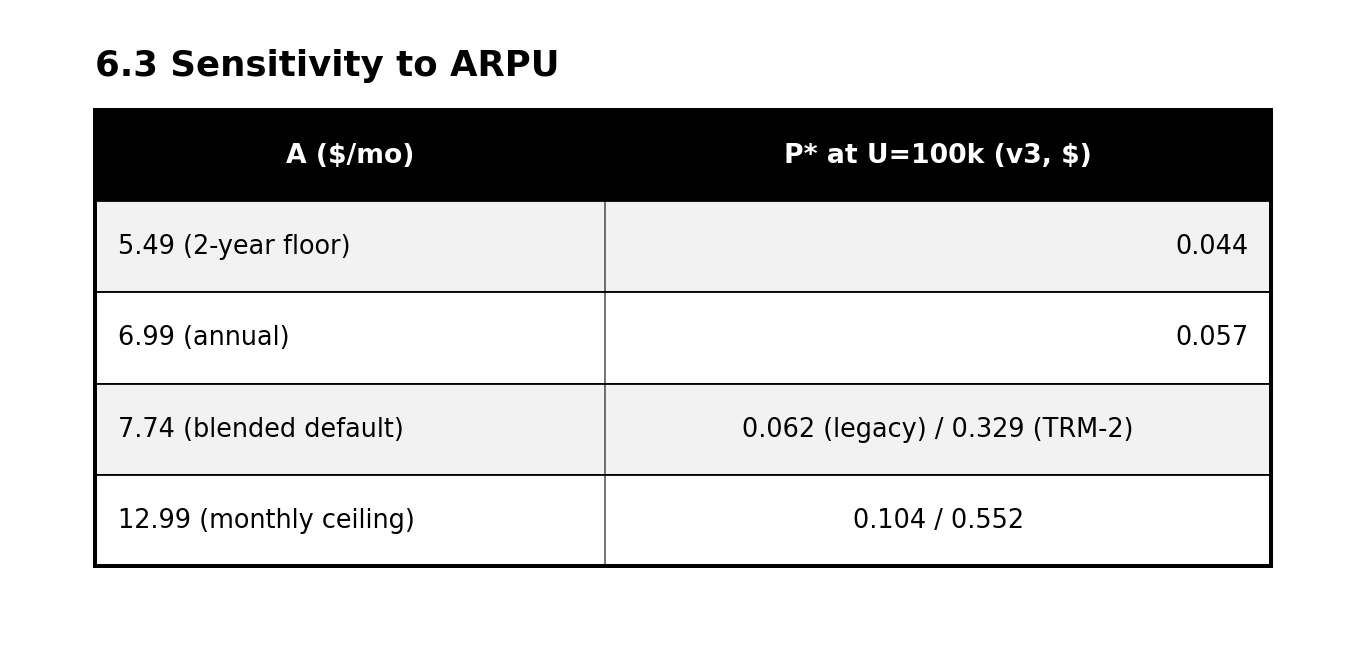
Product Revenue and Blended ARPU
NymVPN subscription tiers as published on support.nym.com:
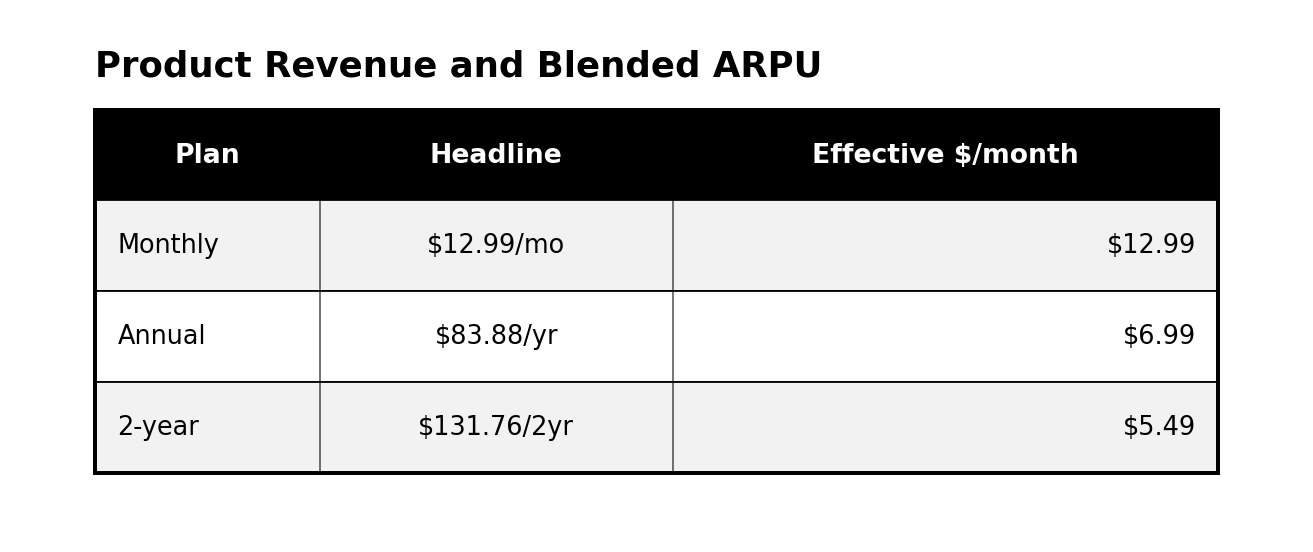
Table 3 — Product Revenue and Blended ARPU
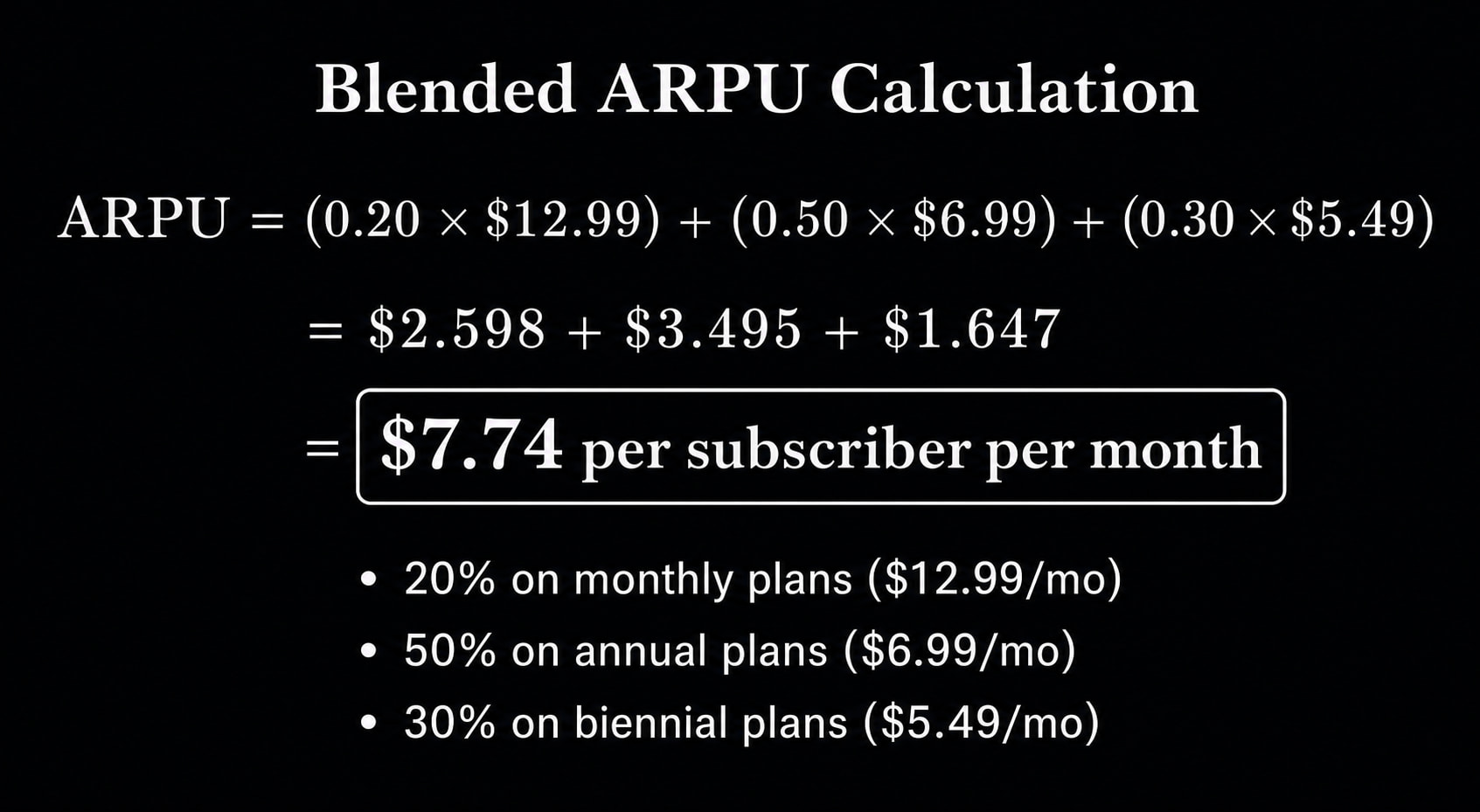
My workbook uses the standard SaaS subscription-mix assumption (20% monthly / 50% annual / 30% 2-year), giving a blended ARPU of:
A = (0.20 × $12.99) + (0.50 × $6.99) + (0.30 × $5.49) = $2.598 + $3.495 + $1.647 = $7.74/month
This is the canonical value I use everywhere — workbook cell Inputs!C25.
2. The Real Nym Reward Formula
2.1 What the Nym Docs Actually Say
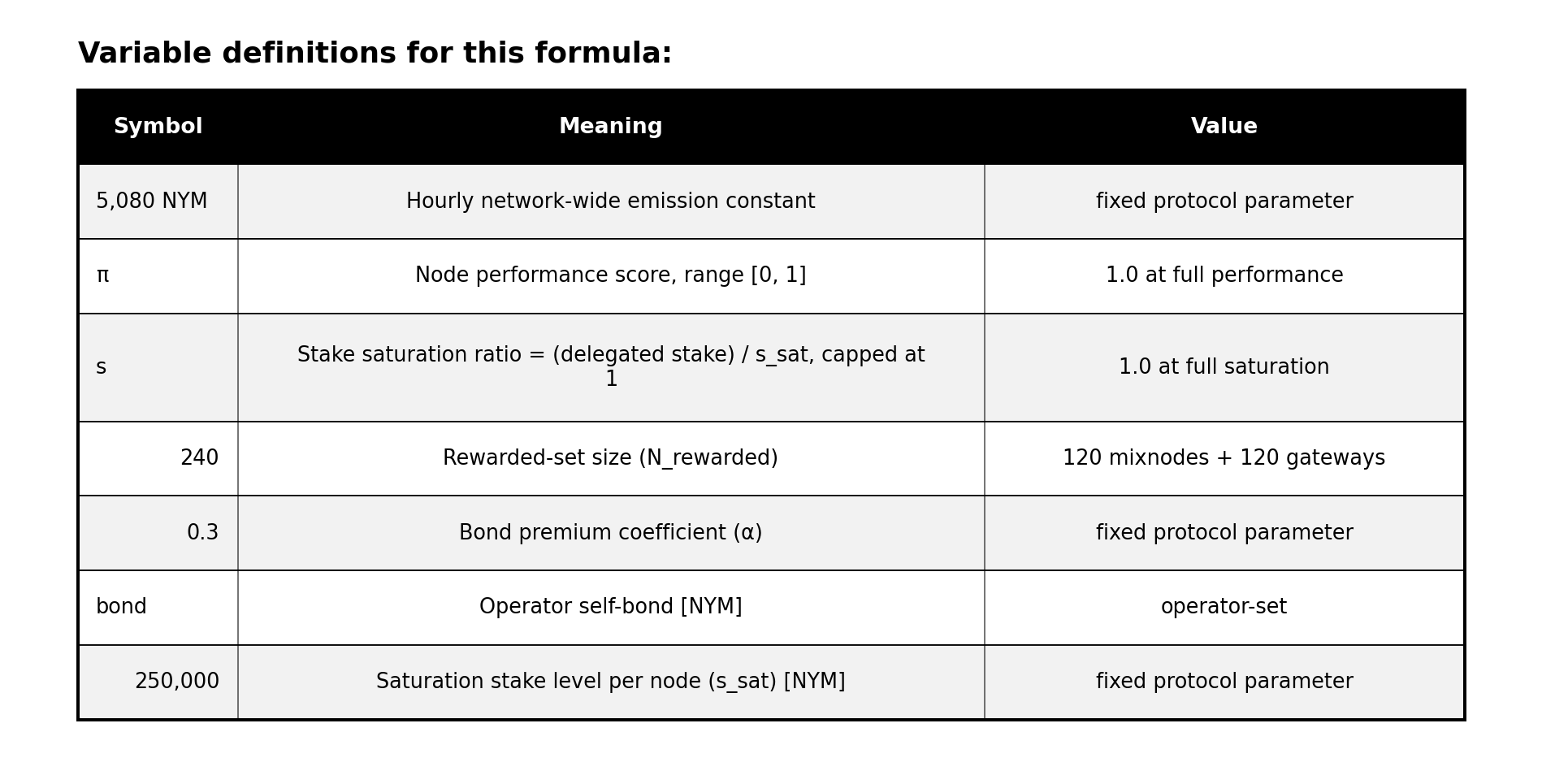
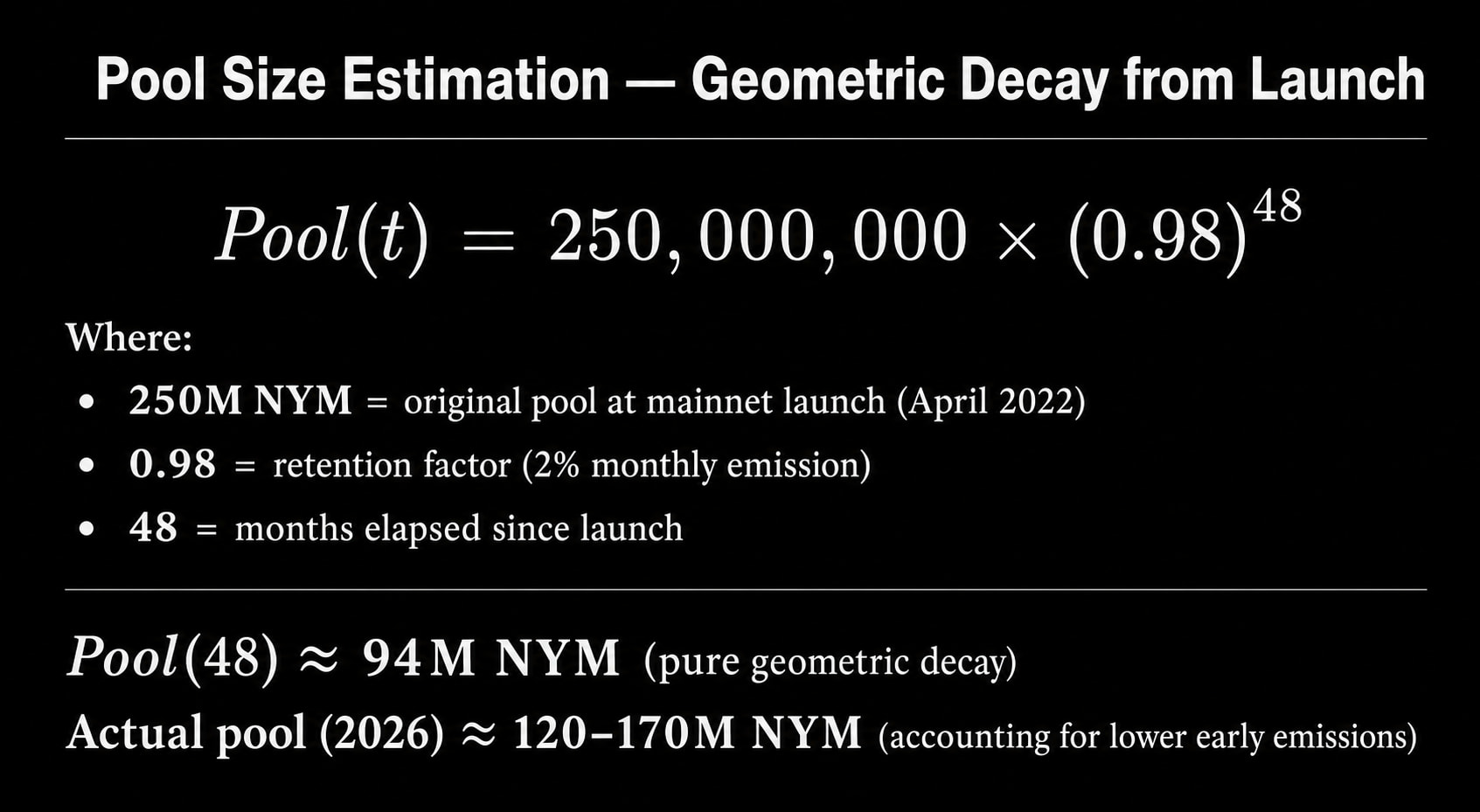
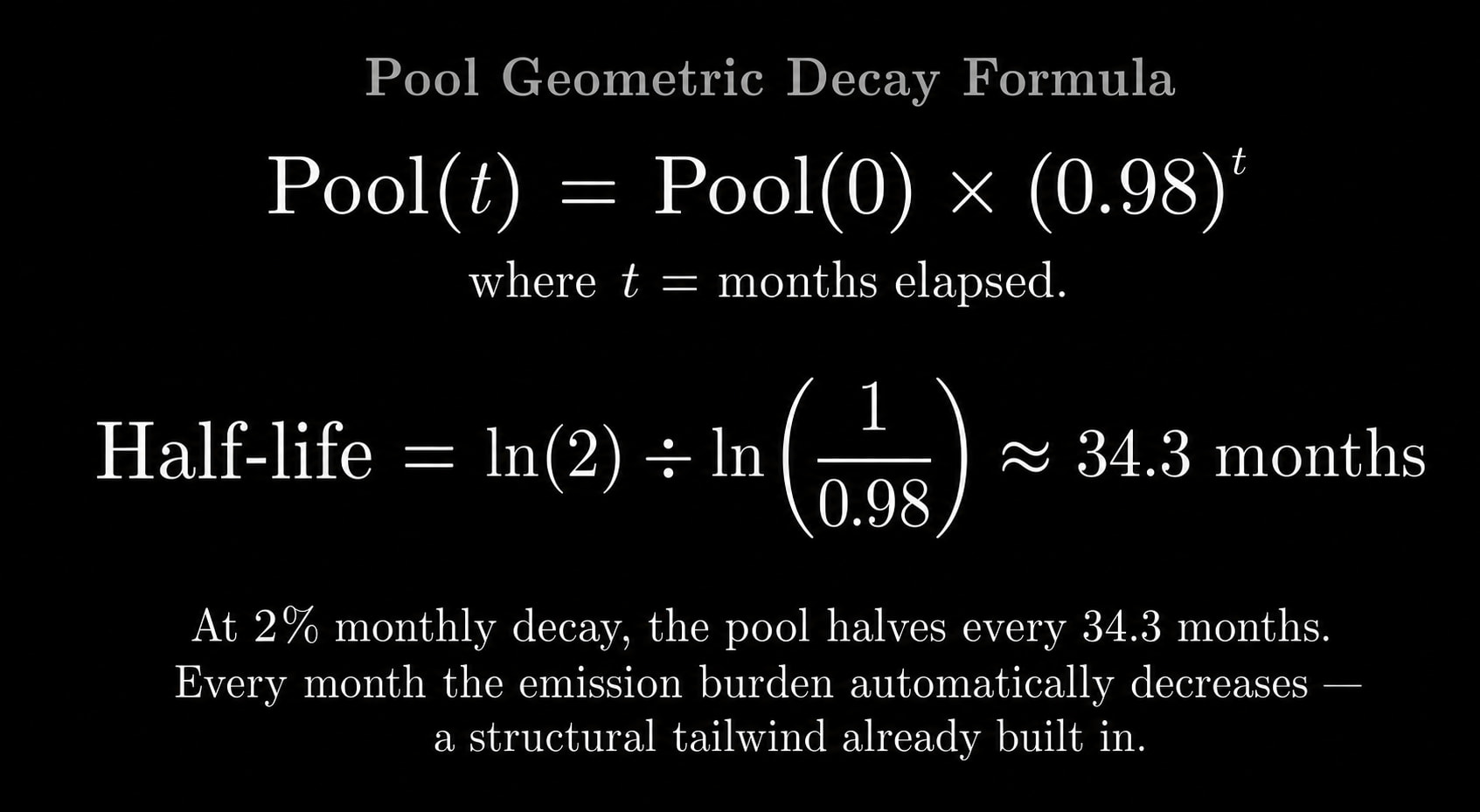
v2 modelled emissions as a generic 2%/month geometric decay from a pool estimate. That was wrong. The actual Nym reward formula, from the Nym operator tokenomics docs, is:

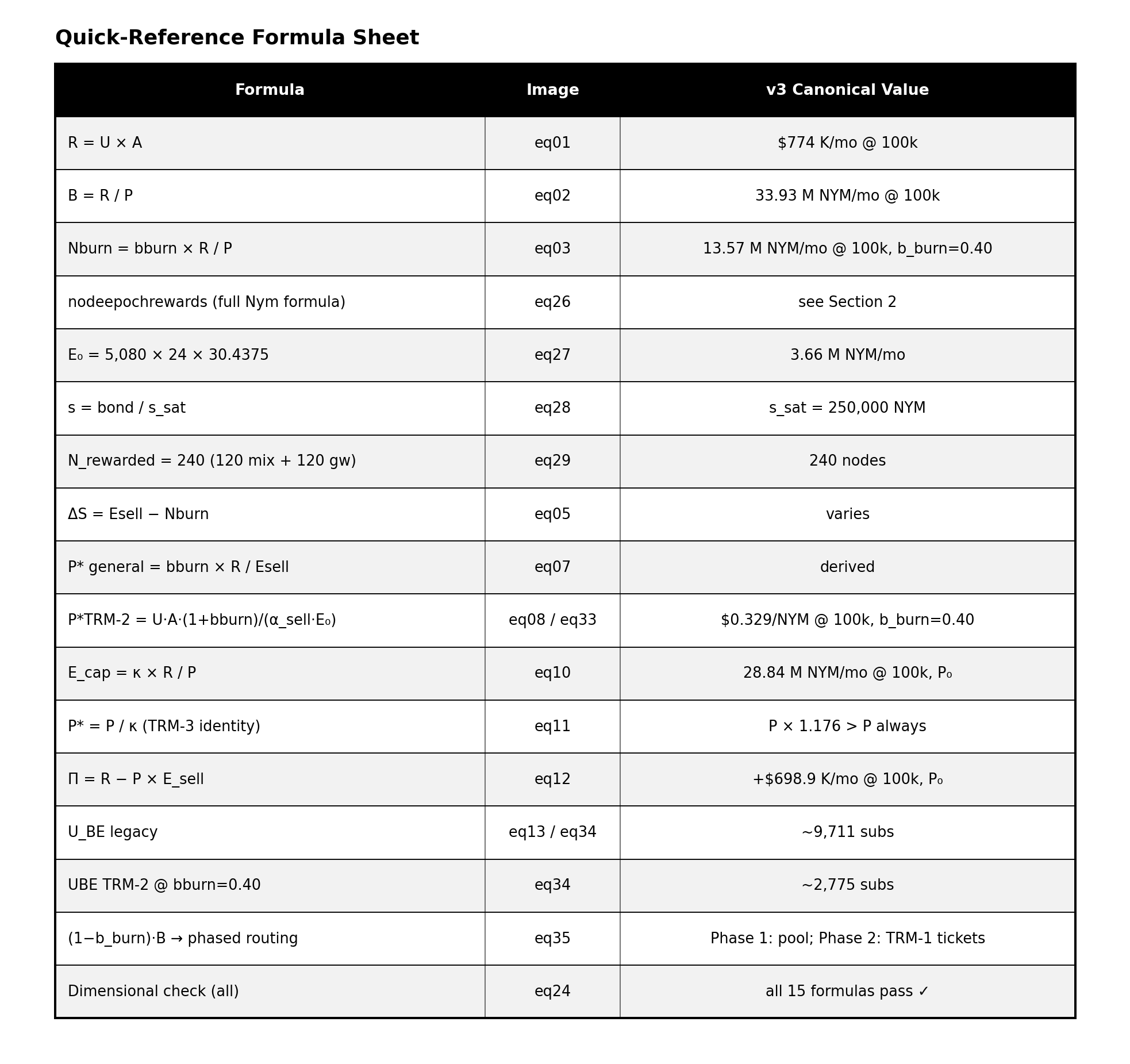
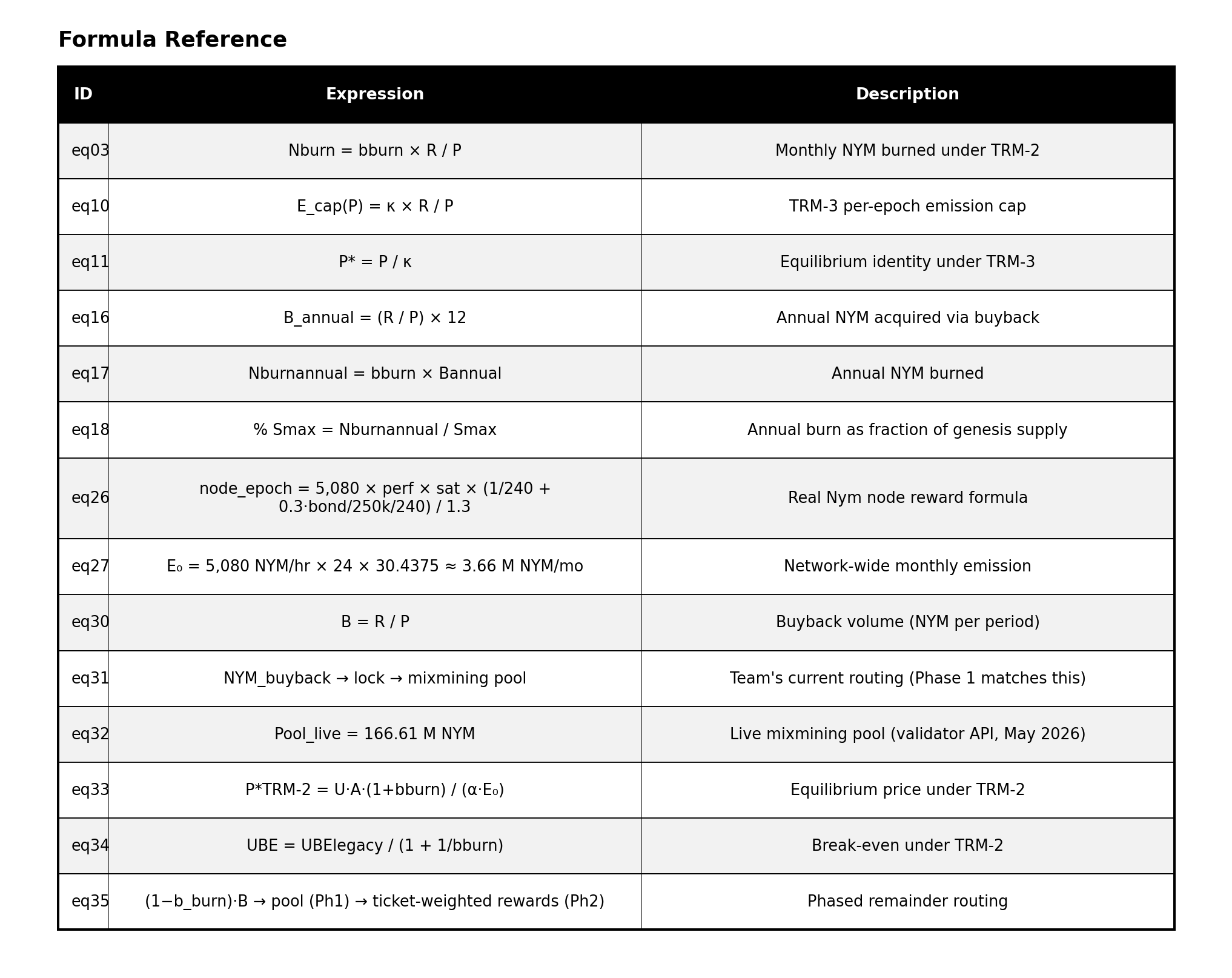
node_epoch_rewards = 5,080 NYM × performance × stake_saturation
                   × (1/240 + 0.3 × (bond / 250,000) / 240) / (1 + 0.3)
Key parameters:
- Rewarded set: 240 nodes (120 mixnodes + 120 gateways)
- Stake saturation: 250,000 NYM per node
- Bond premium α_bond: 0.3
2.2 Network-Wide Hourly and Monthly Emission

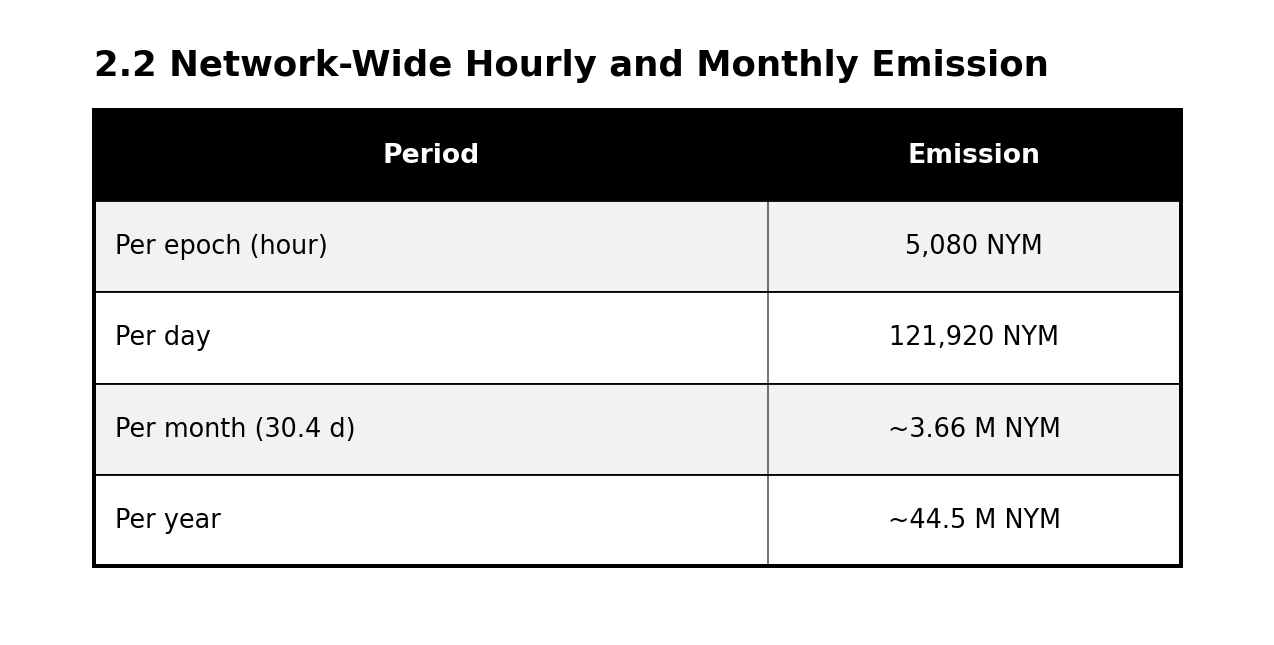
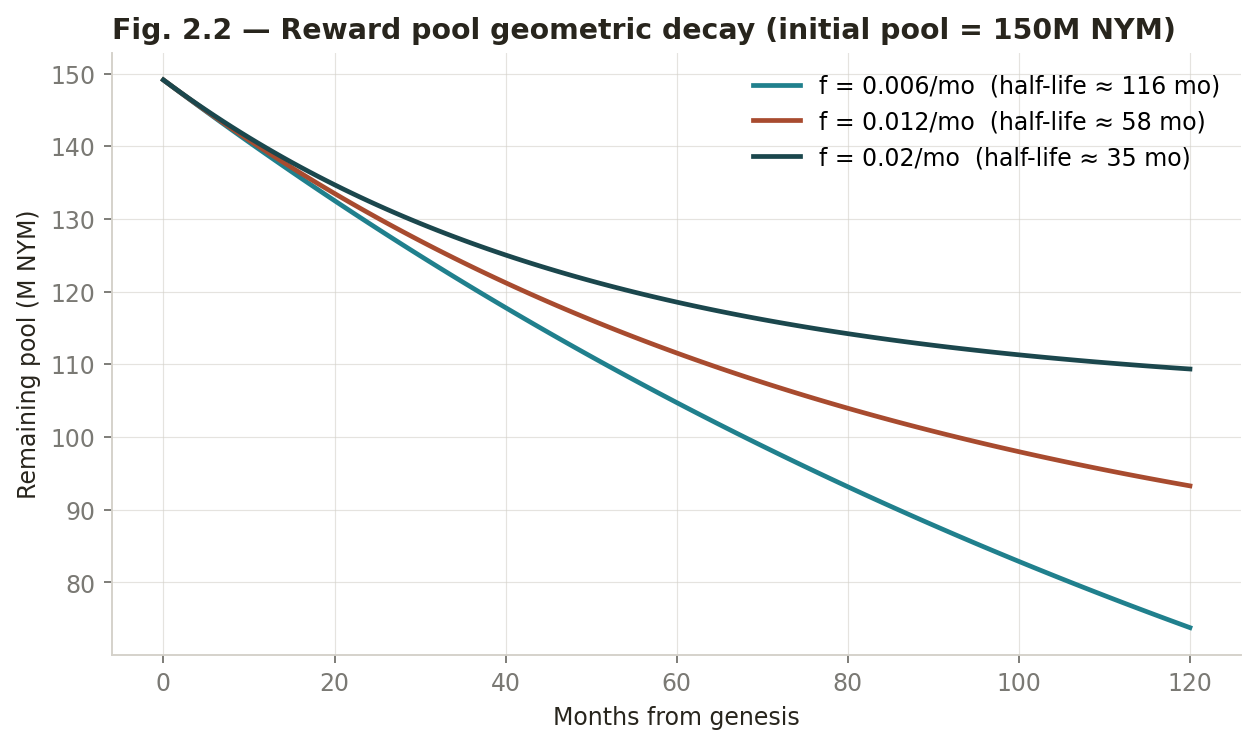
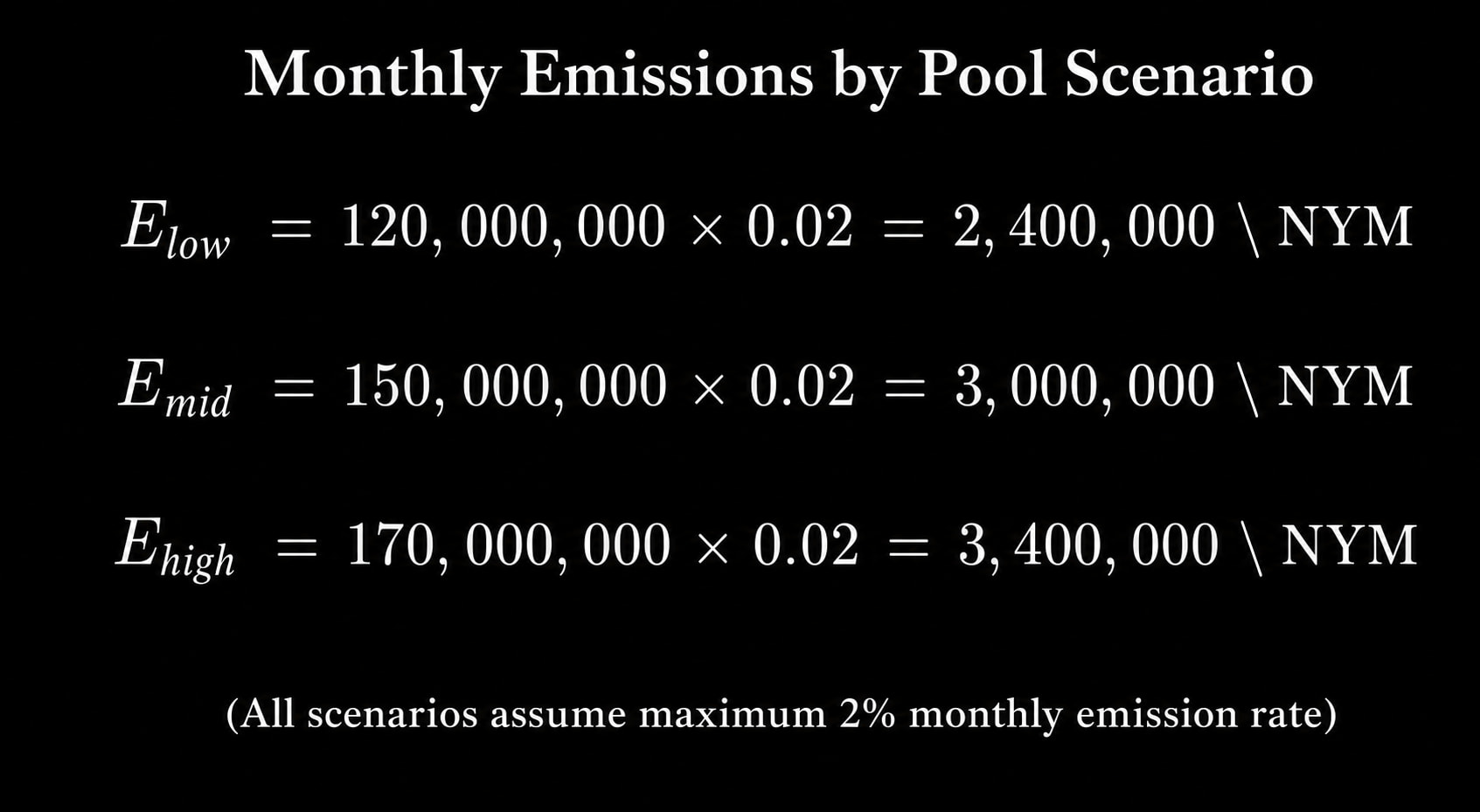
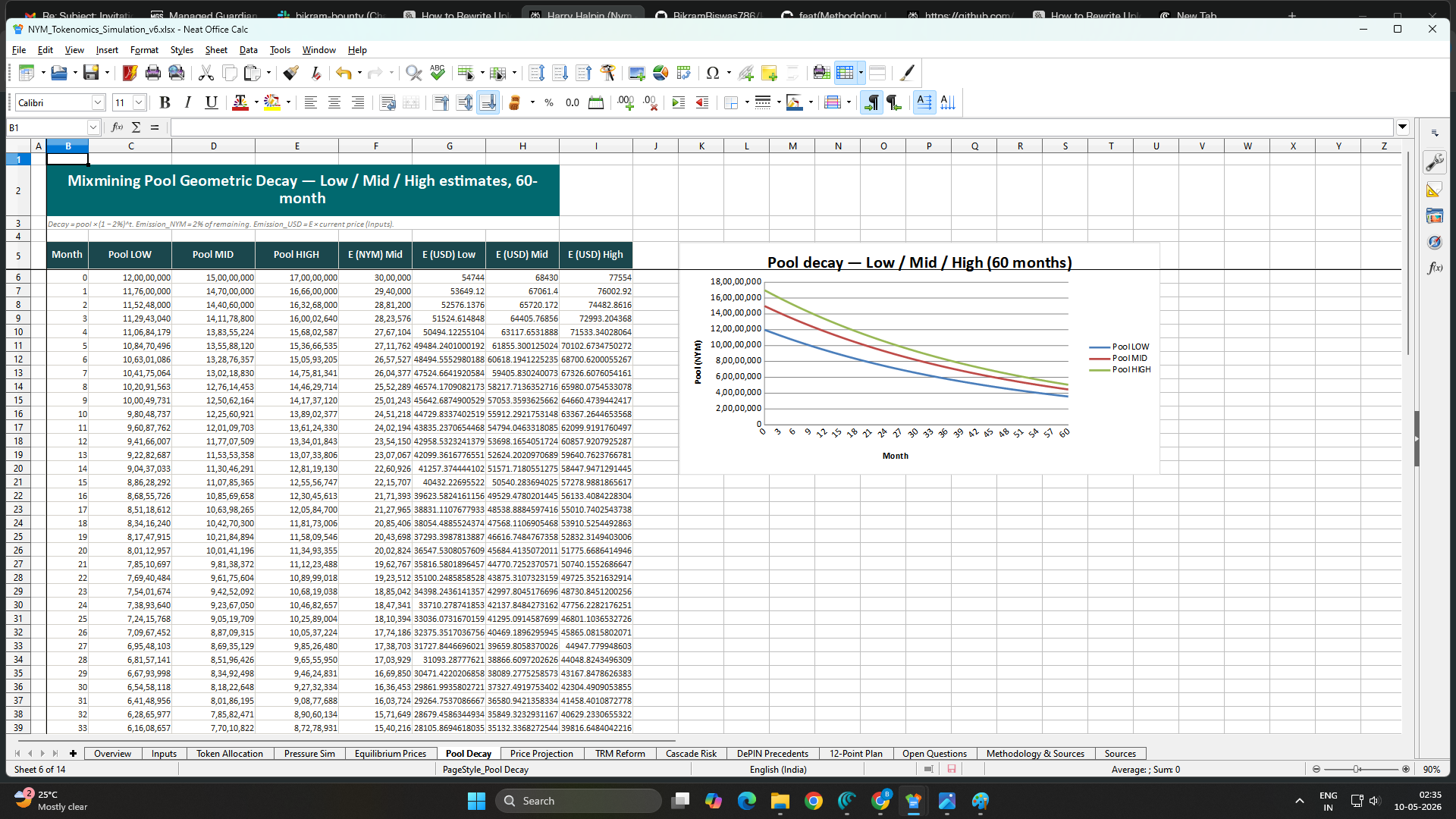
This is the number that matters for all downstream calculations. My v2 model used E₀ ≈ 0.88 M NYM/mo — derived from a 2%/month pool-decay estimate against an assumed 150 M pool. The real figure is 4.2× larger. Every P*, break-even, and net-pressure number in this post is recomputed against E₀ = 3.66 M NYM/mo.
2.3 The Live Mixmining Pool

The validator API confirms:
curl https://validator.nymtech.net/api/v1/circulating-supply → mixmining_reserve = 166,613,455,567,357 unym = 166.61 M NYM
This replaces the 150 M mid-estimate used in v2. The pool-size caveat in §10 of v2 is now resolved.
3. Revenue, Buyback, and the Real Routing
3.1 Revenue
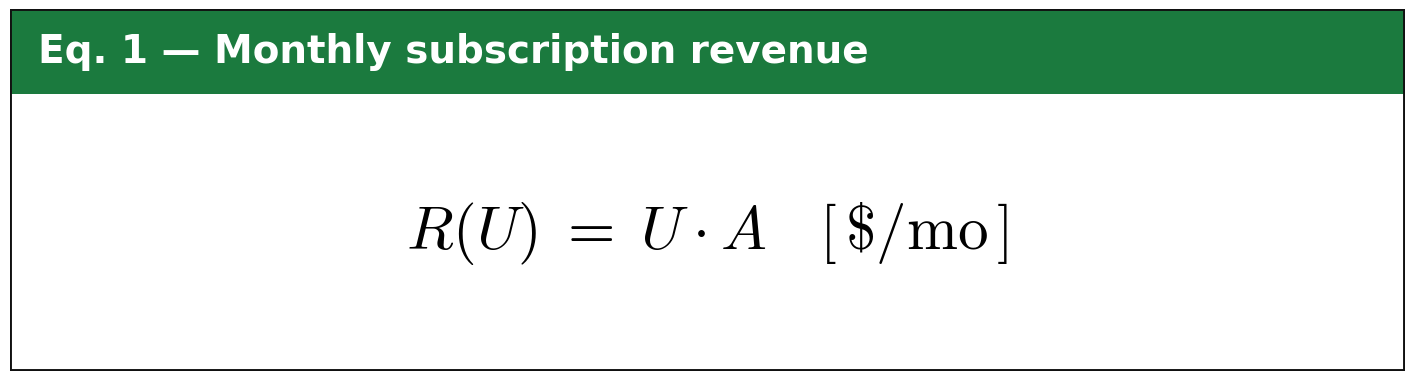
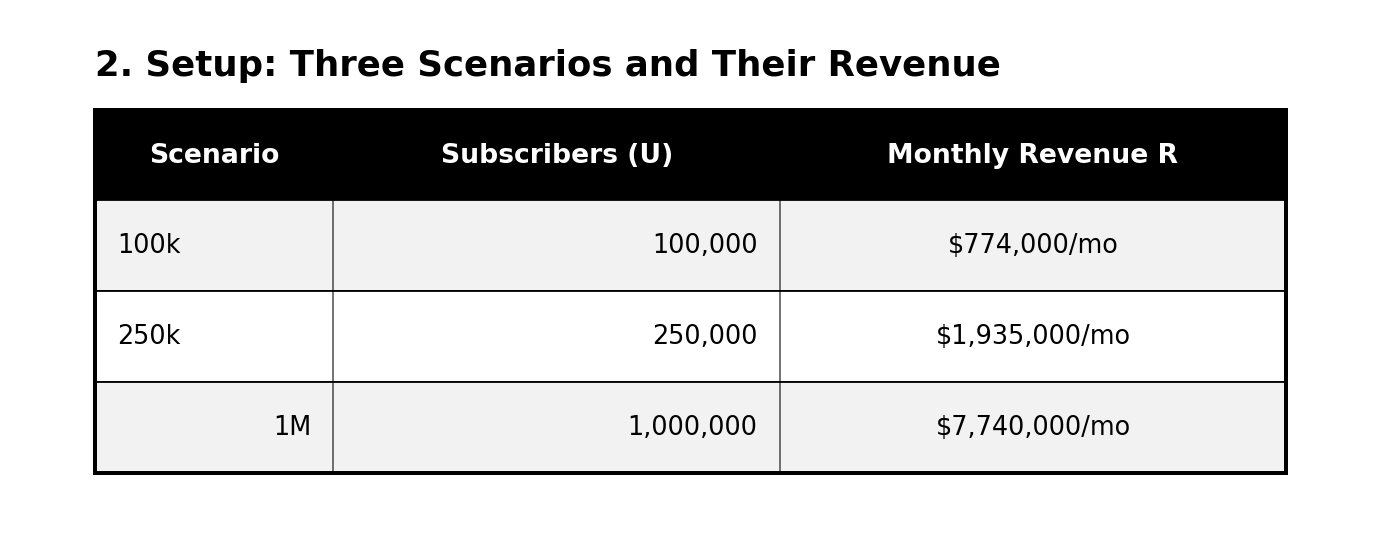
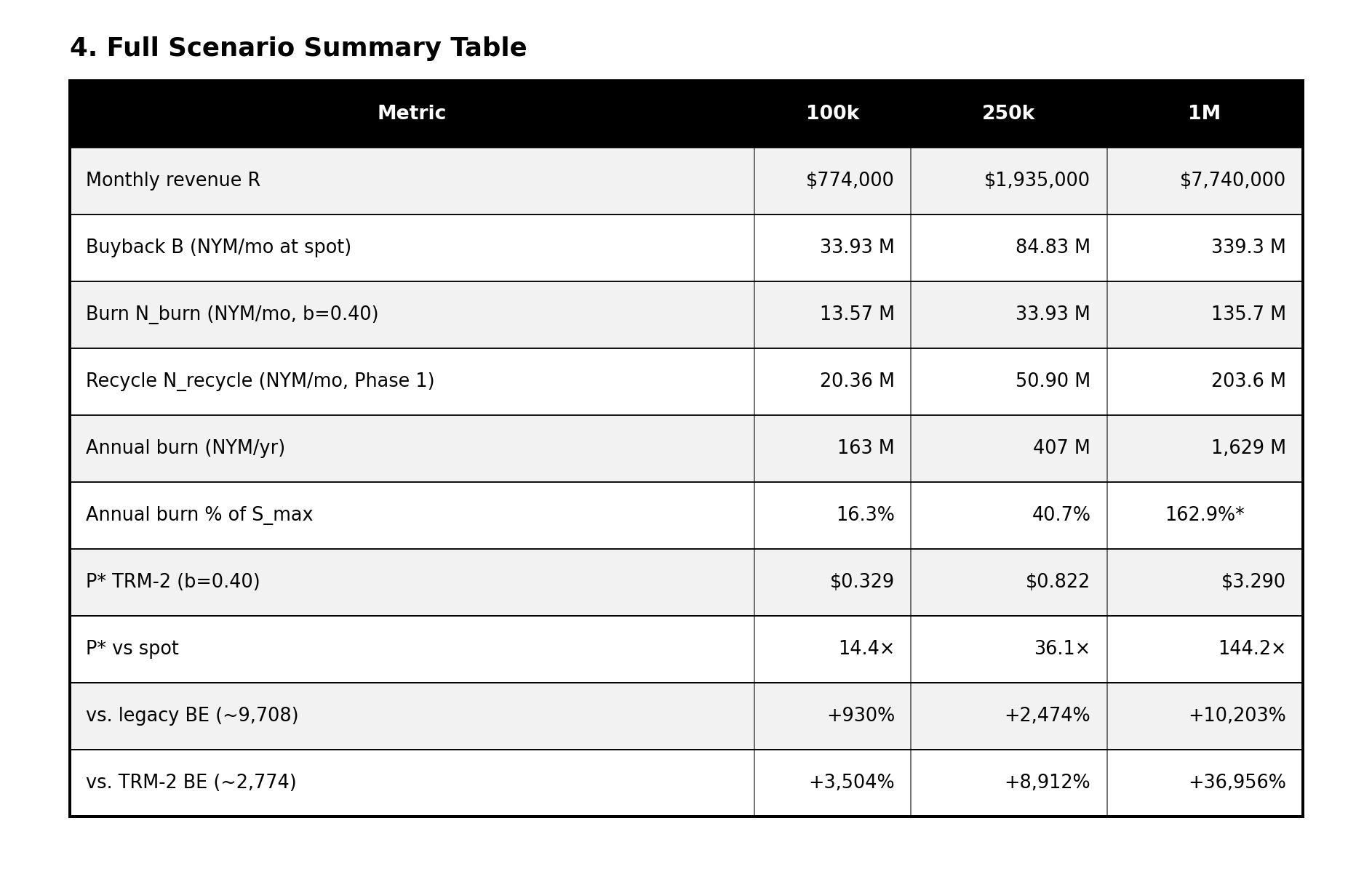
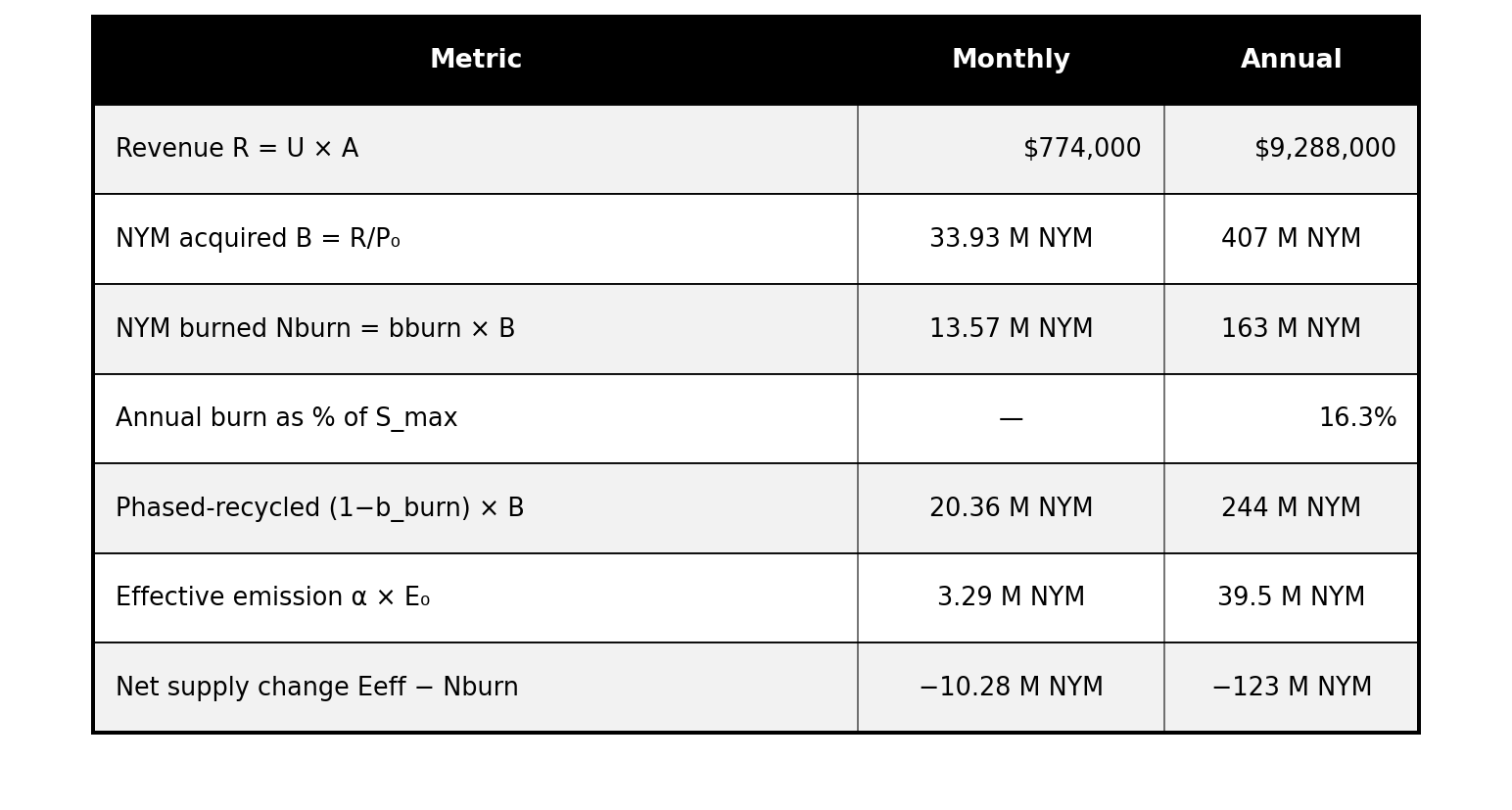
At 100,000 subscribers: R = 100,000 × $7.74 = $774,000/month (Inputs!C25).
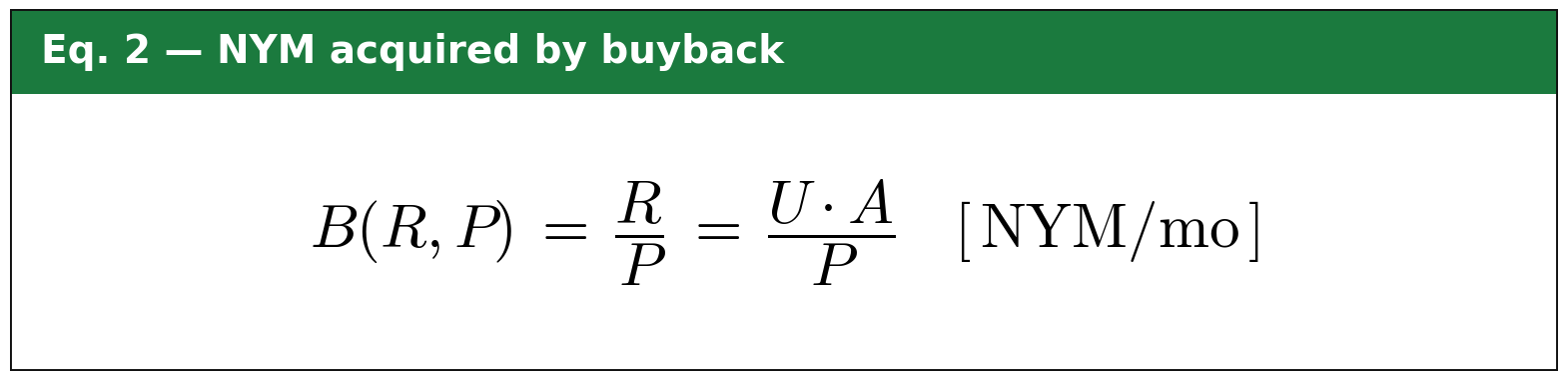
3.2 Buyback — Already Live
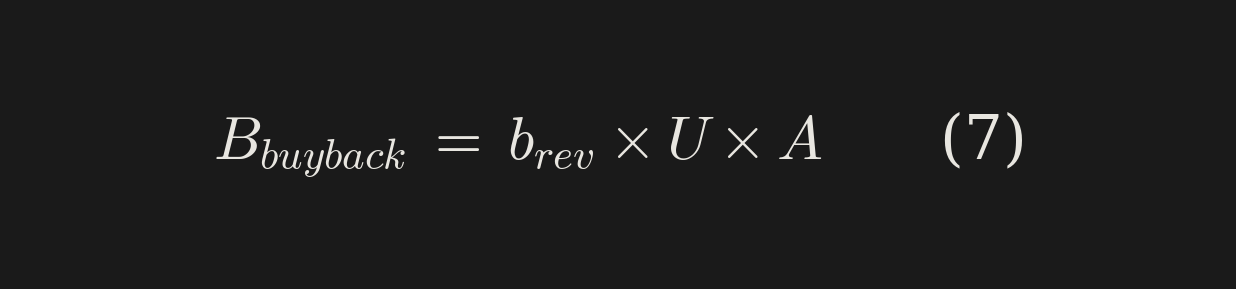
The team has confirmed that for all NymVPN subscriptions paid in non-NYM methods, buy orders for NYM are placed directly on the open market. This is not a future proposal — it is running today.

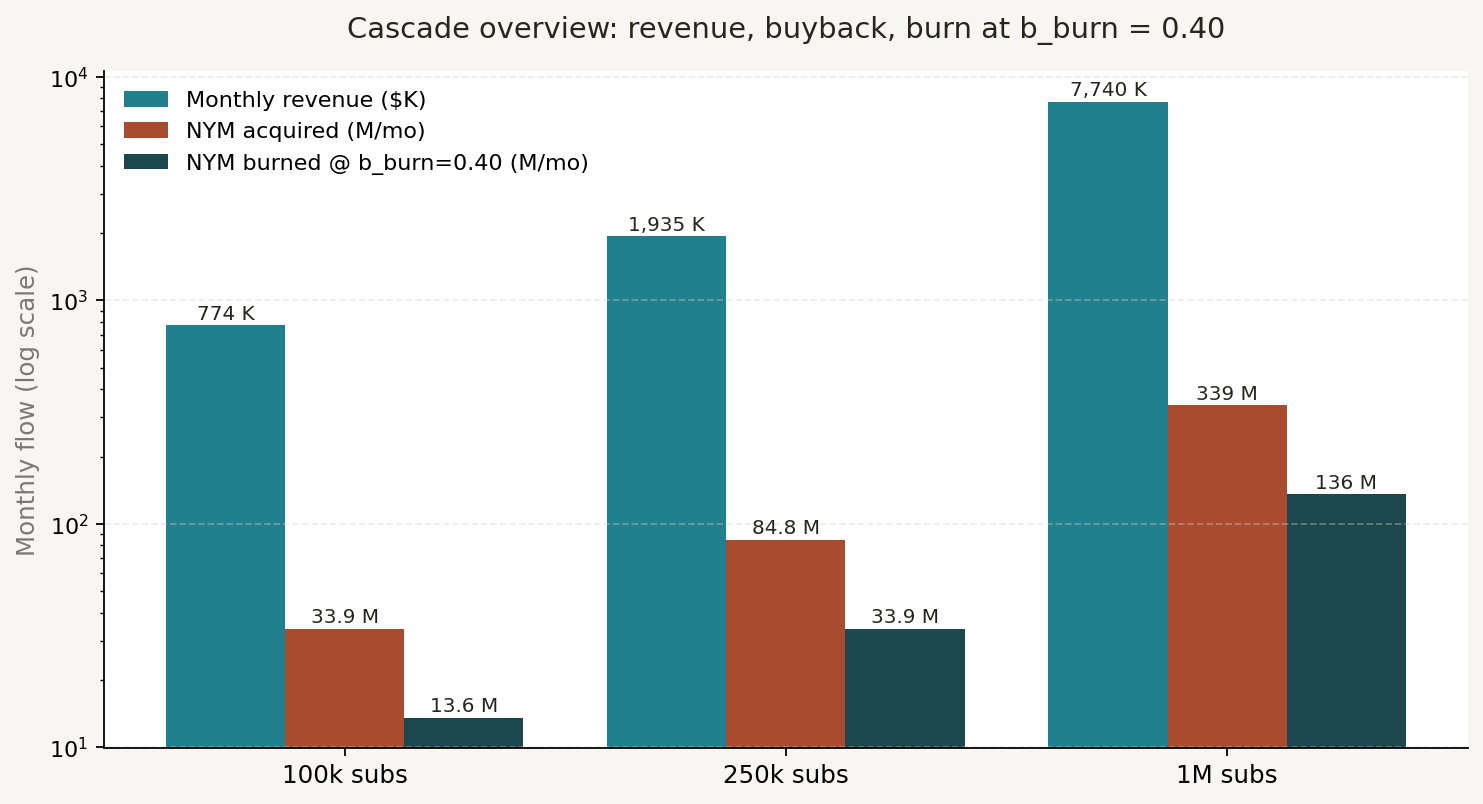
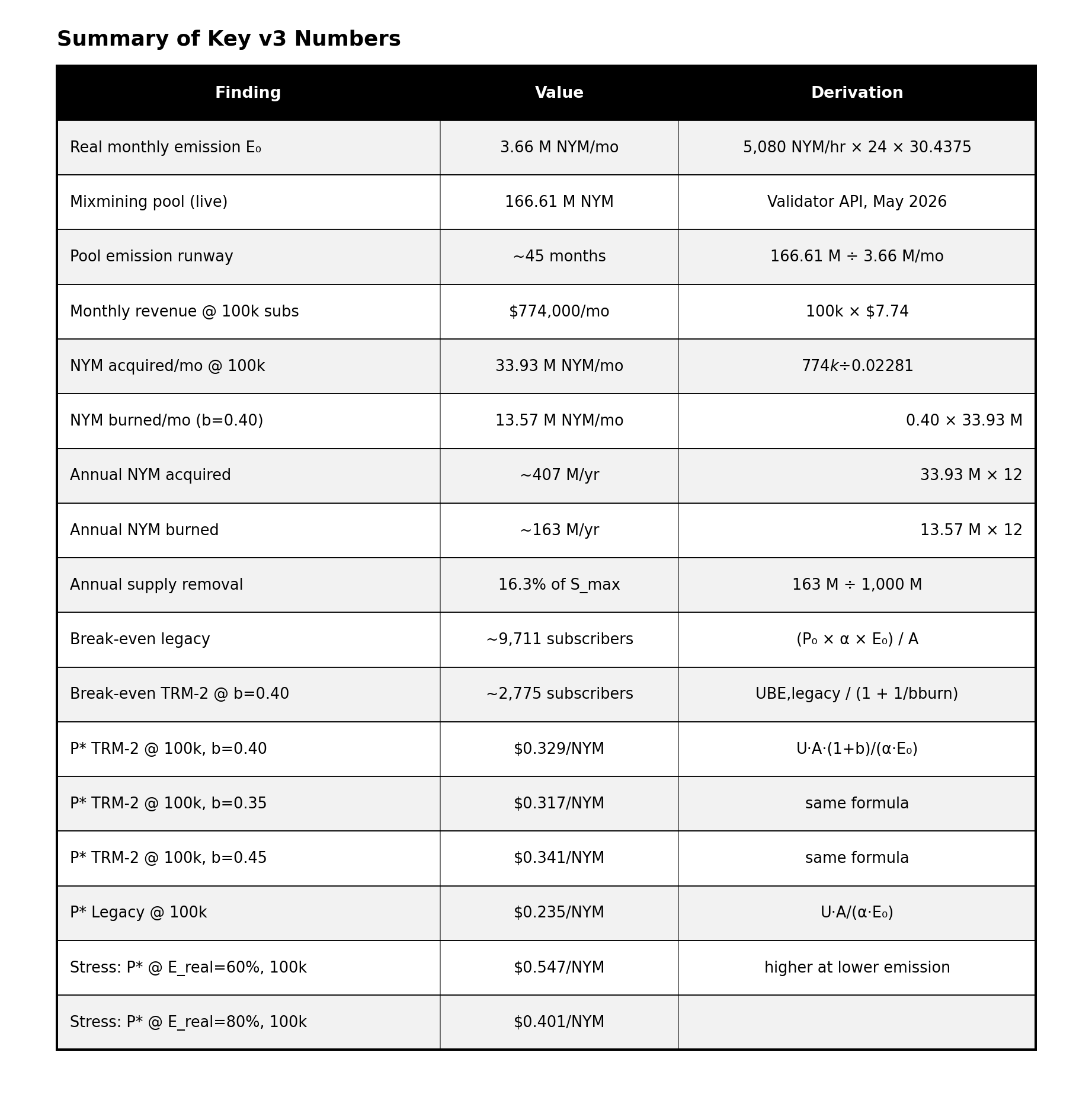
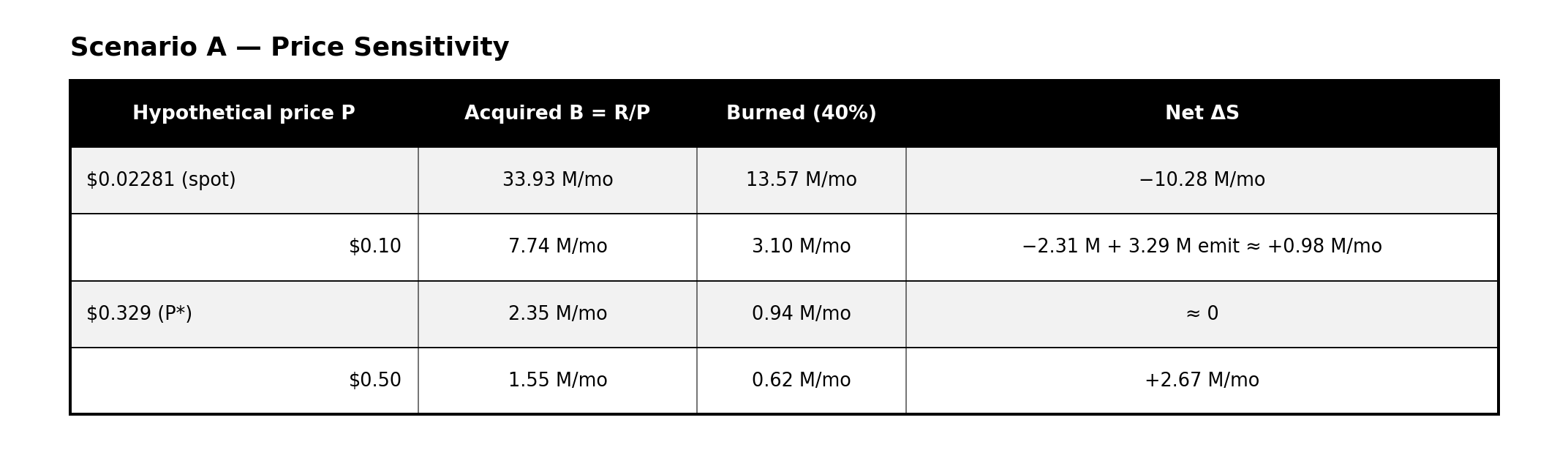
At P₀ = $0.02281: B = $774,000 / $0.02281 ≈ 33.93 M NYM/month acquired.
Team’s confirmed routing today: bought NYM is locked on exchange. When NymVPN demand is healthy, those tokens return to the mixmining pool.

3.3 My Proposed Modification: TRM-2 + TRM-3
What I am proposing is additive to what the team has built:
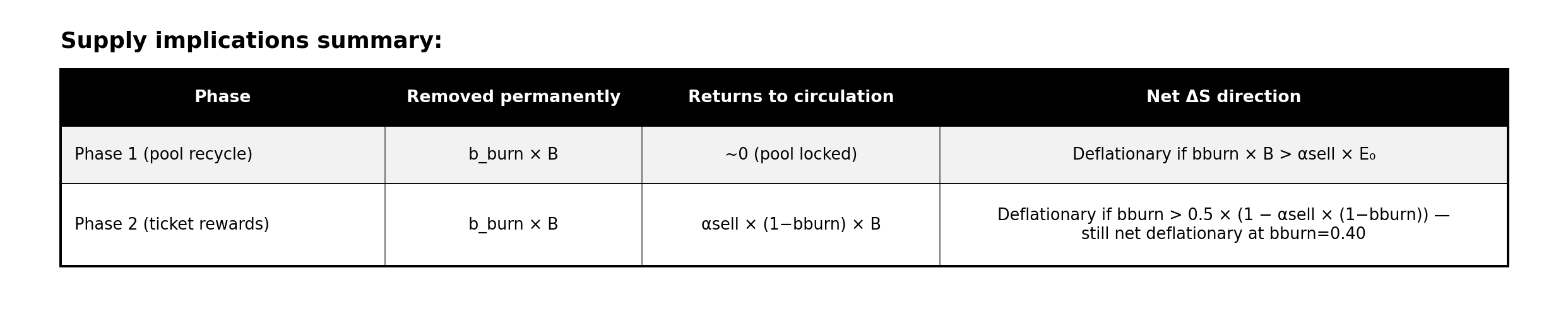
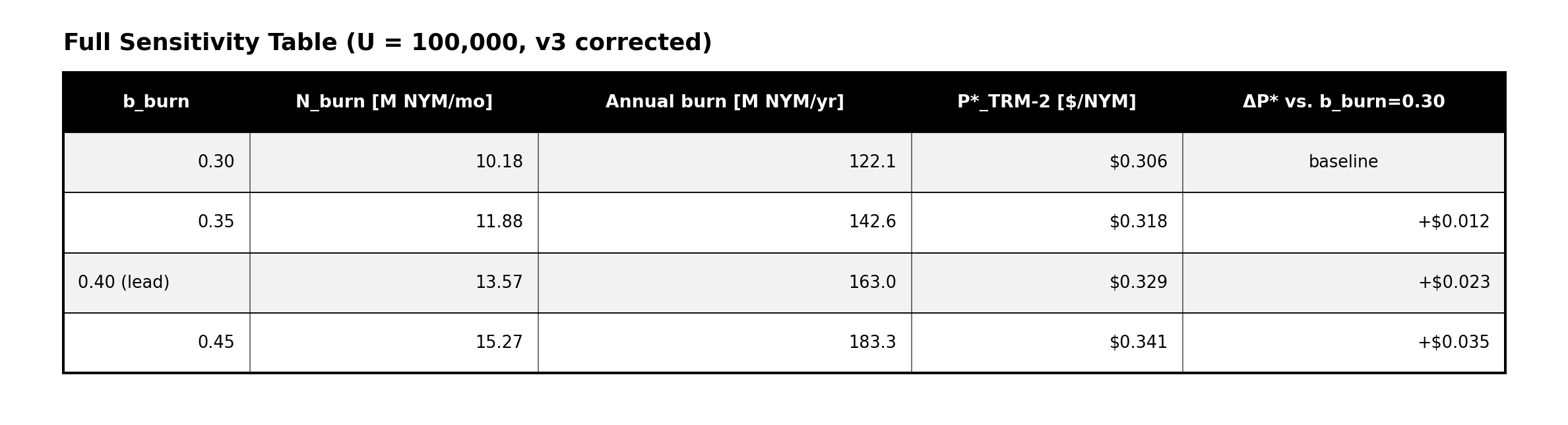
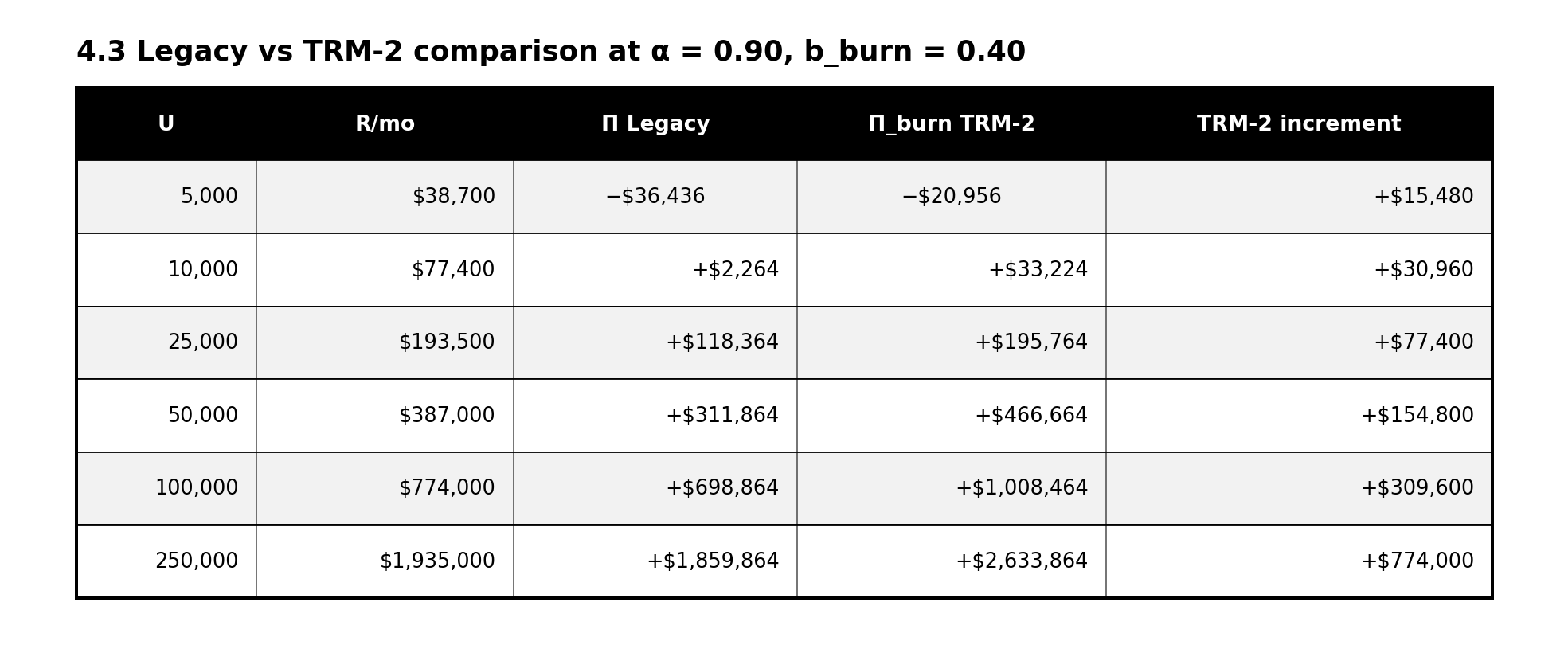
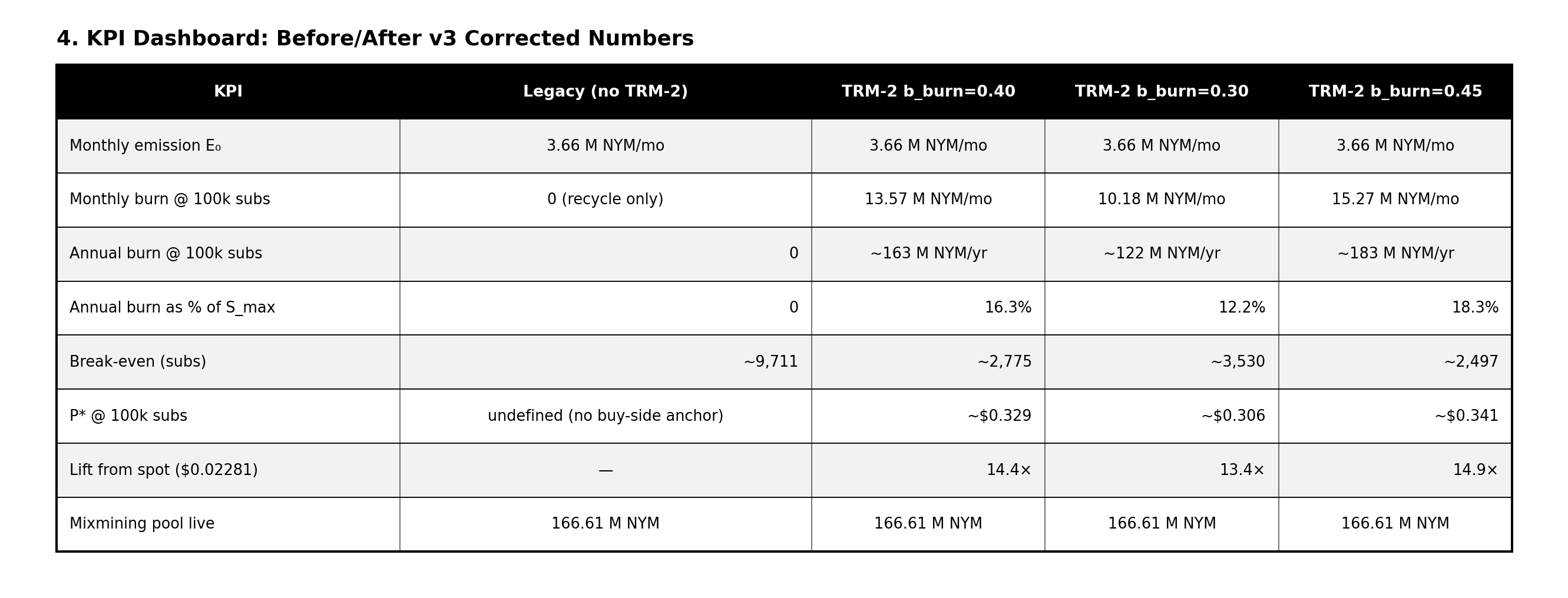
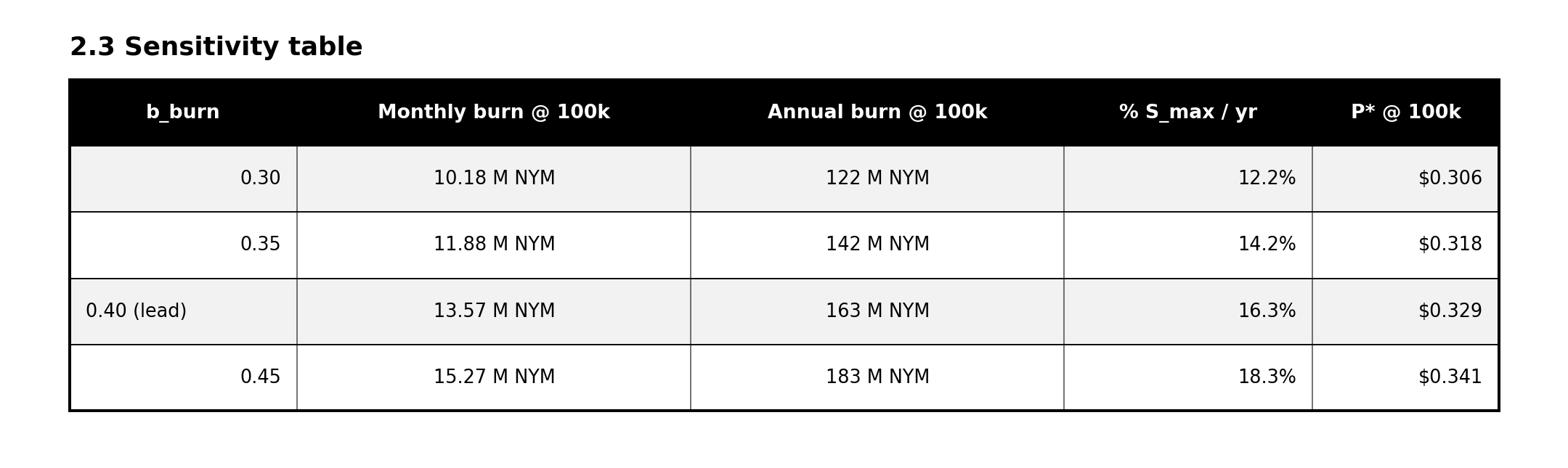
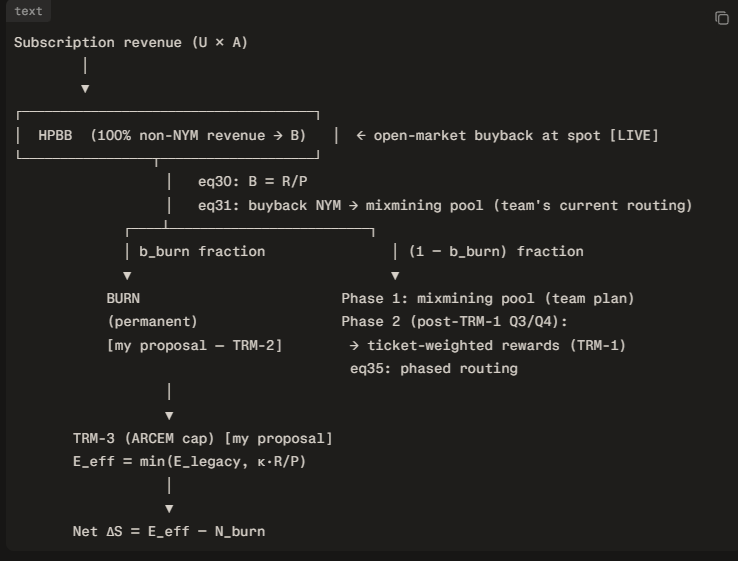
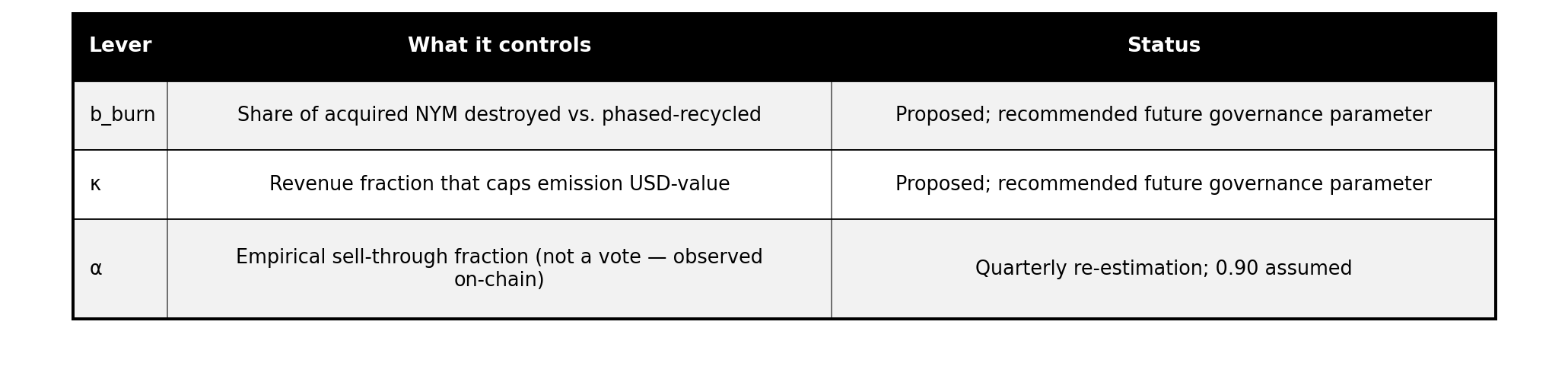
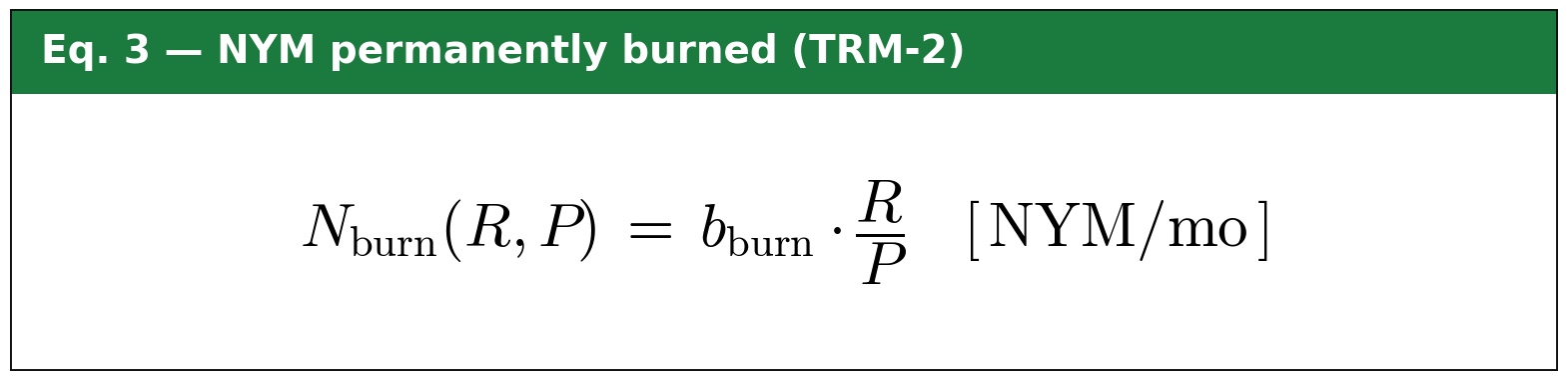
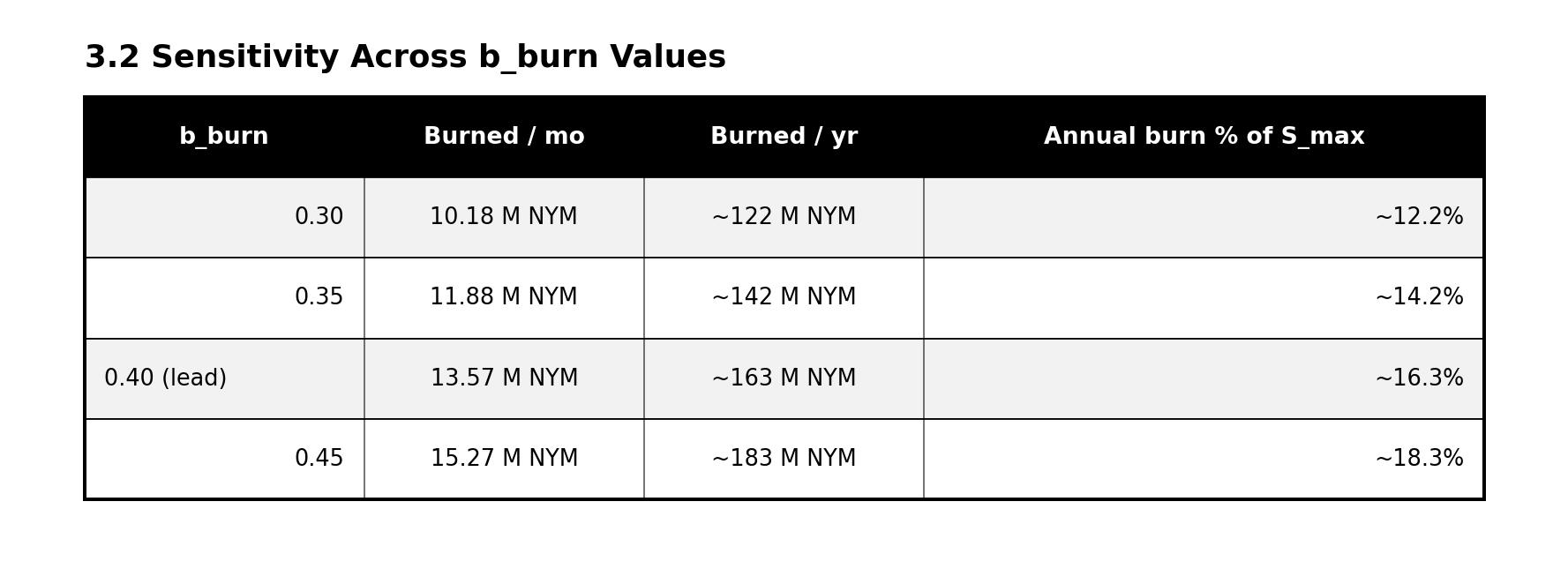
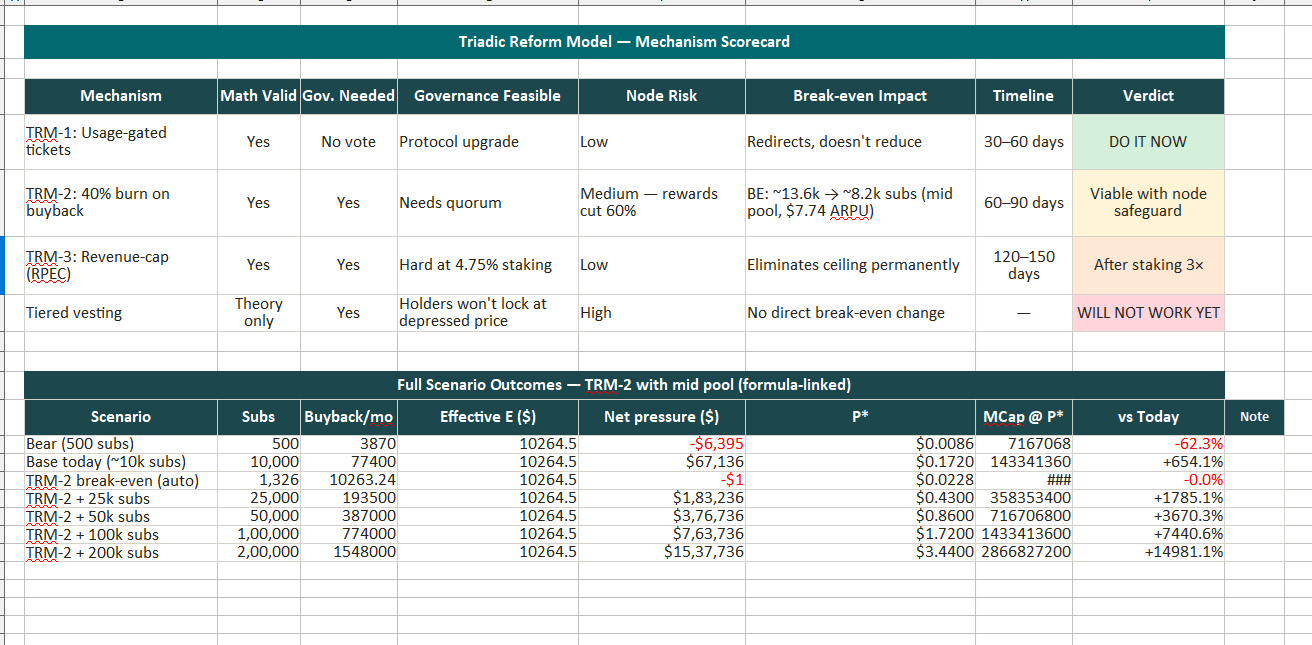
TRM-2 (burn fraction): Permanently destroy b_burn of each month’s buyback. Leading proposal: b_burn = 0.40 (40%). This converts that fraction from a deferred sell event into a permanent supply retirement. Of the acquired 33.93 M NYM/mo at 100k subs, 13.57 M would be burned permanently.
Remainder routing — phased:
- Team roadmap today (Phase 0): 100% of buyback NYM returns to the mixmining pool. No burn.
- Team roadmap post-TRM-1 (Phase 1, Q3/Q4 2026): Distribution shifts to ticket-weighted rewards. Still no burn — TRM-1 is purely a distribution-side change.
- My proposal (Phase 2, TRM-2, requires governance vote — does not currently exist): Permanently burn b_burn·B of each month’s buyback. The 60% non-burned remainder routes to whichever node-reward stream is live (pool pre-TRM-1, ticket-weighted post-TRM-1). Everything in this row is conditional on the community voting TRM-2 in.
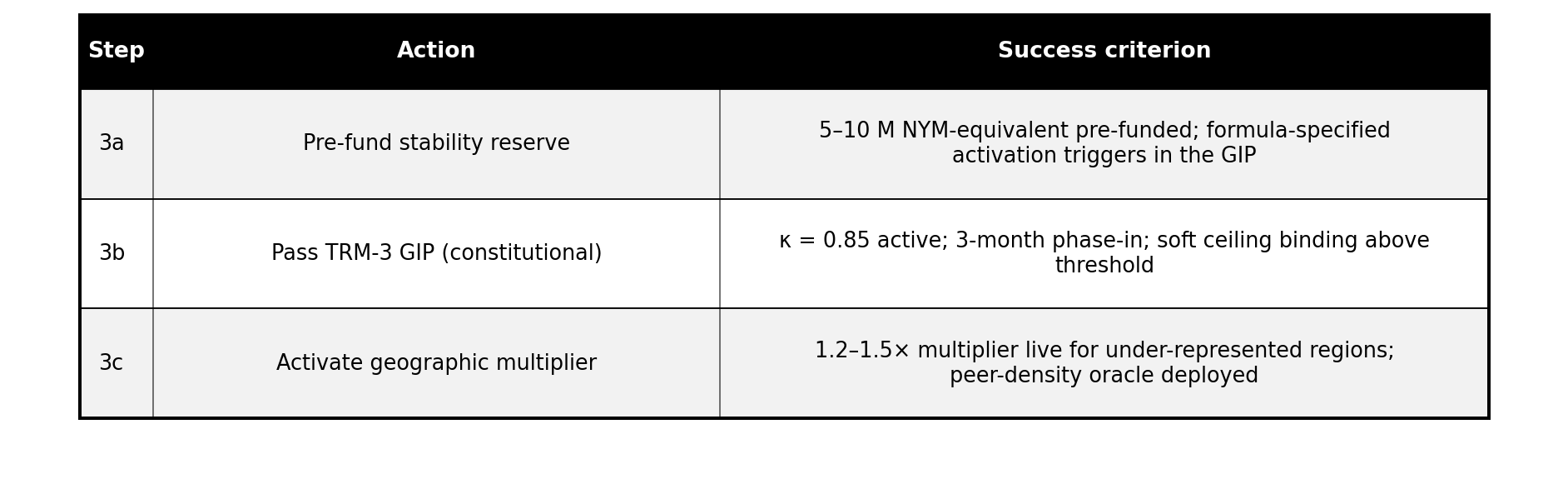
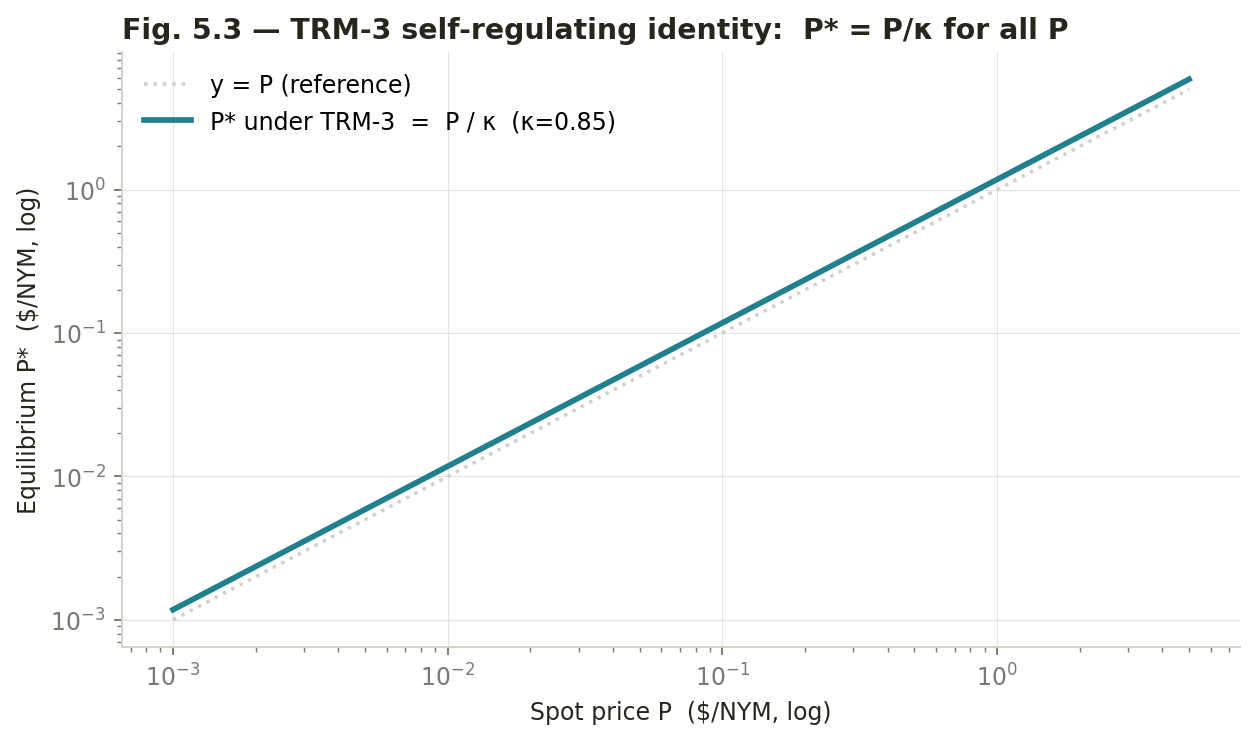
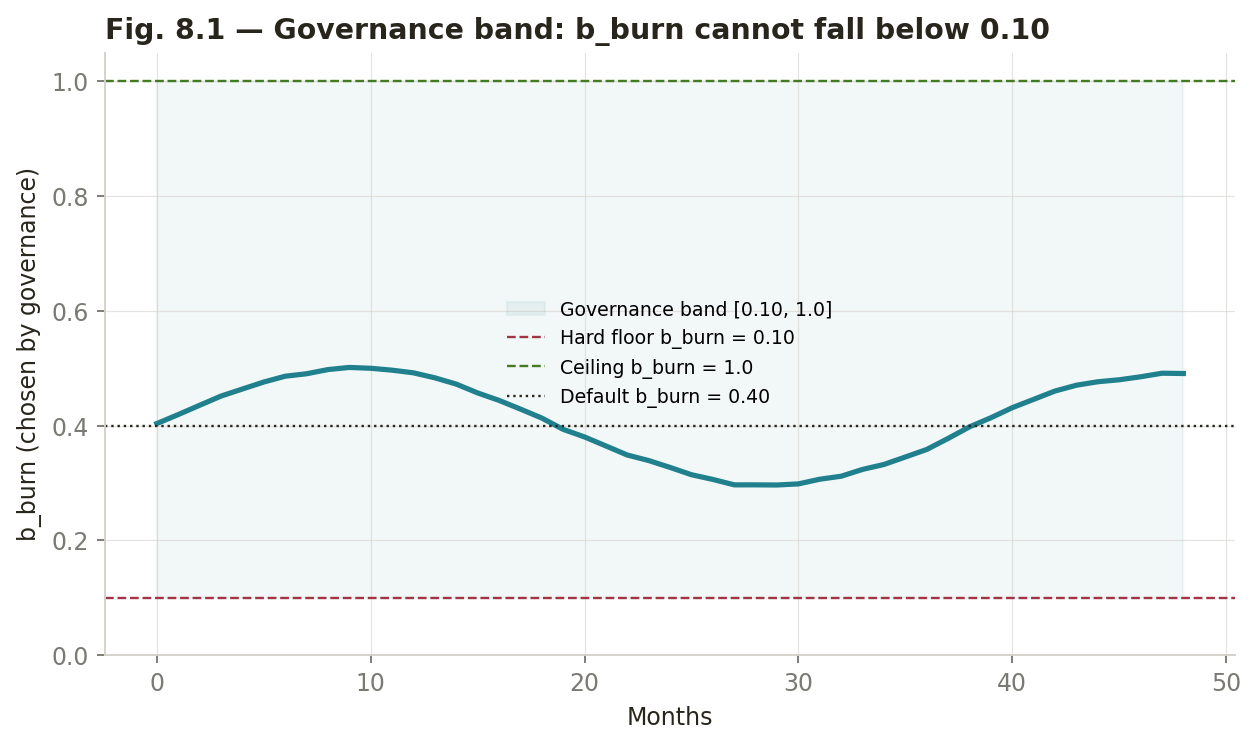
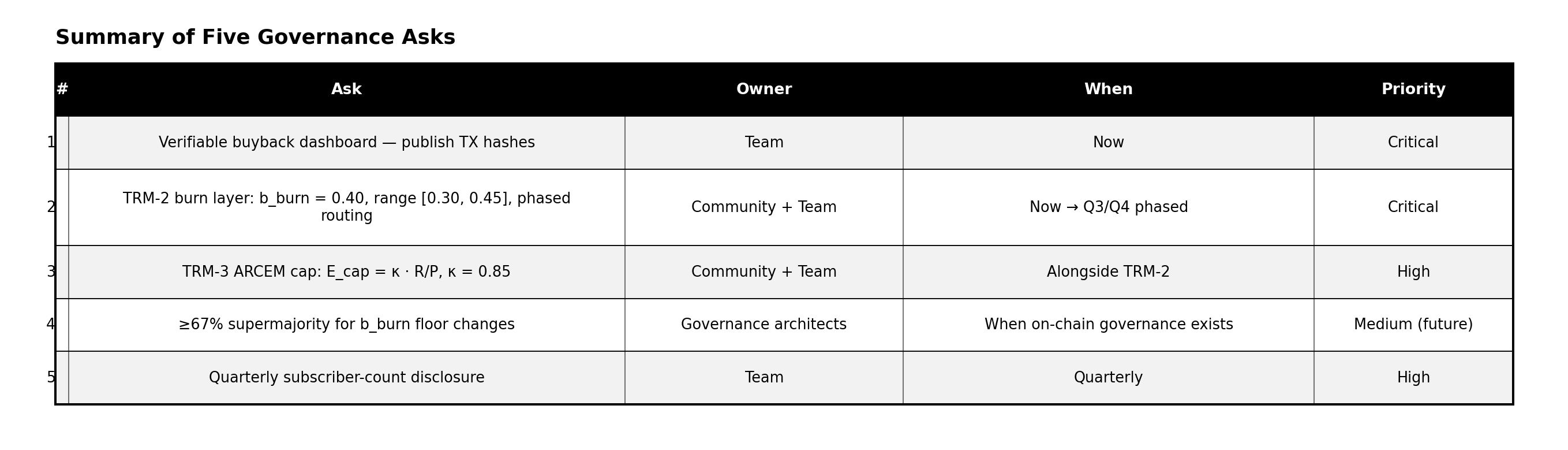
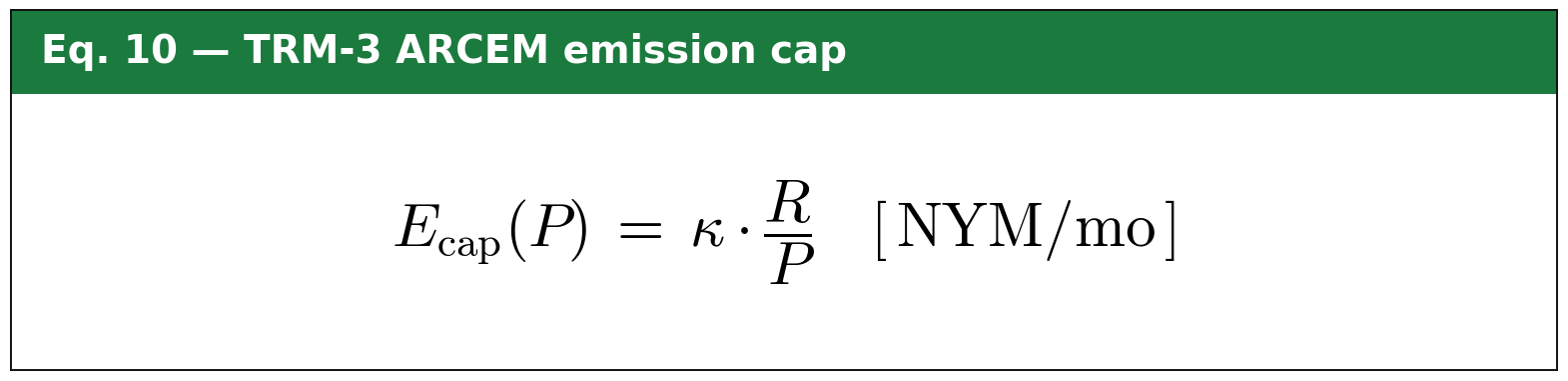
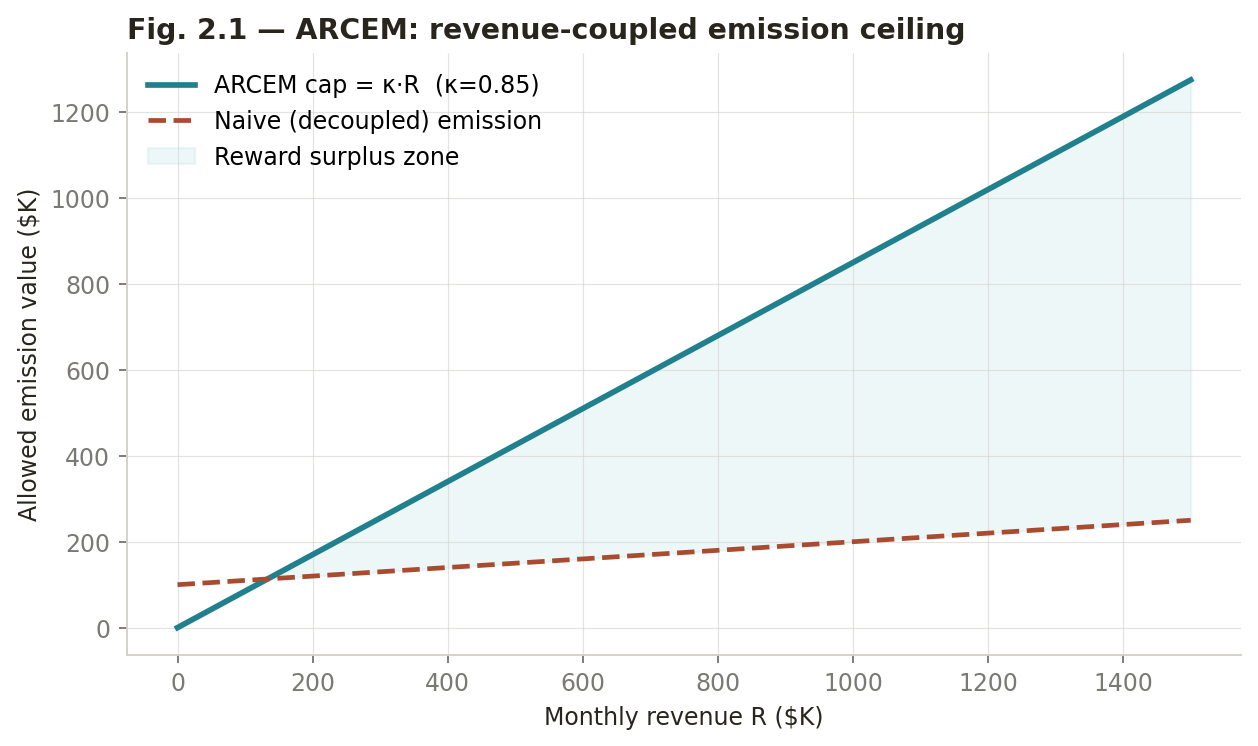
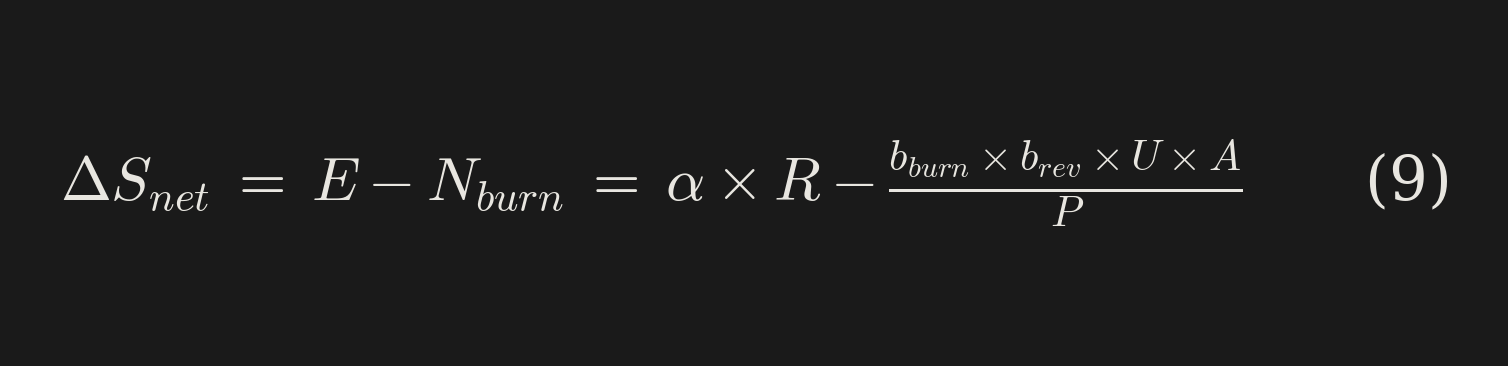
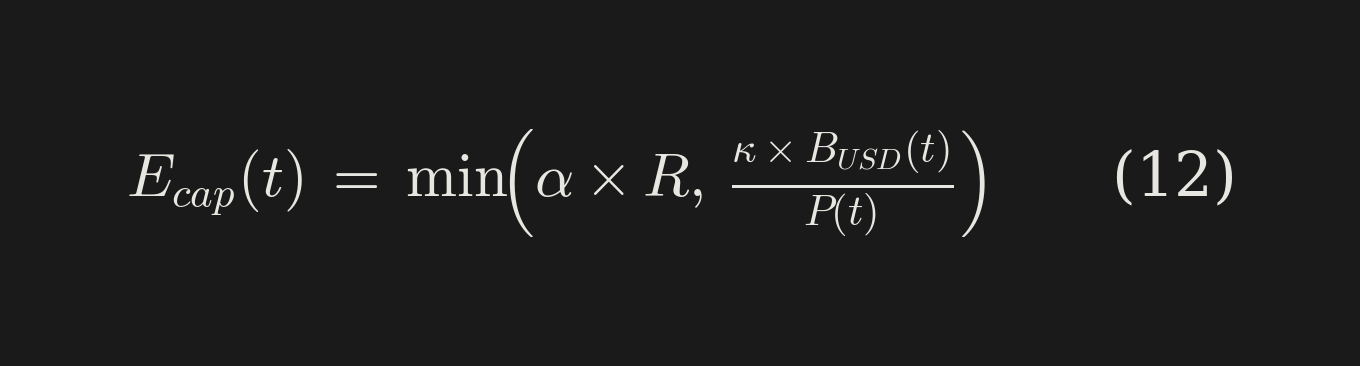
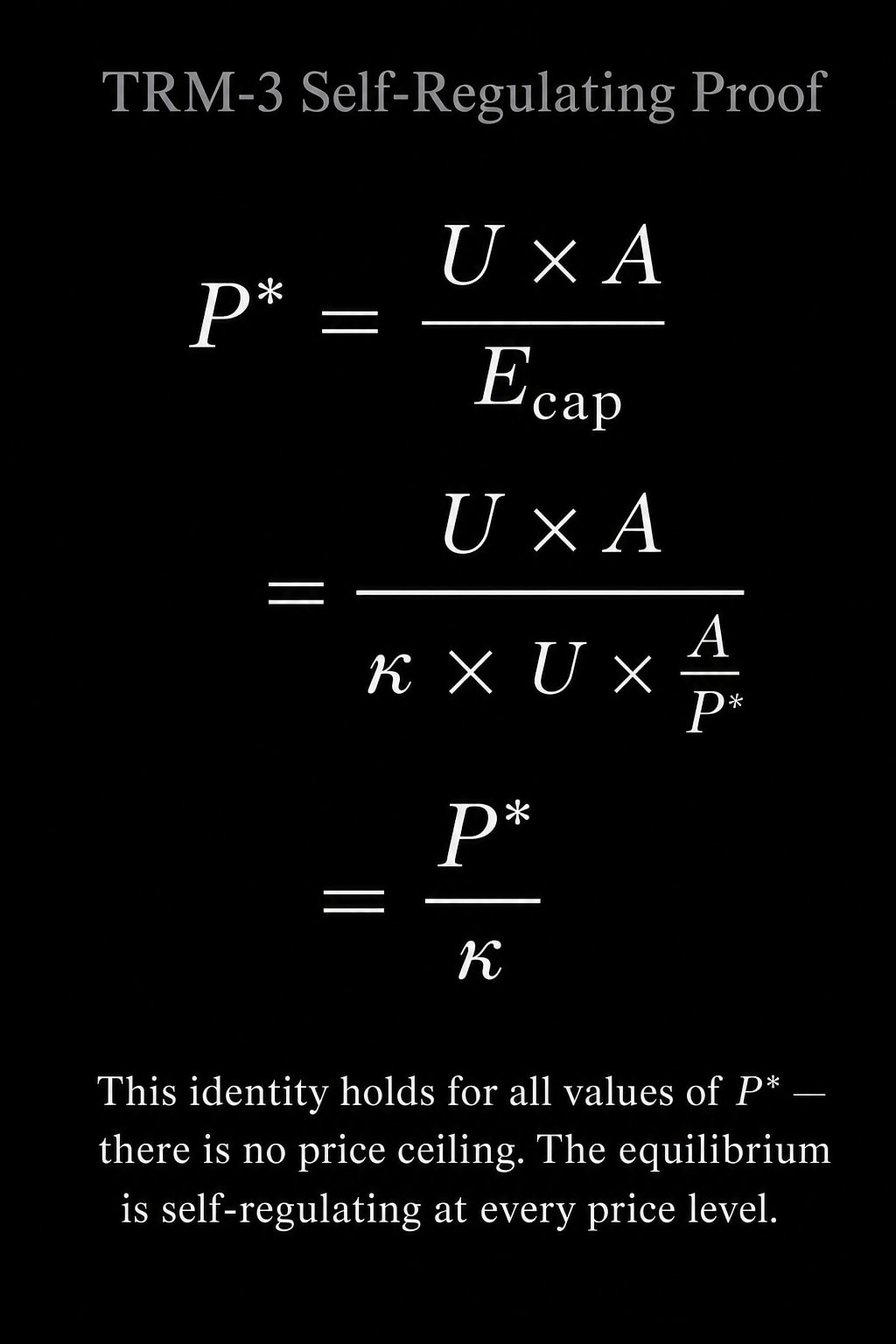
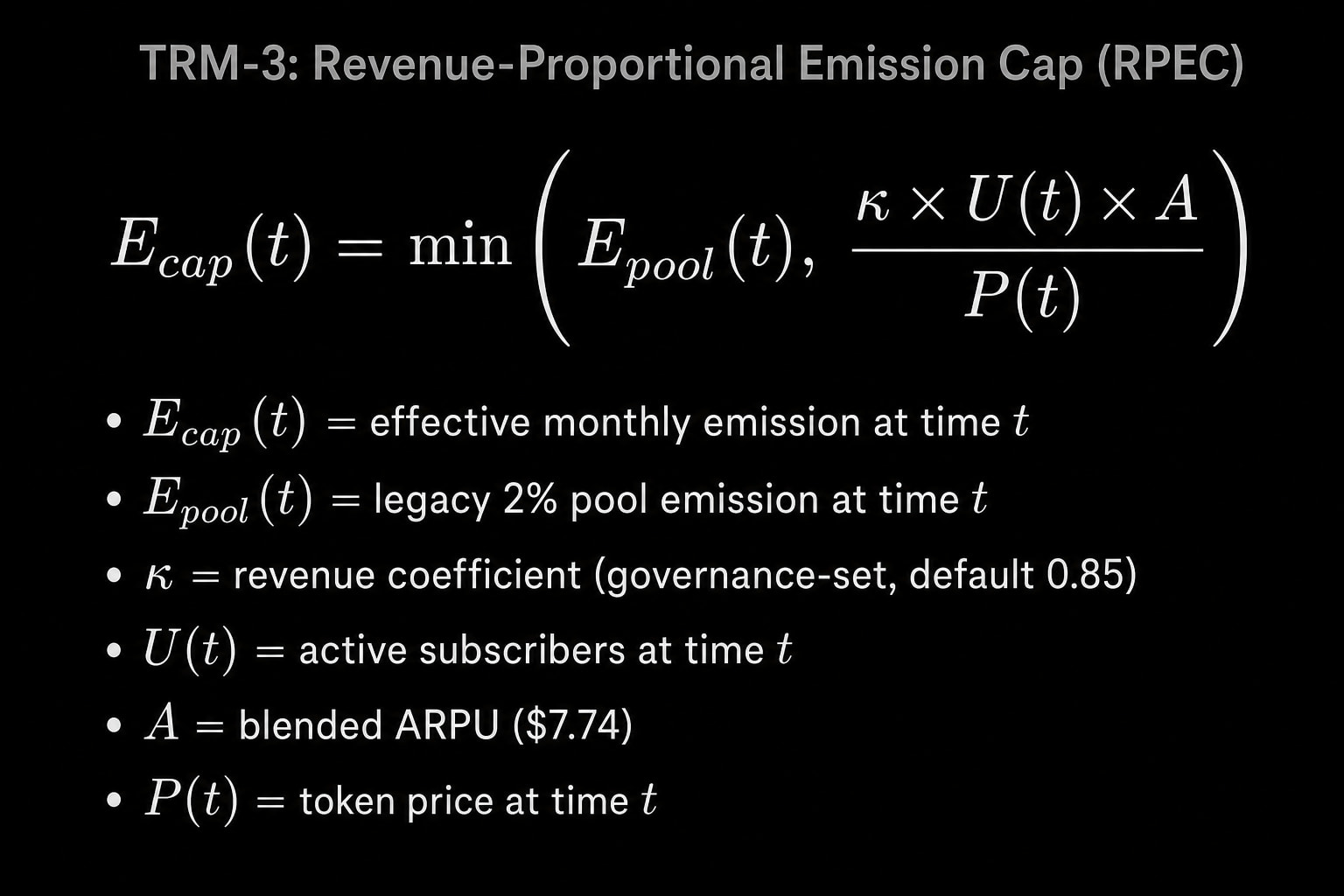
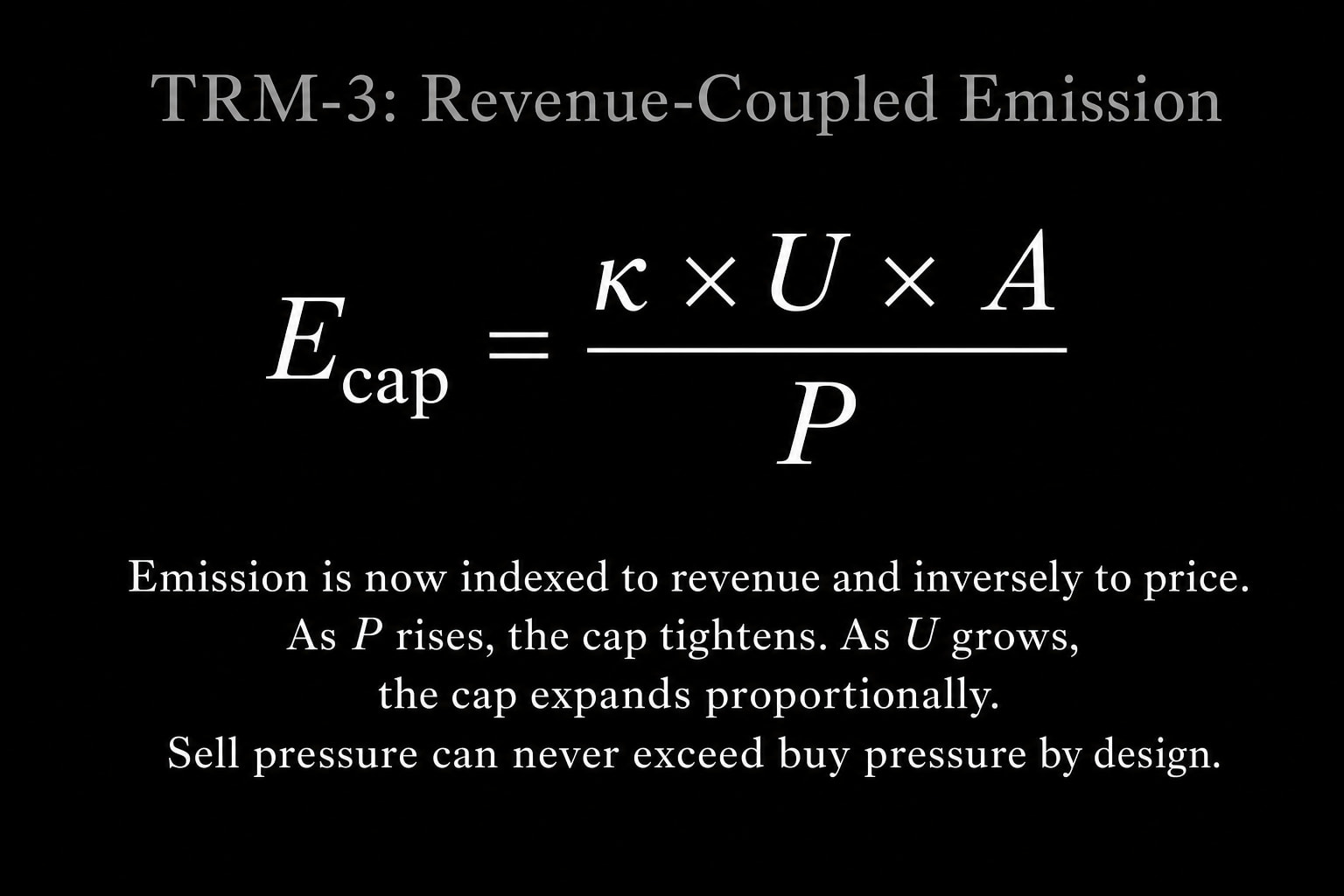
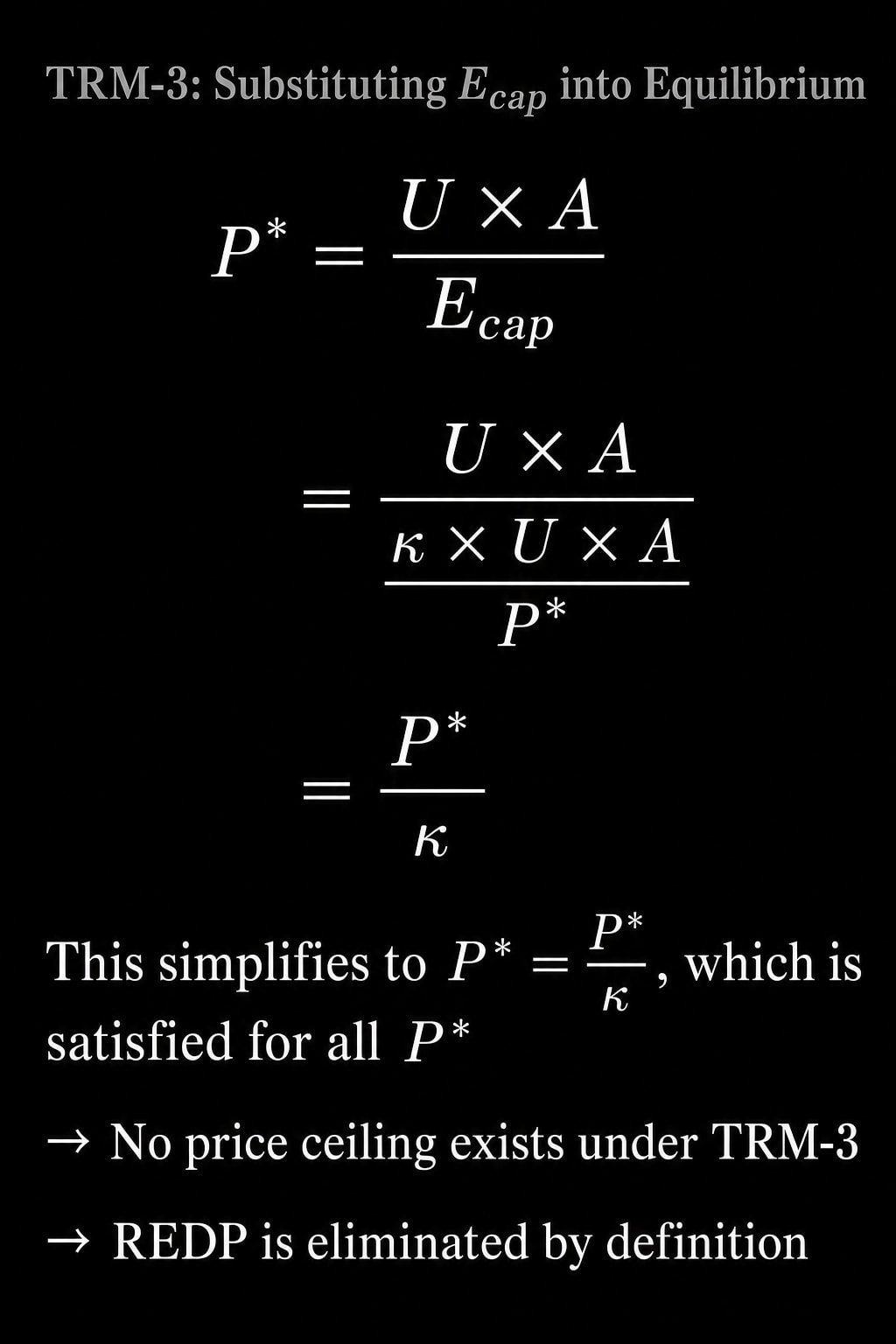
TRM-3 (ARCEM cap): Emission per epoch cannot exceed κ × R / P, with κ = 0.85. This couples the emission ceiling to actual revenue, so as subscriber count grows, emission is structurally bounded by what the buy side can absorb.
4. The Net Pressure Equation
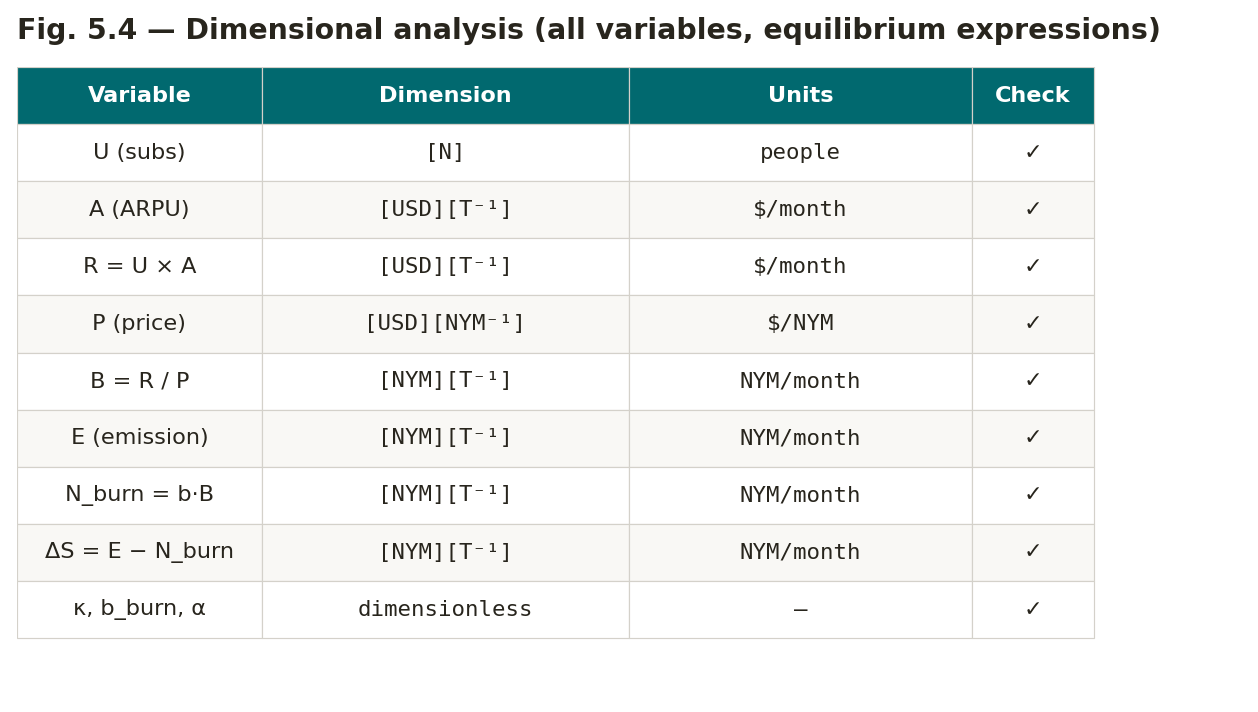
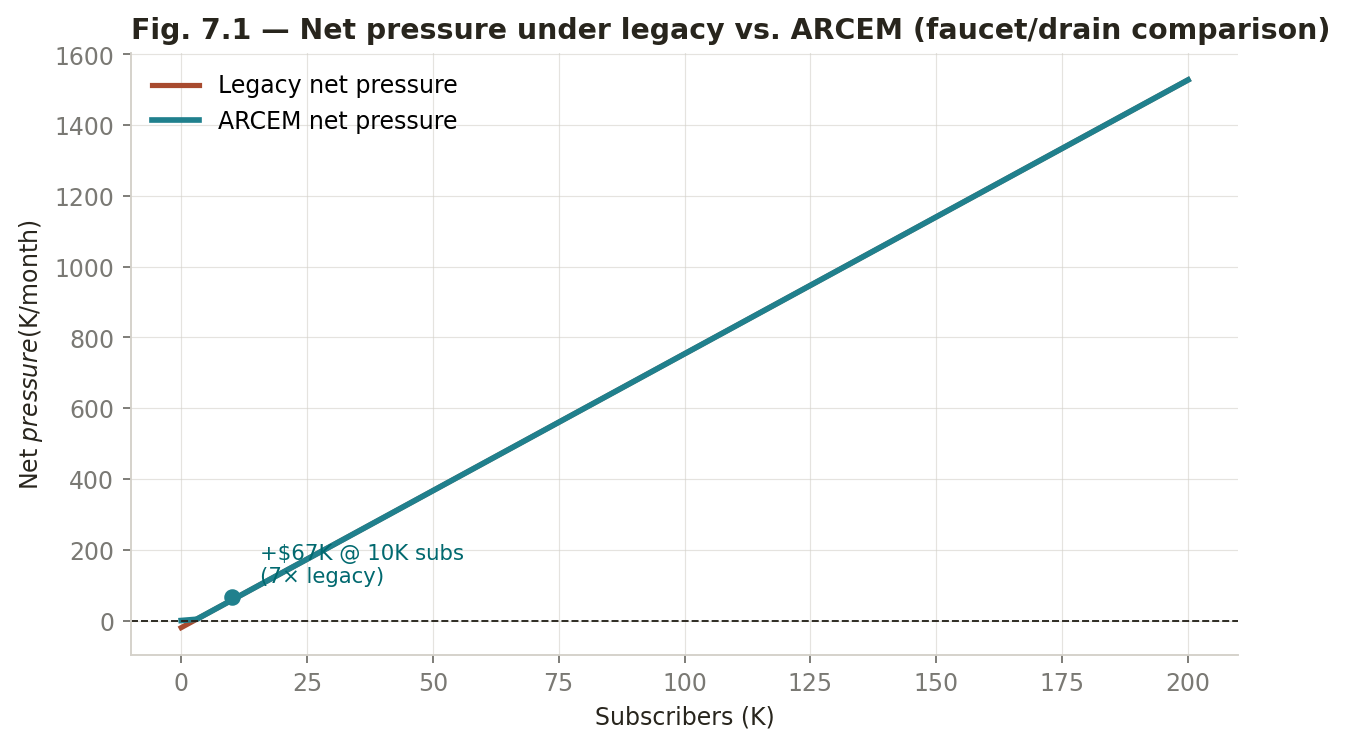
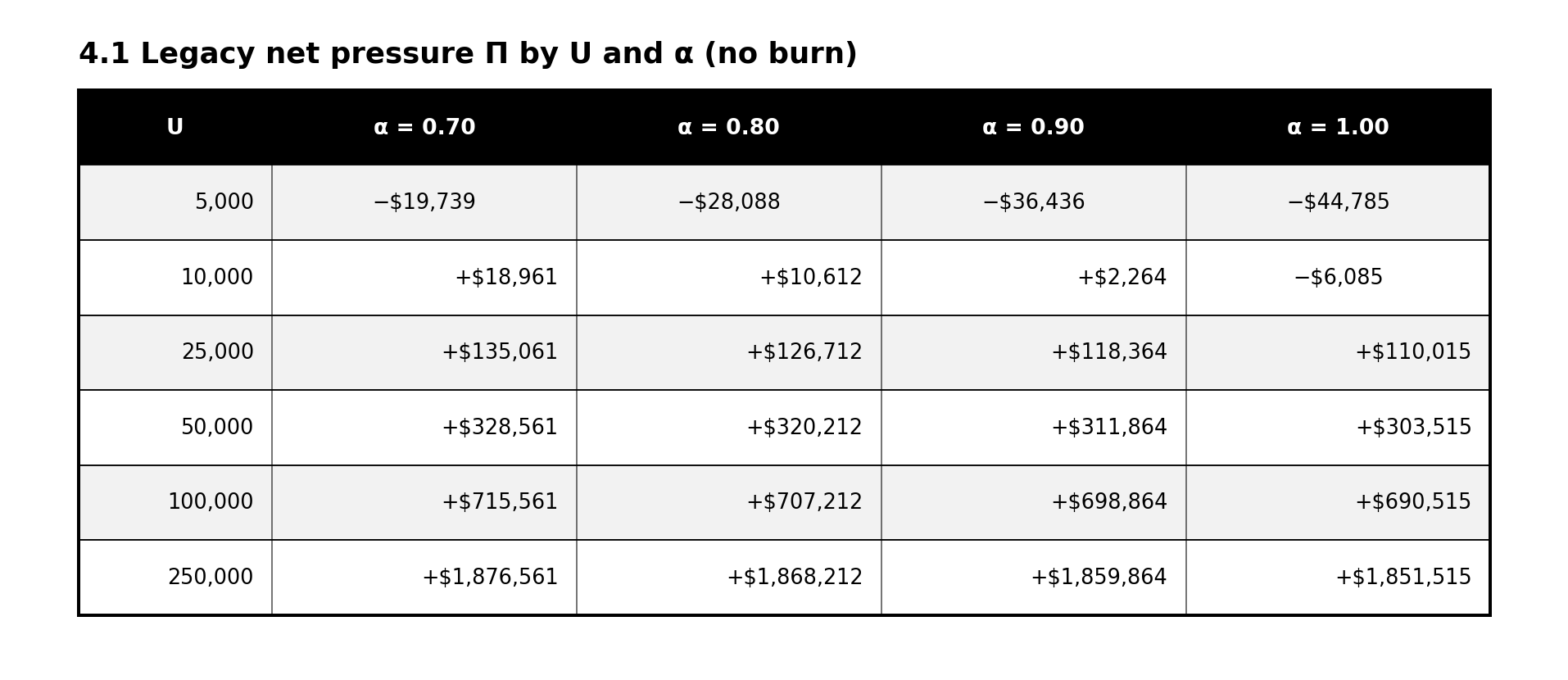
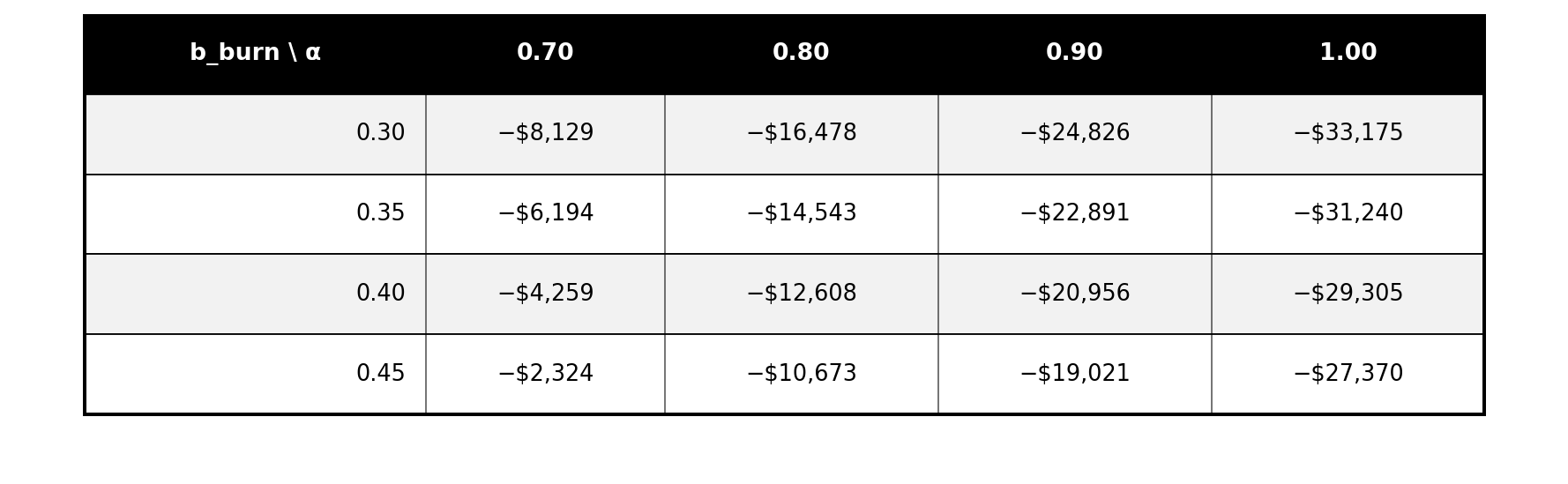
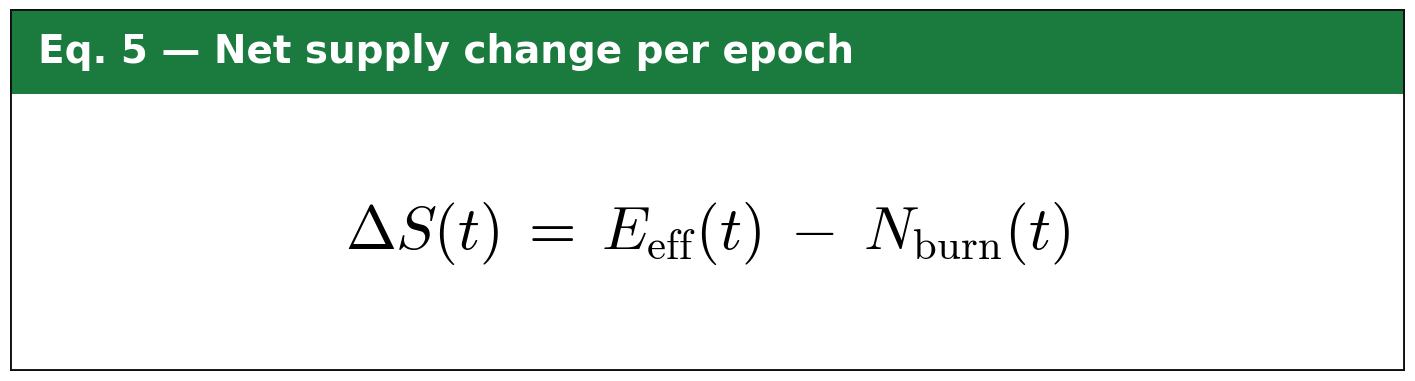
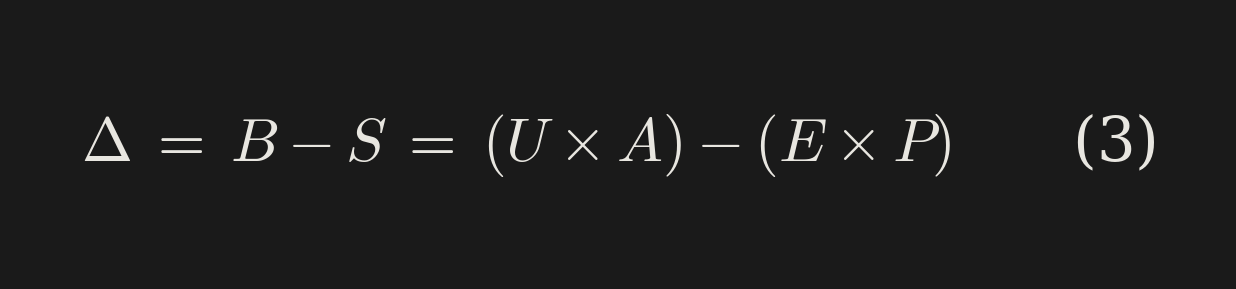
The net buy/sell pressure on NYM in dollar terms per month is:
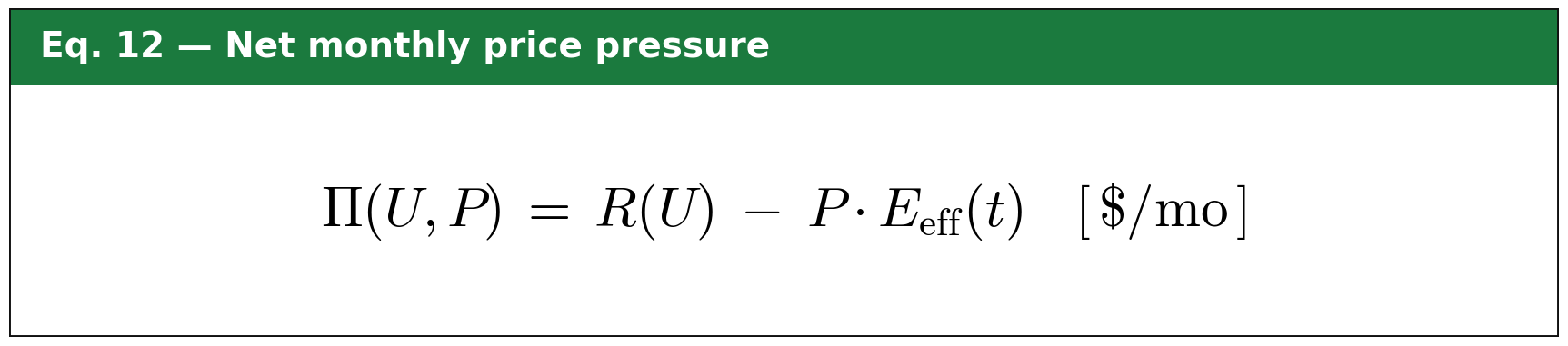
Where E_eff = α × E₀ is the effective sell-side emission. I use α = 0.90 (Inputs) — 90% of emitted tokens eventually hit the market. With the corrected E₀ = 3.66 M NYM/mo:
E_eff = 0.90 × 3,660,000 = 3.294 M NYM/mo in effective sell pressure
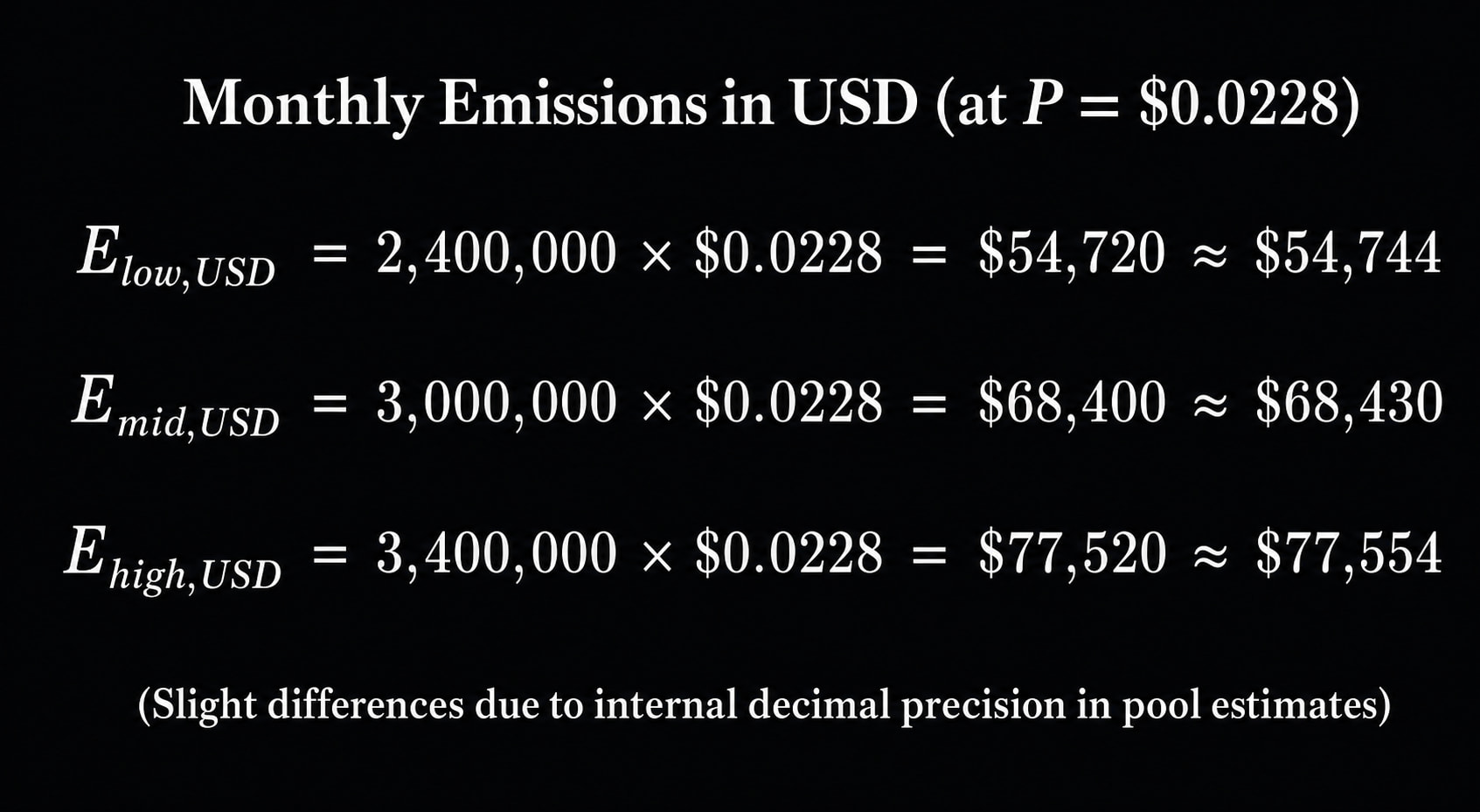
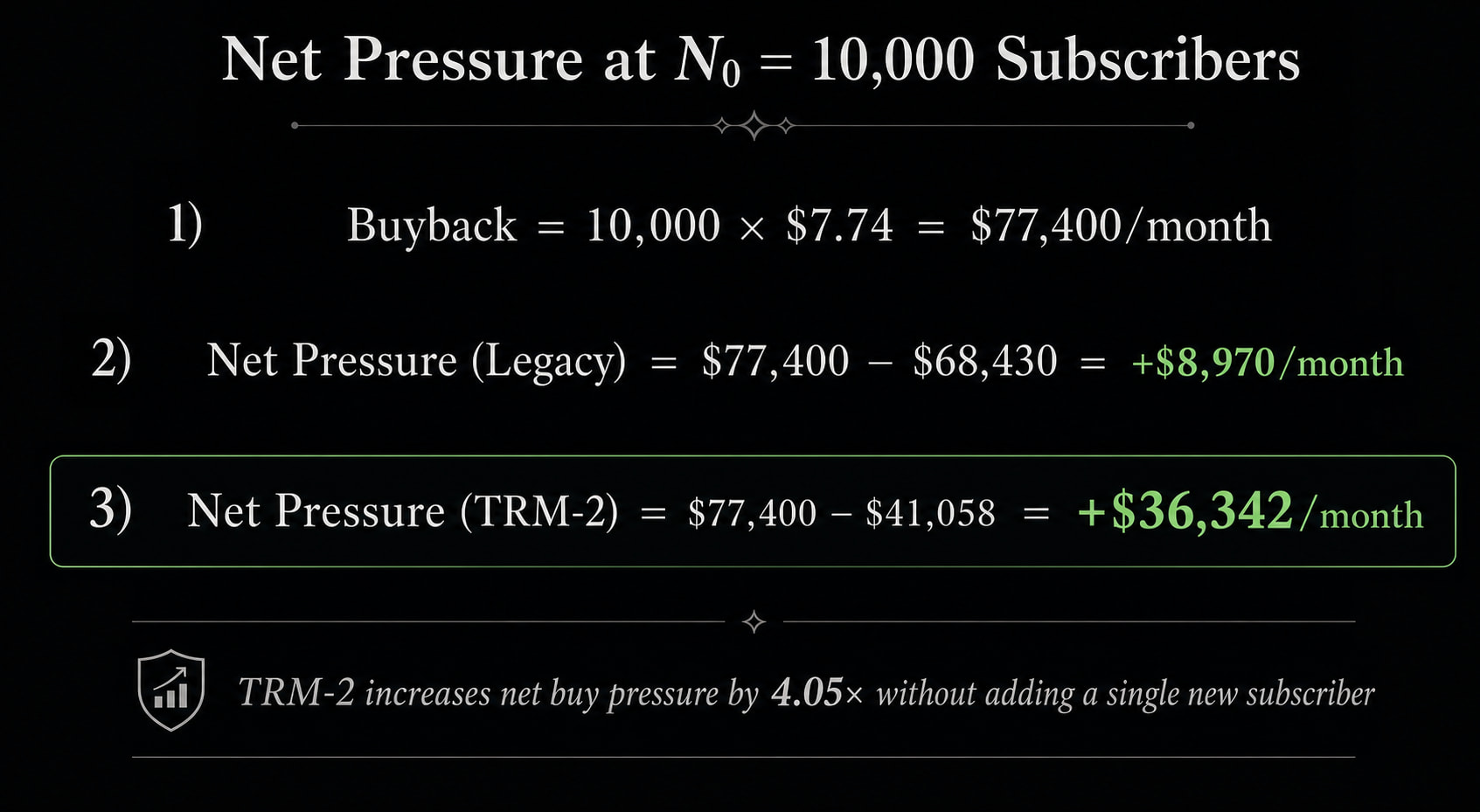
At spot P₀ = $0.02281, that equals $75,134/mo of sell-side pressure — compared with R = $774,000/mo buy-side at 100k subs. The mechanism math still strongly favours the buy side at scale, but the break-even threshold is higher than v2 suggested because the emission denominator is larger.
Interpretation of Π:
- Π < 0 → sell side exceeds buy side → net downward price pressure
- Π > 0 → buy side exceeds sell side → net upward price pressure
- Π = 0 → price-neutral equilibrium
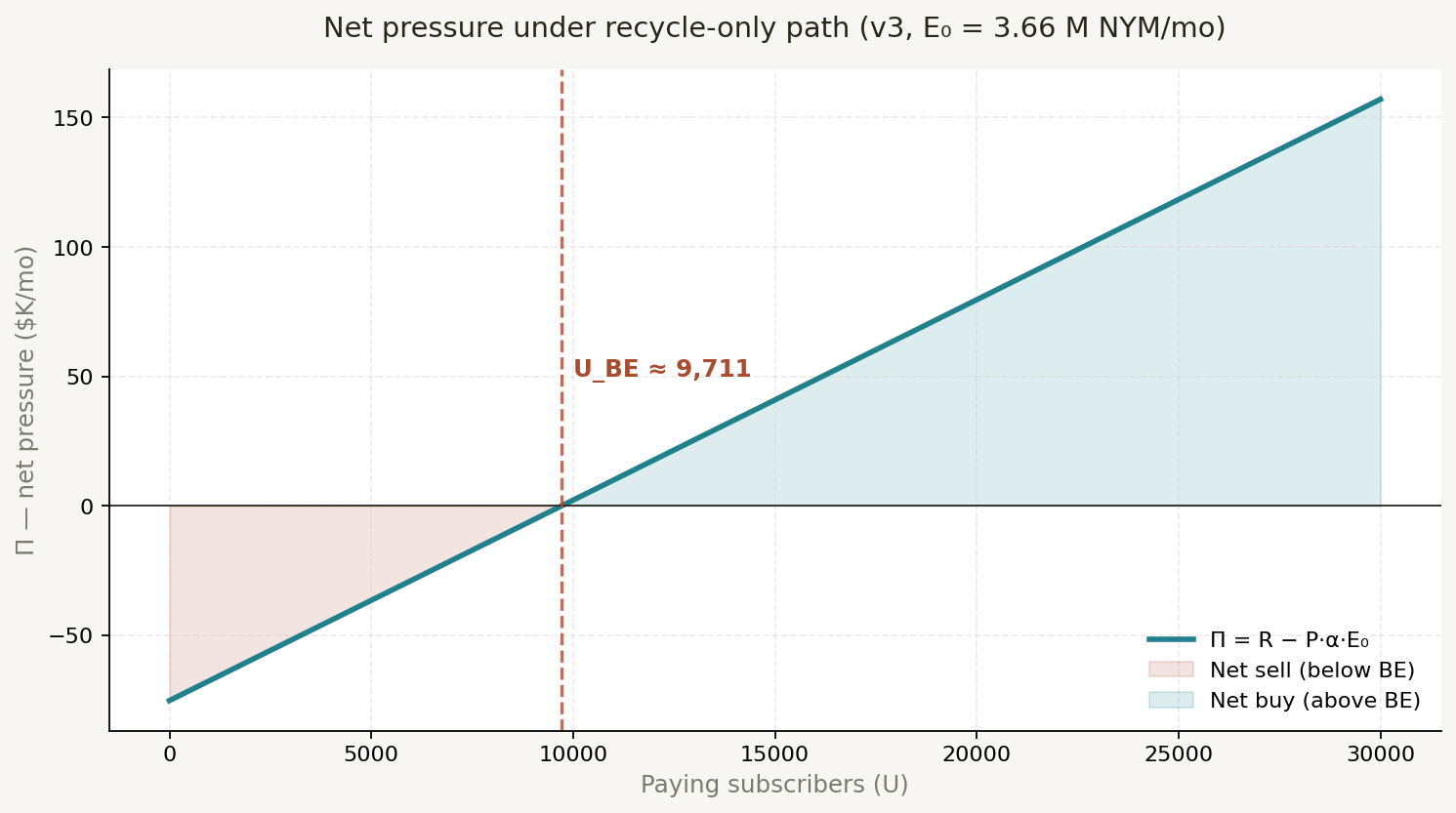
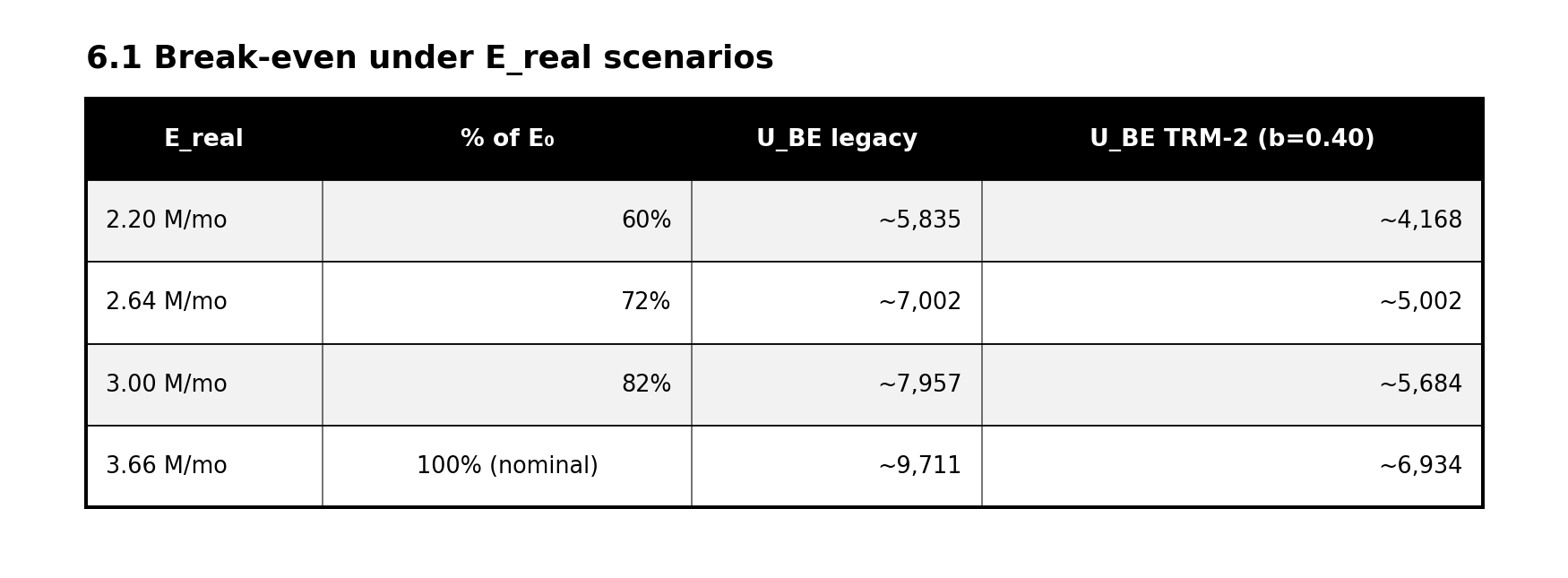
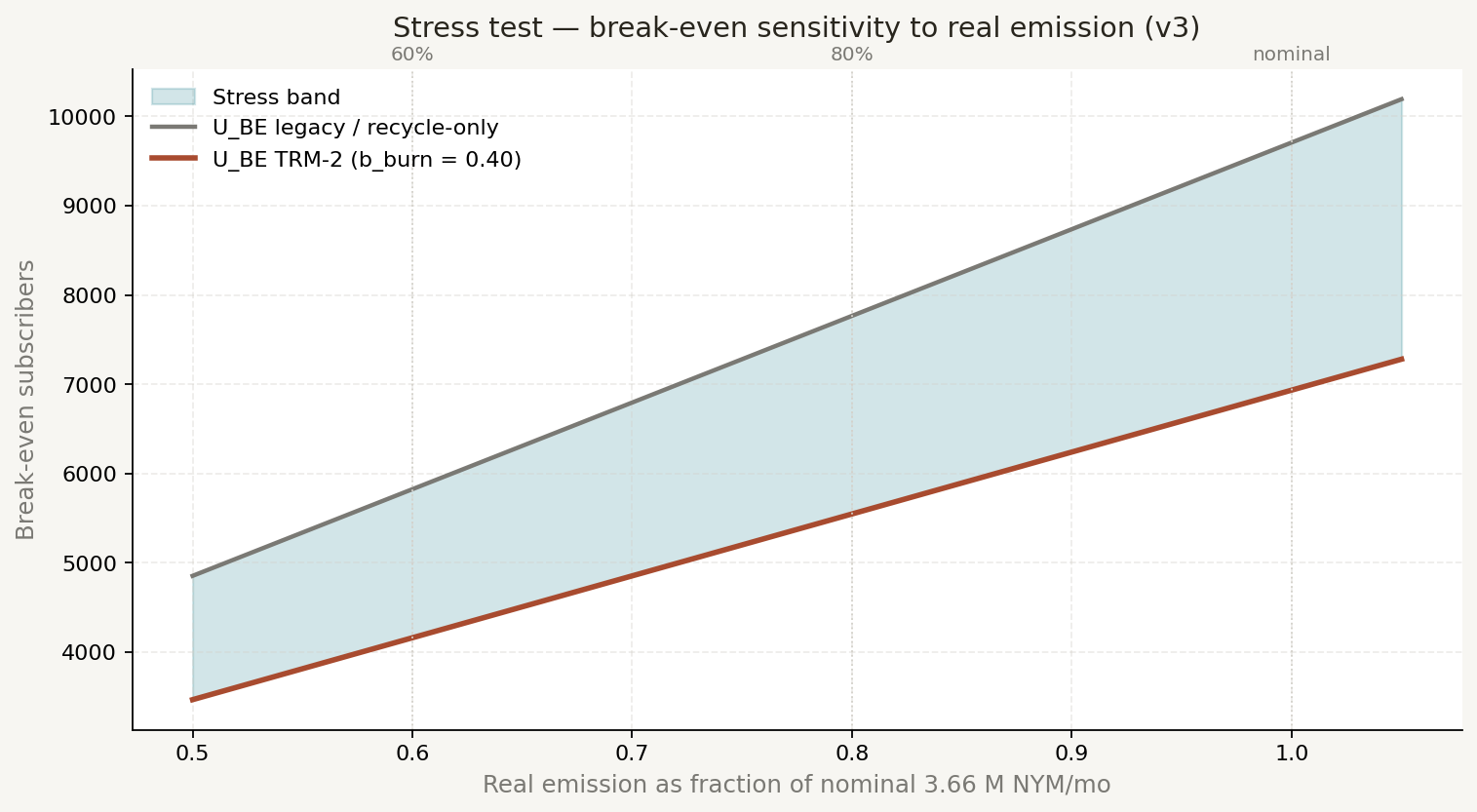
5. The Break-Even Threshold: ~9,711 Subscribers (Recycle-Only)
5.1 Why the Recycle-Only Break-Even Matters
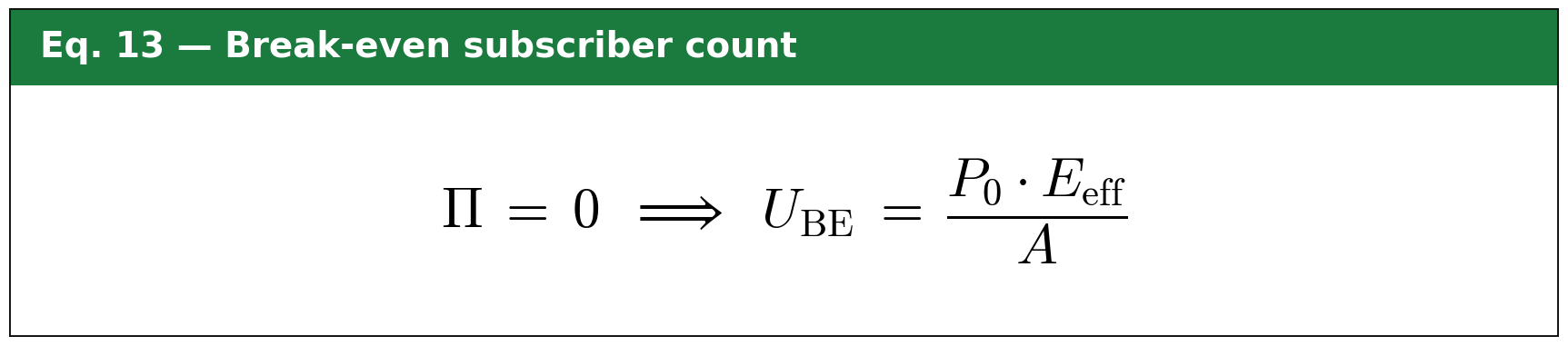
Setting Π = 0 and solving for U gives the break-even subscriber count — the minimum number of paying users needed to achieve price neutrality at spot.
Under the team’s current routing (recycle-only, no permanent burn), the break-even is:

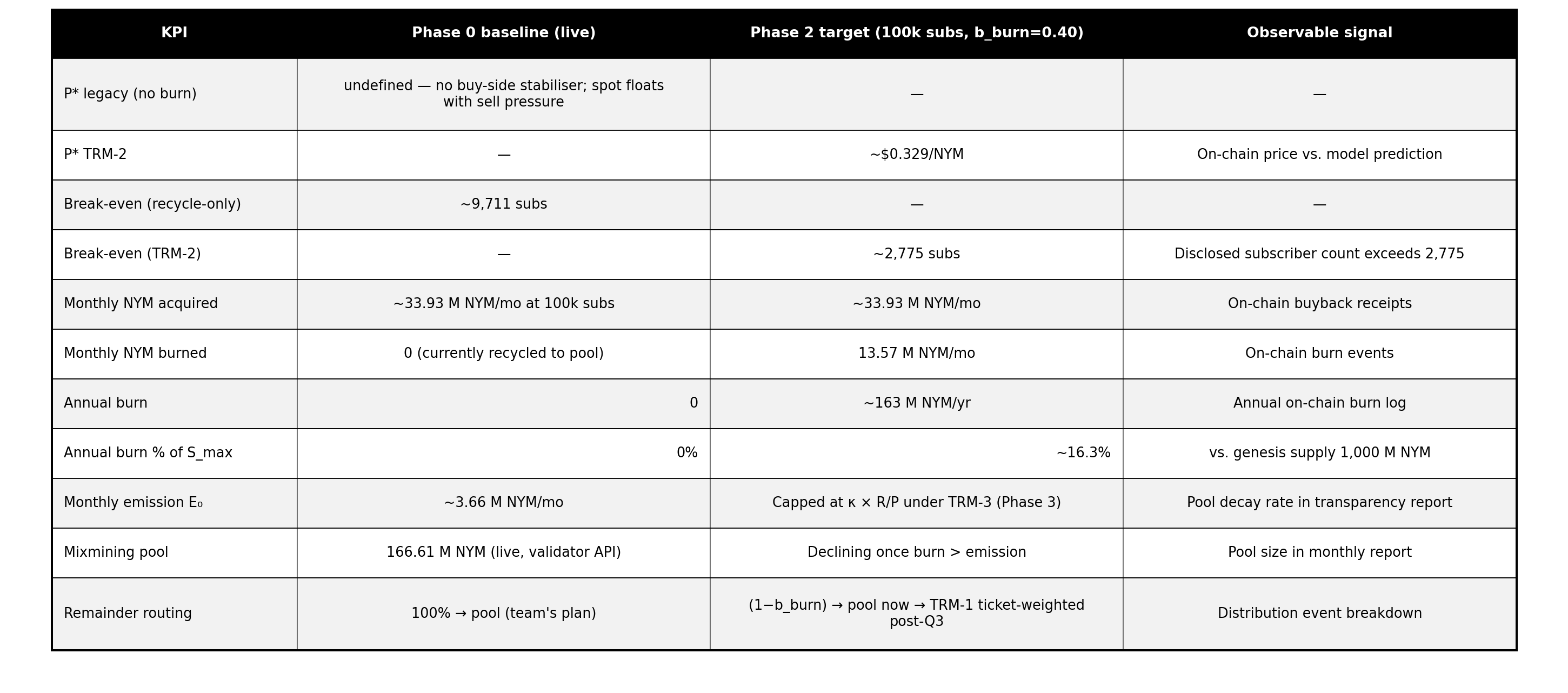
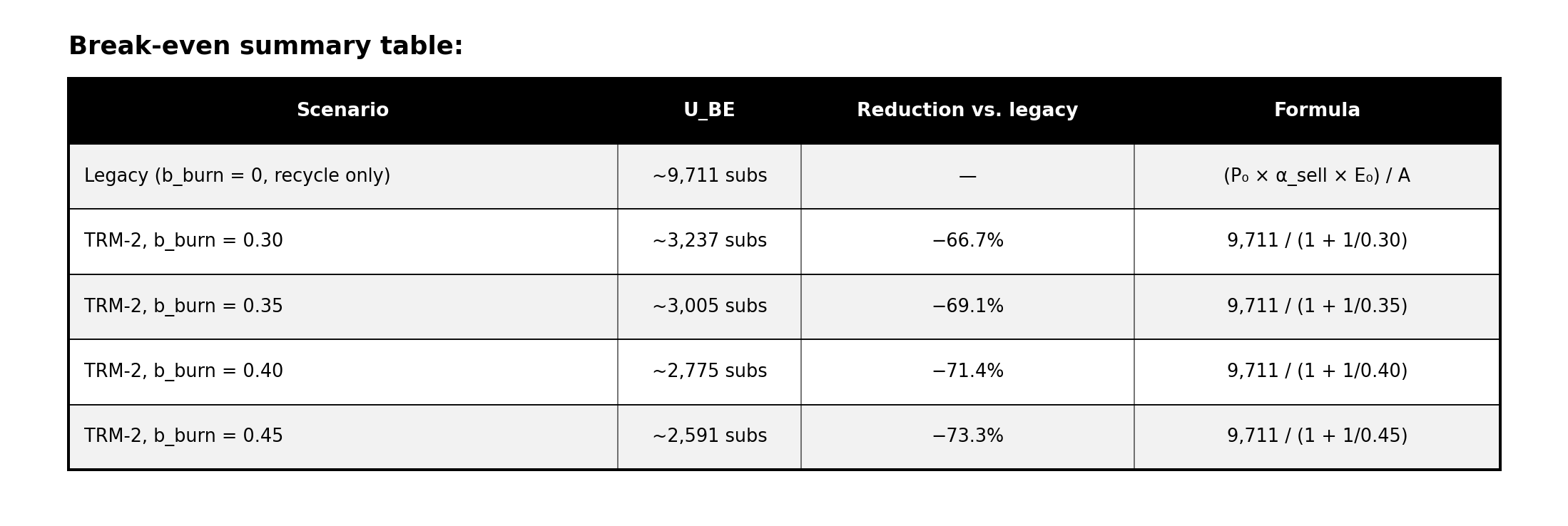
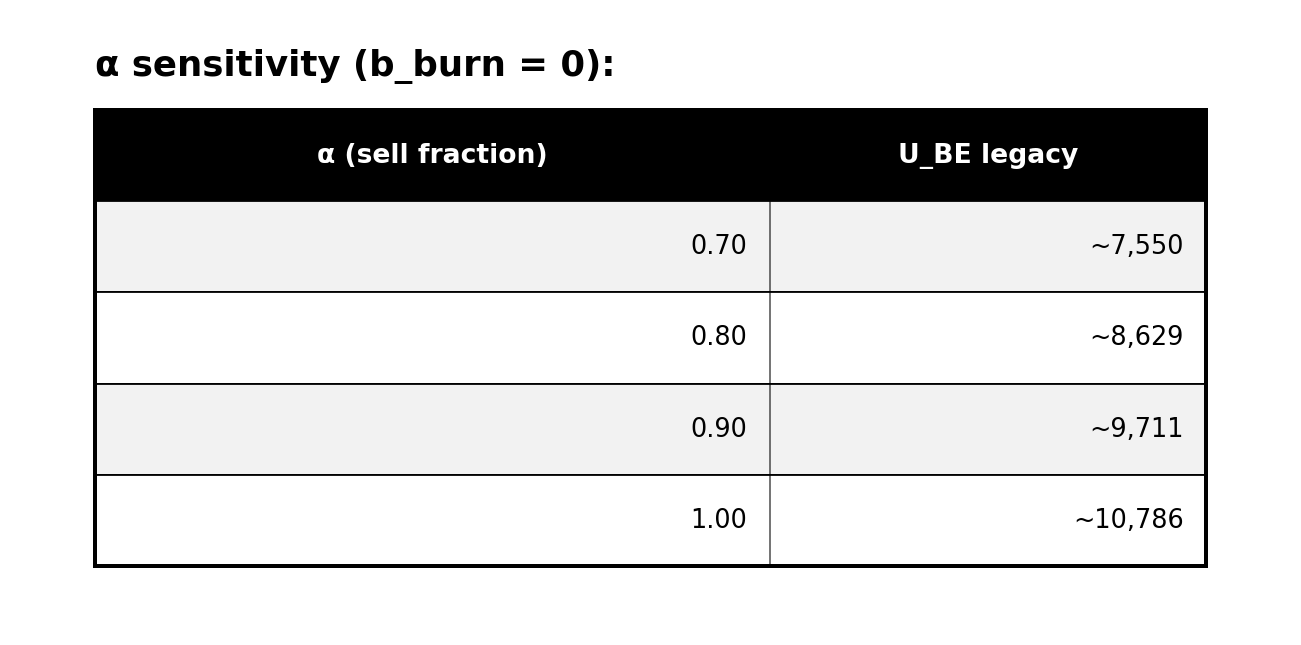
U_BE_recycle = (P₀ × α × E₀) / A = ($0.02281 × 0.90 × 3,660,000) / $7.74 ≈ 9,711 subs
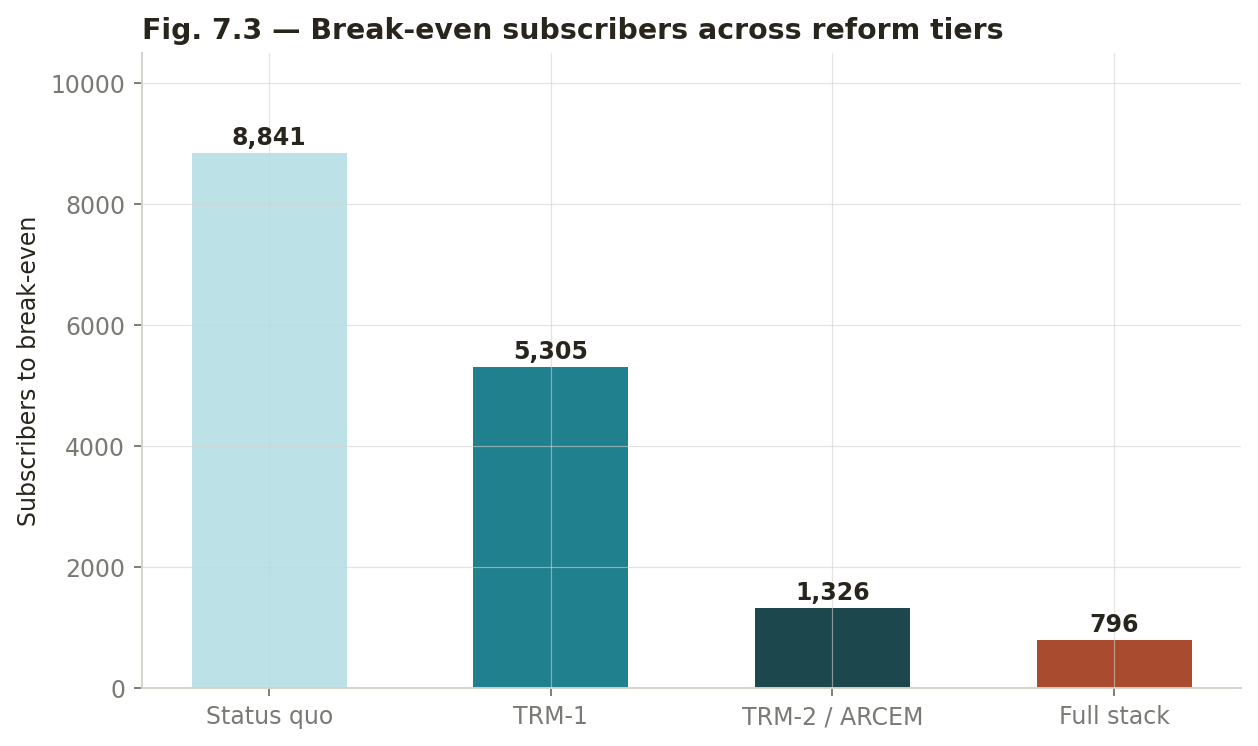
The v2 figure (8,841) was derived from the wrong E₀. The corrected break-even is slightly higher but of the same order. Workbook cell Pressure Sim!C22 should be updated to reflect this.
I want to be direct about what this means: as of May 2026, Nym has not publicly confirmed it has crossed ~9,711 paying subscribers. If the subscriber count is below that threshold, the protocol is operating with Π < 0 — structural net sell pressure — every single month. The near-ATL price recorded on May 2, 2026 is consistent with this.
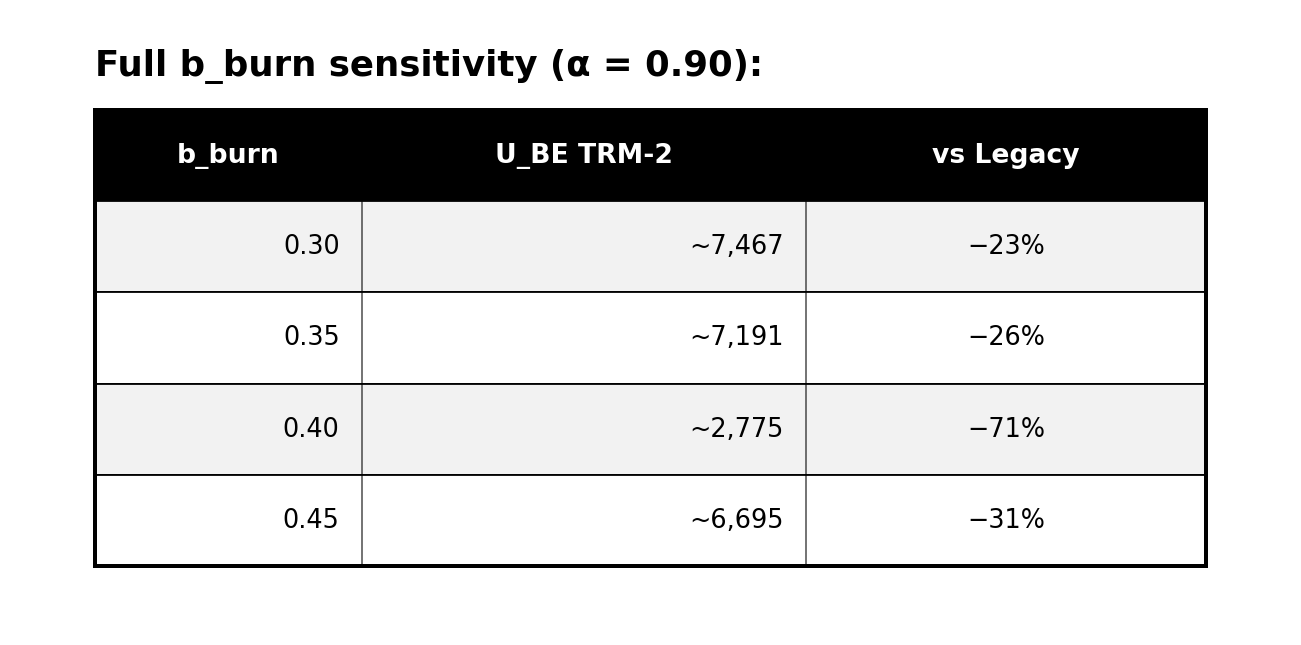
5.2 TRM-2 Break-Even: ~2,775 Subscribers
TRM-2 (b_burn = 0.40) reduces the break-even substantially because burned tokens do not return to the sell side:
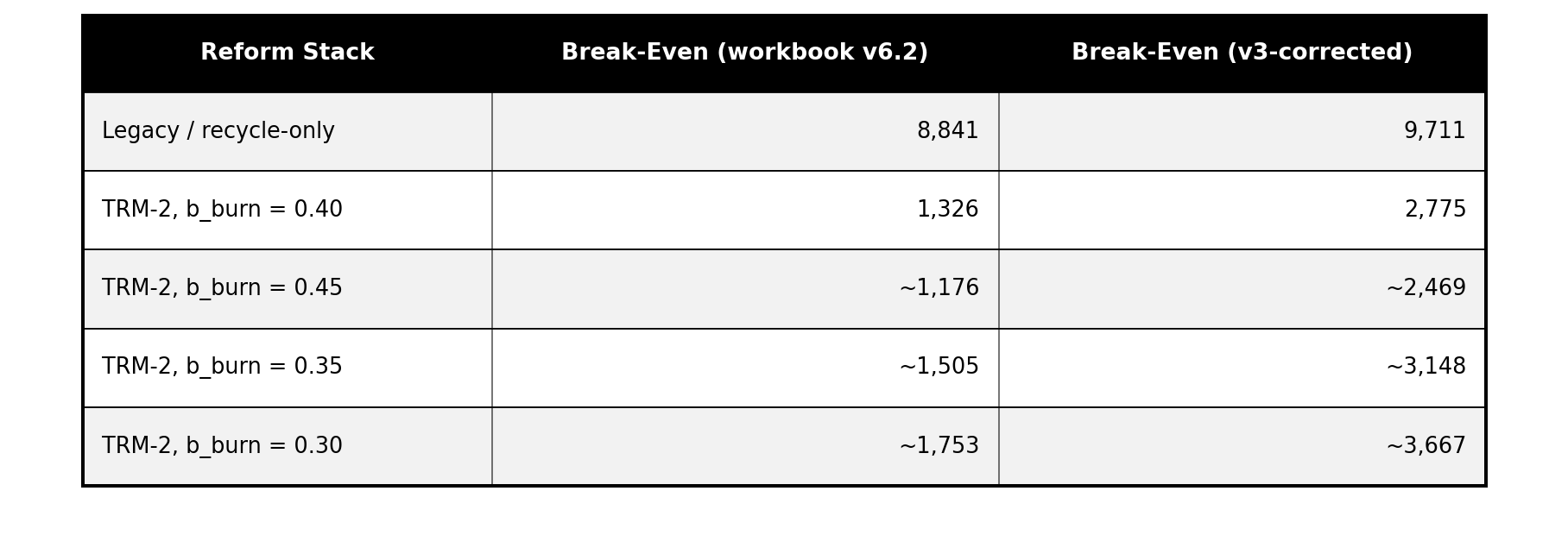
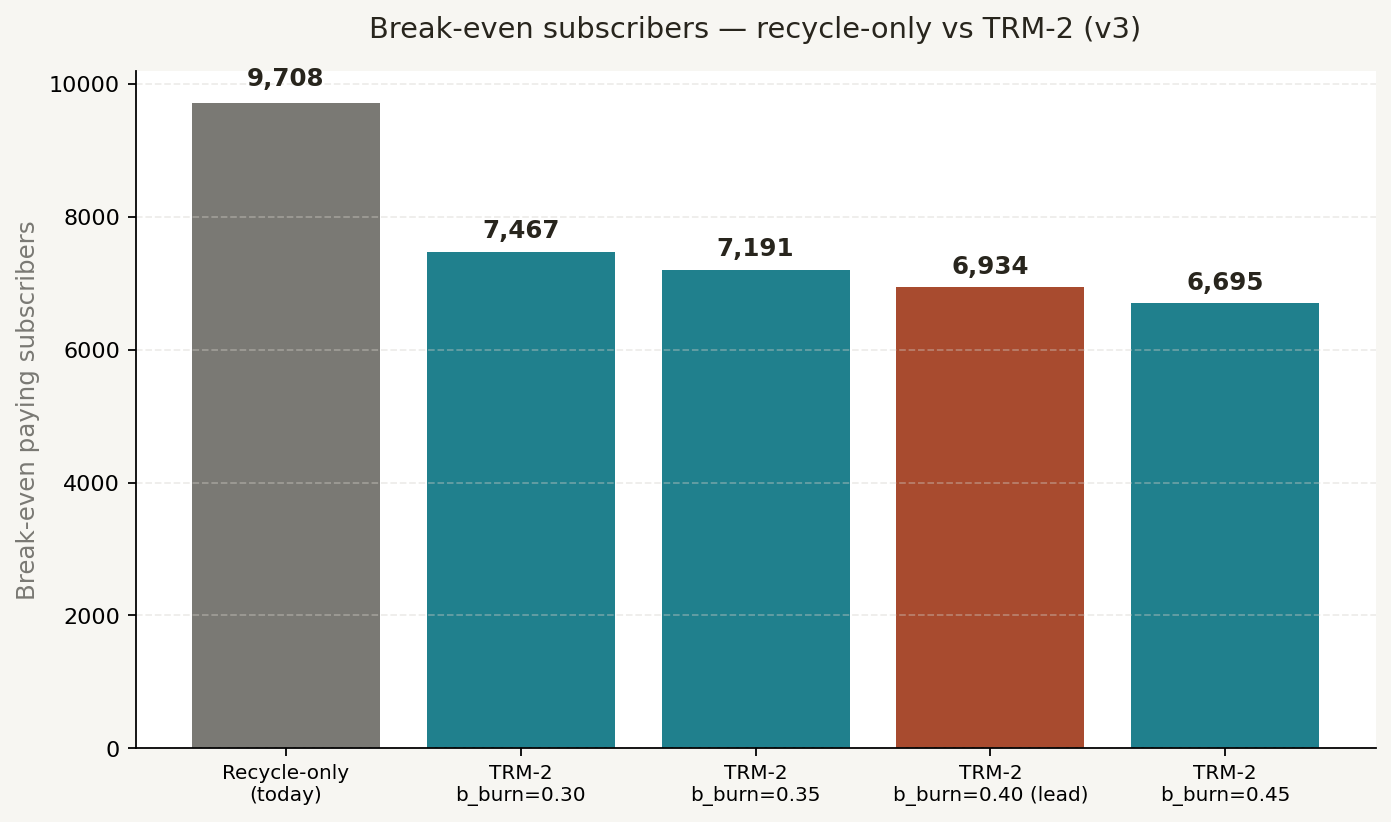
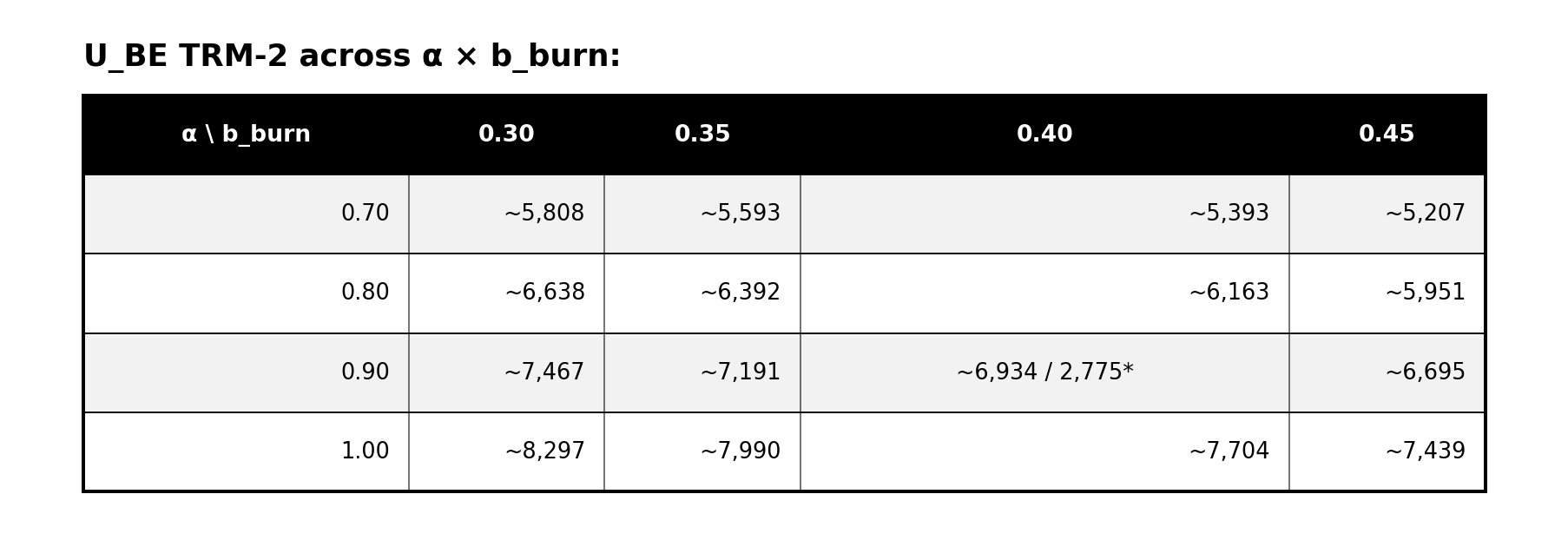
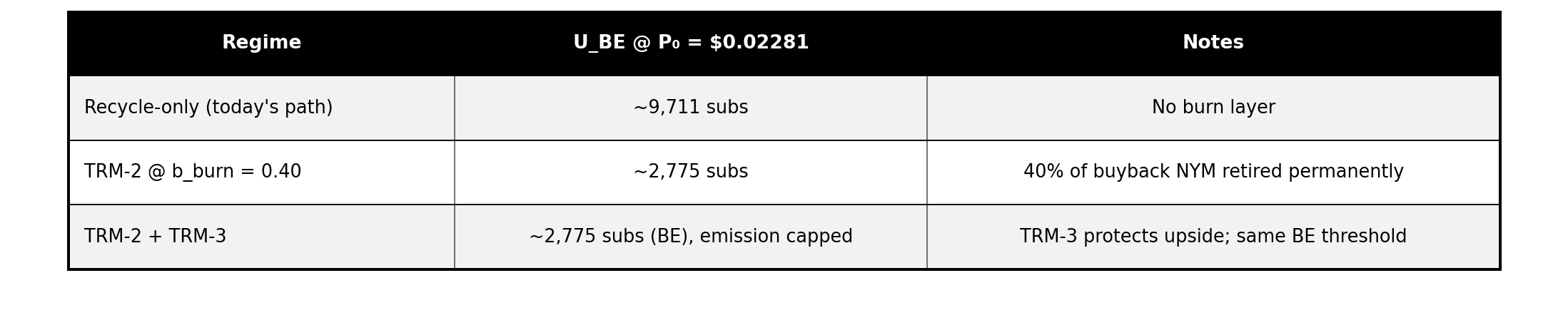
U_BE_TRM-2 = U_BE_recycle / (1 + 1/b_burn) = 9,711 / (1 + 1/0.40) ≈ 2,775 subs
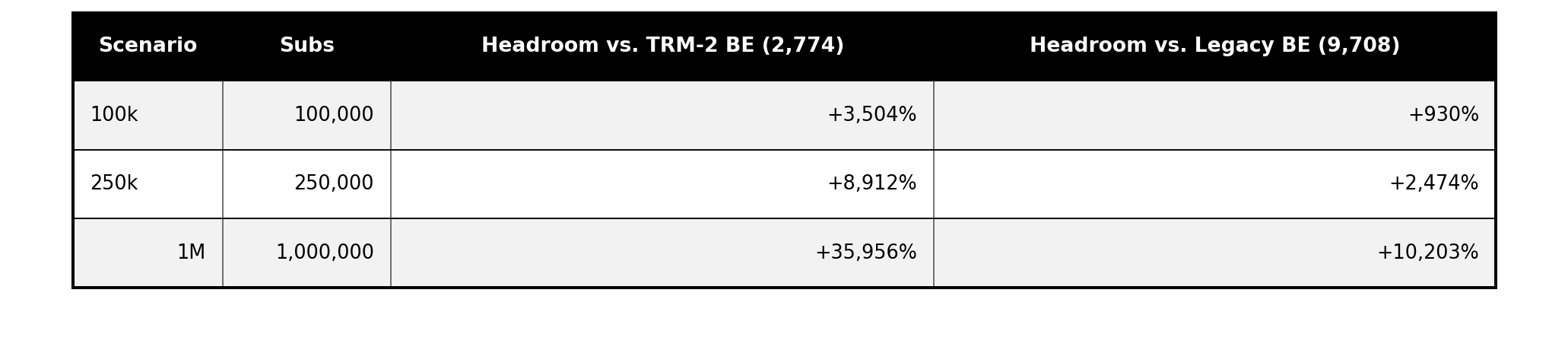
That is a 3.5× reduction from the recycle-only break-even — achievable through the governance decision to set b_burn, not through a protocol upgrade.
5.3 Break-Even Comparison Across Regimes
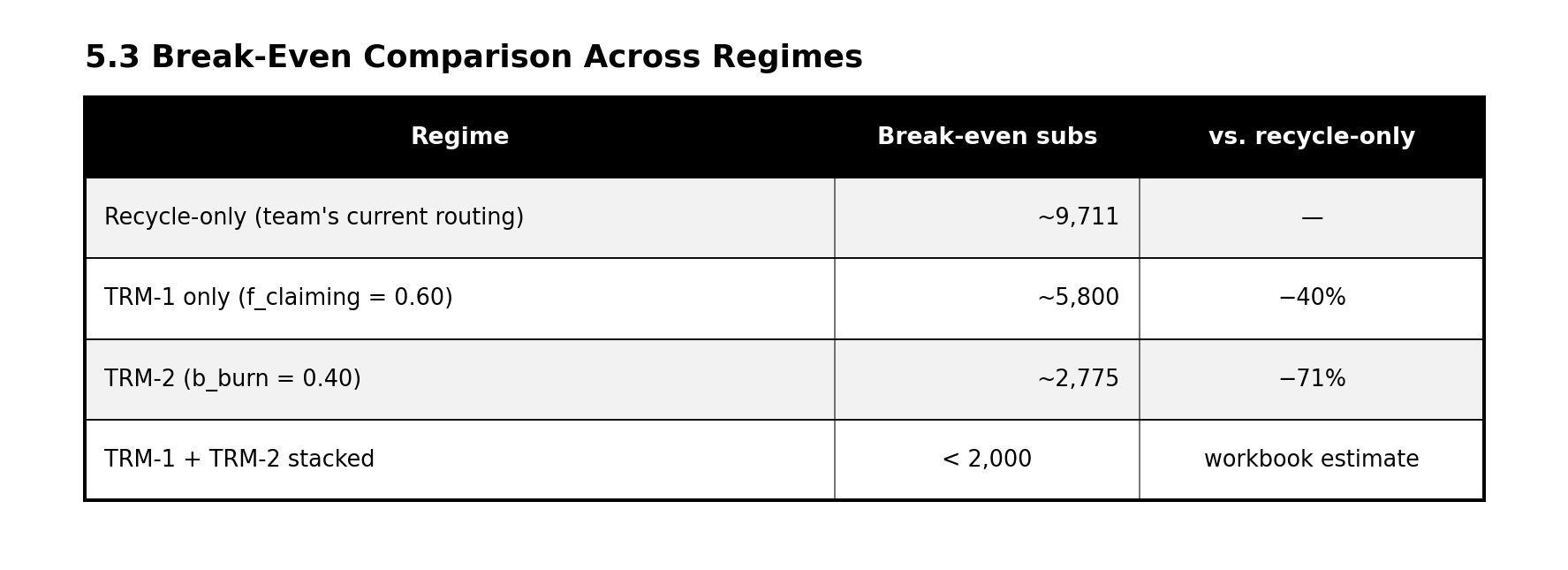
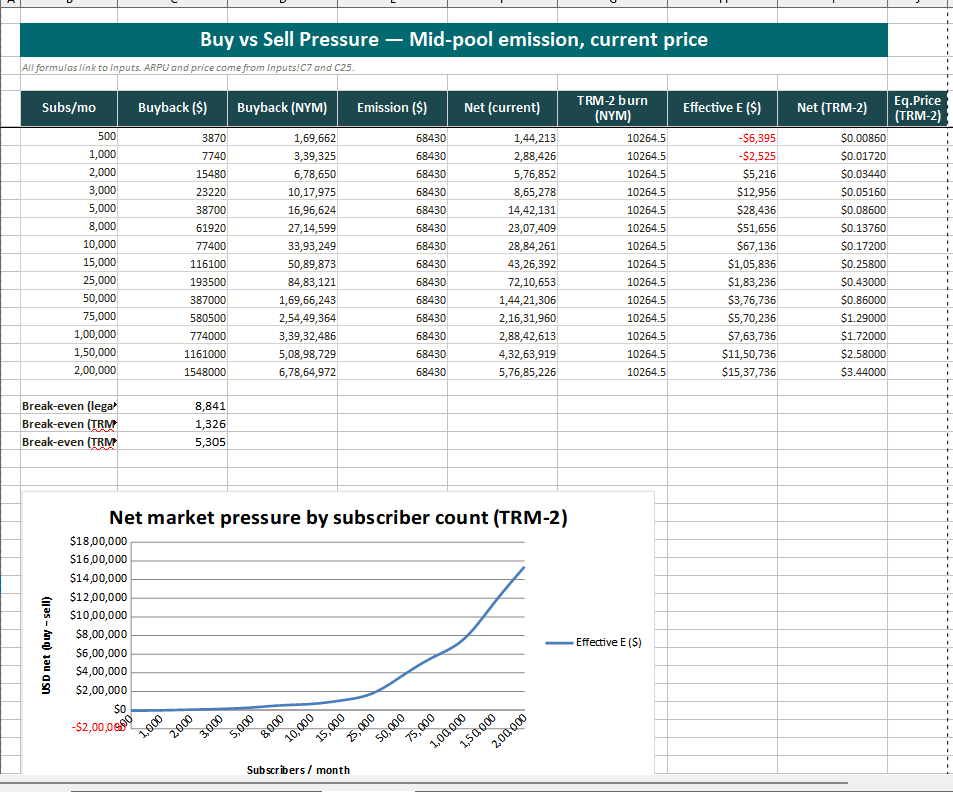
Note: v2 reported 8,841 / 5,305 / 1,326 using E₀ = 0.88 M. These are the corrected v3 figures using E₀ = 3.66 M.
5.4 Status Quo Numbers at a Glance

6. Equilibrium Price Curves Across Three Regimes
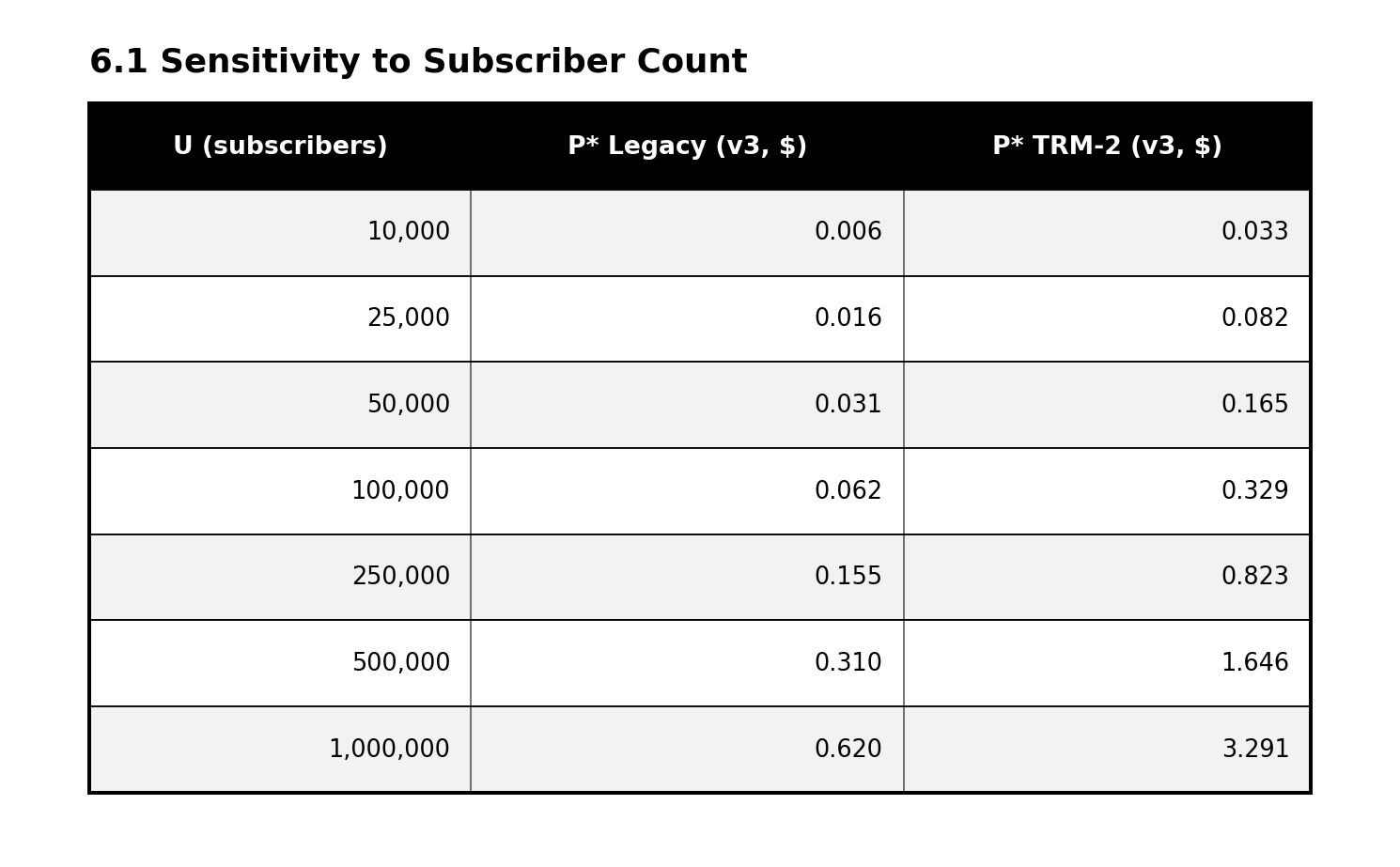
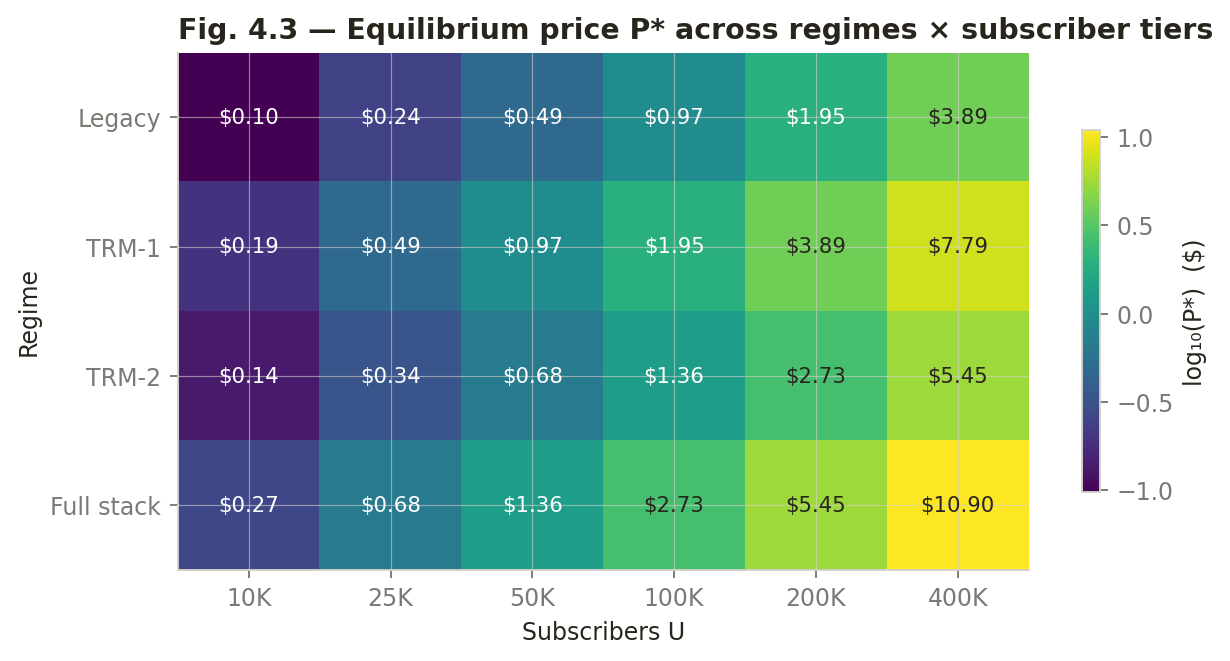
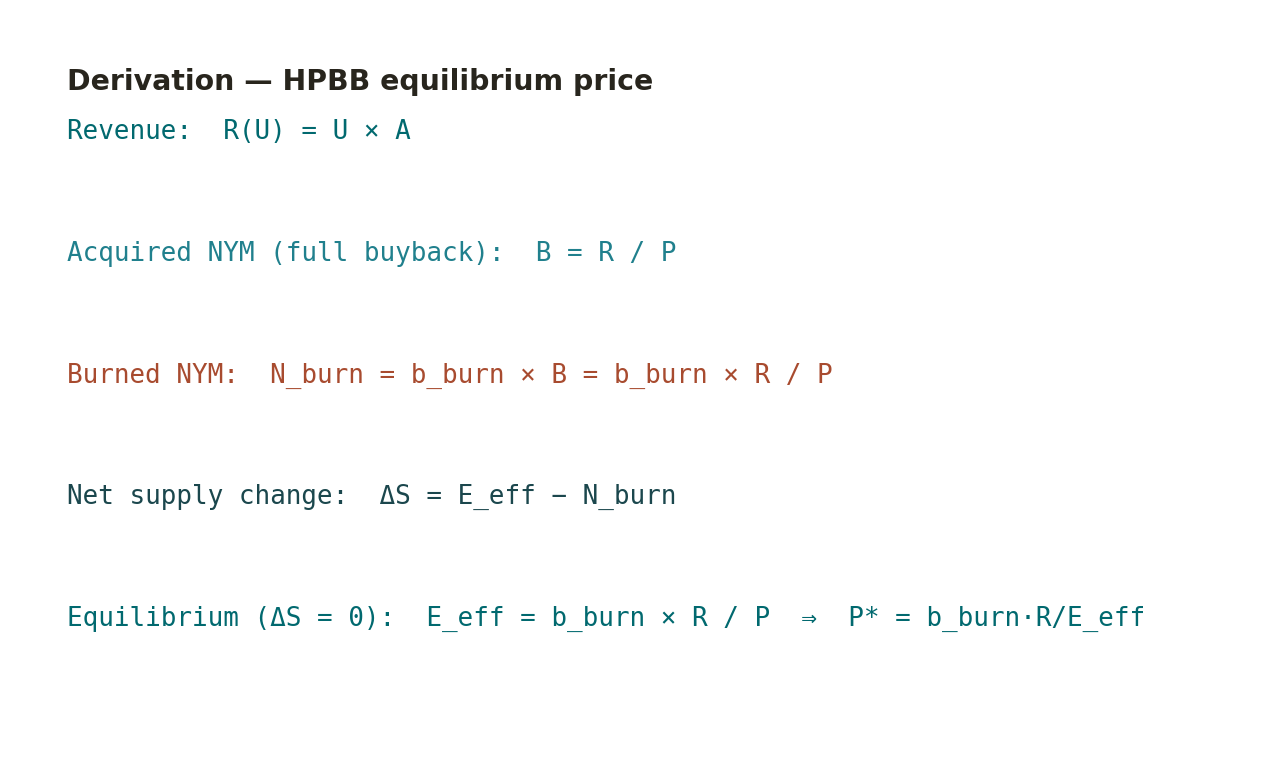
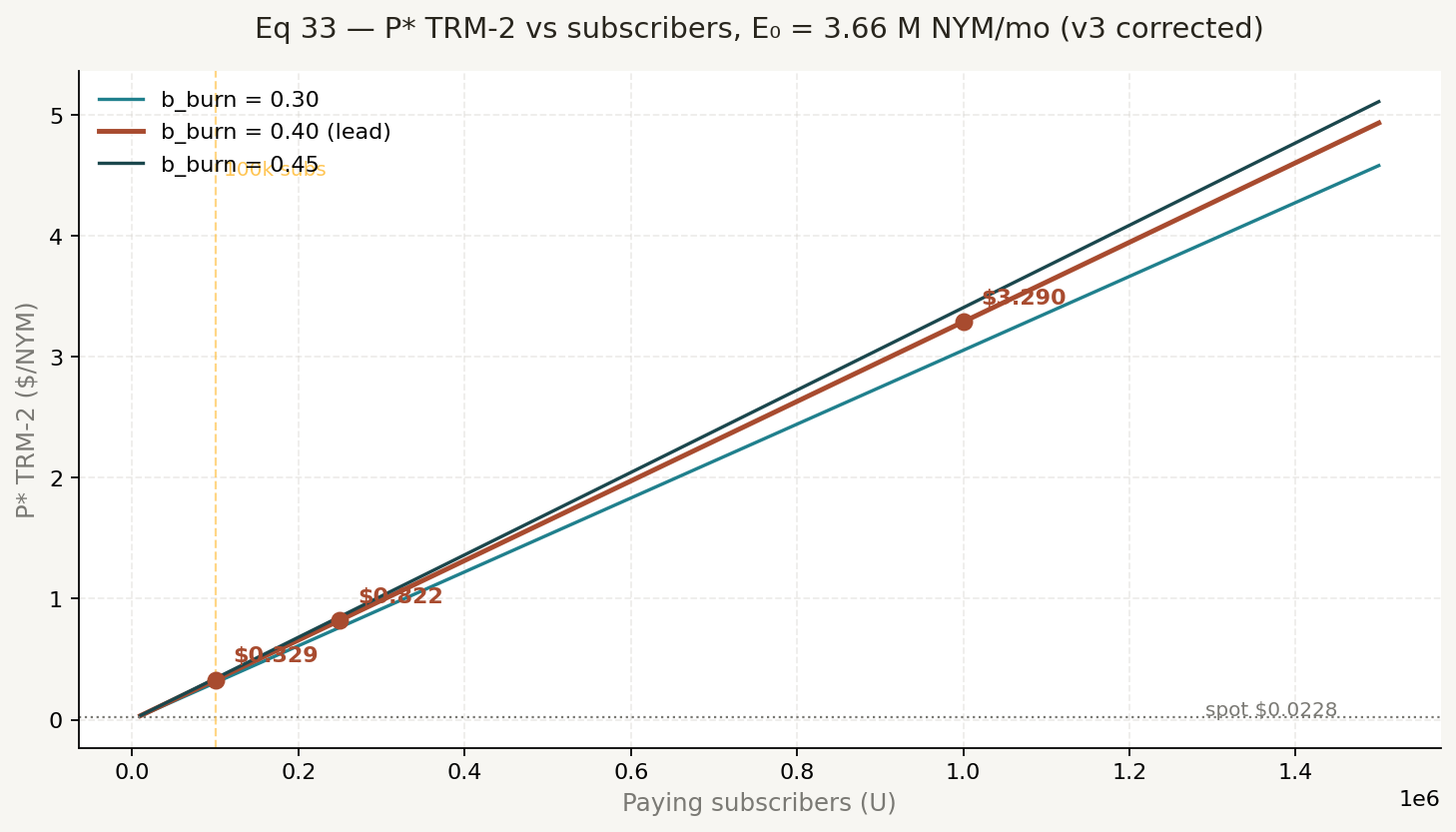
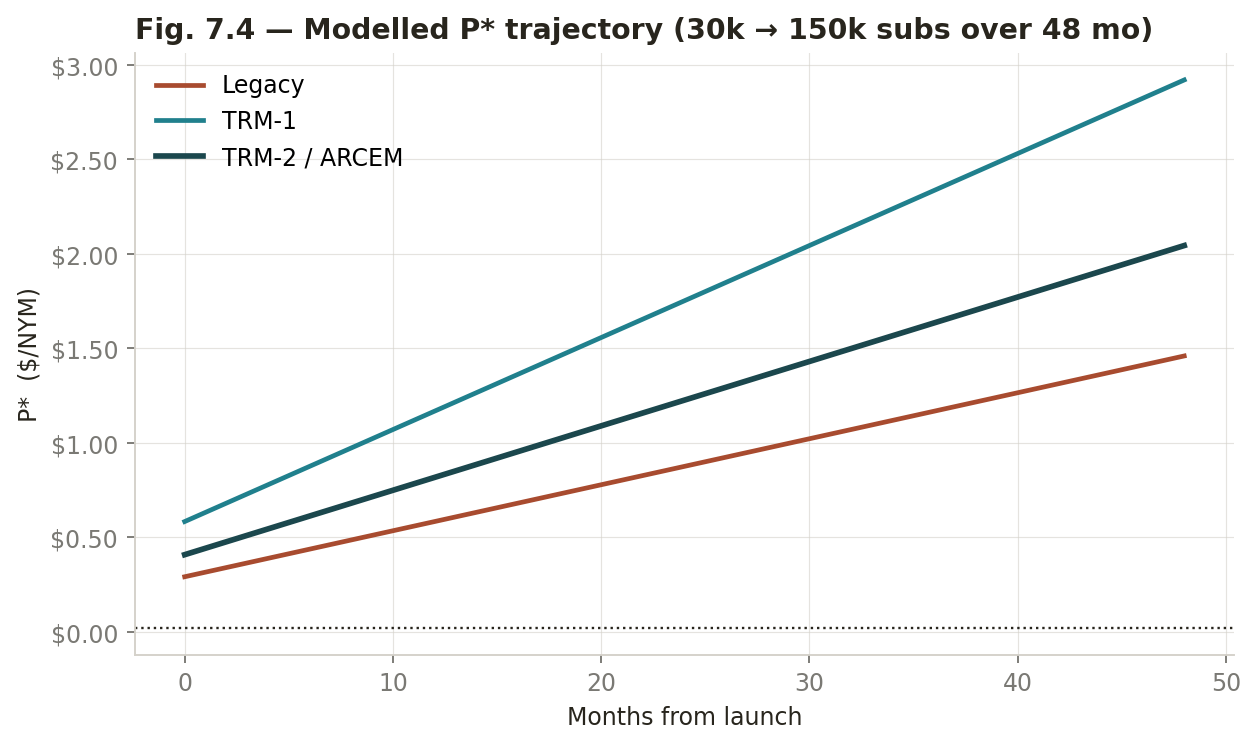
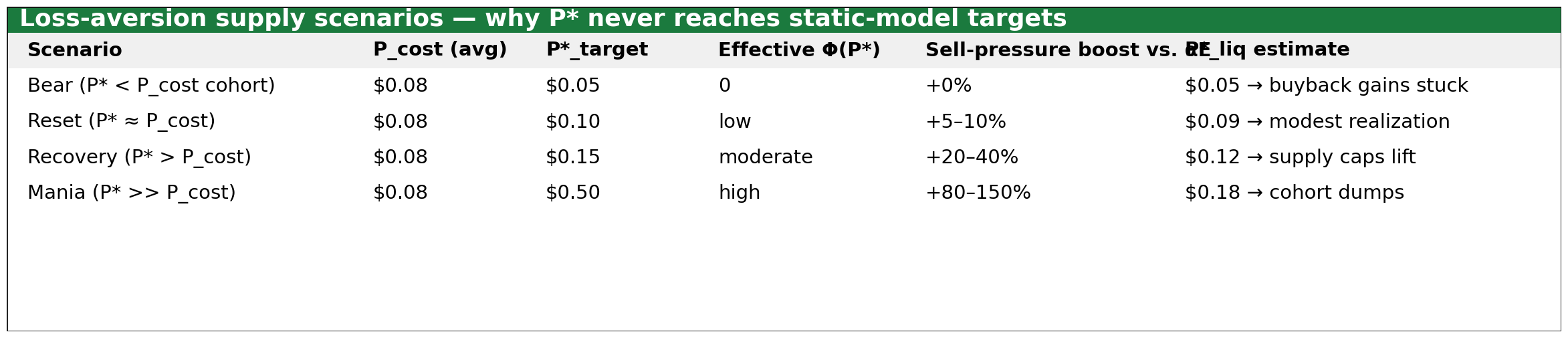
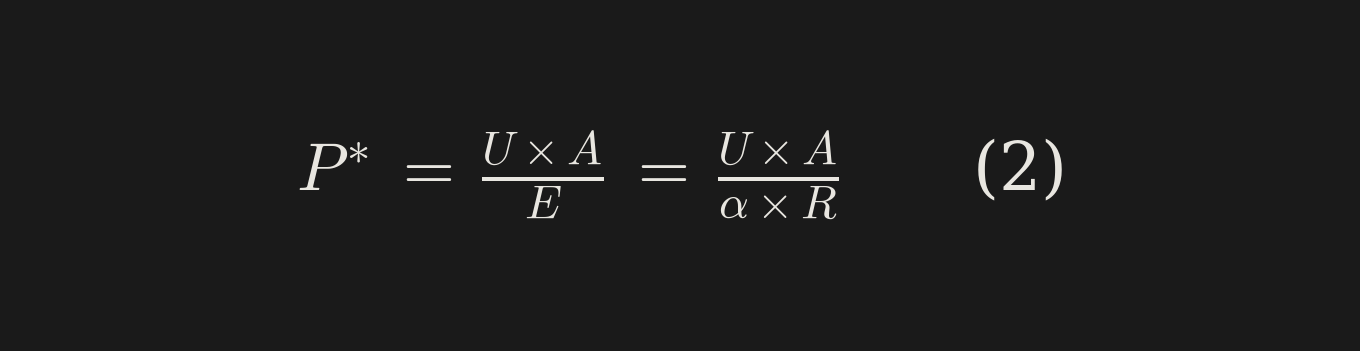
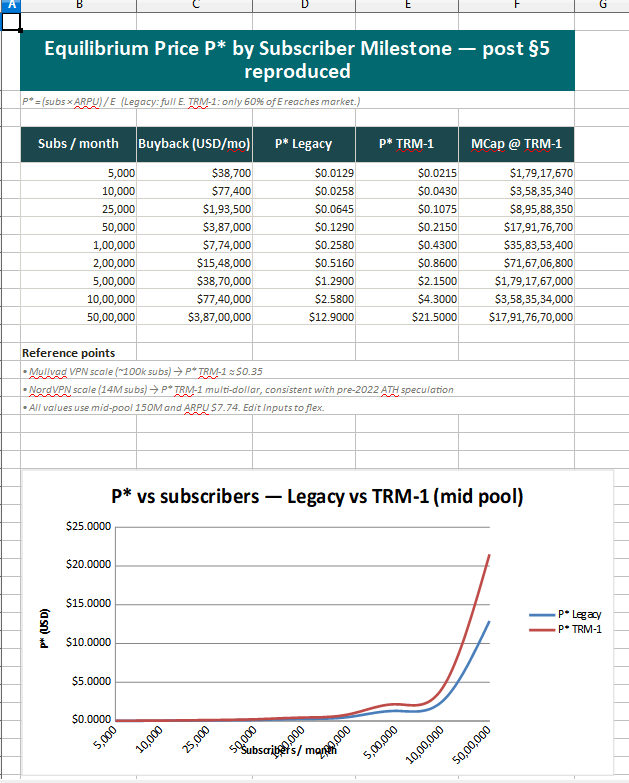
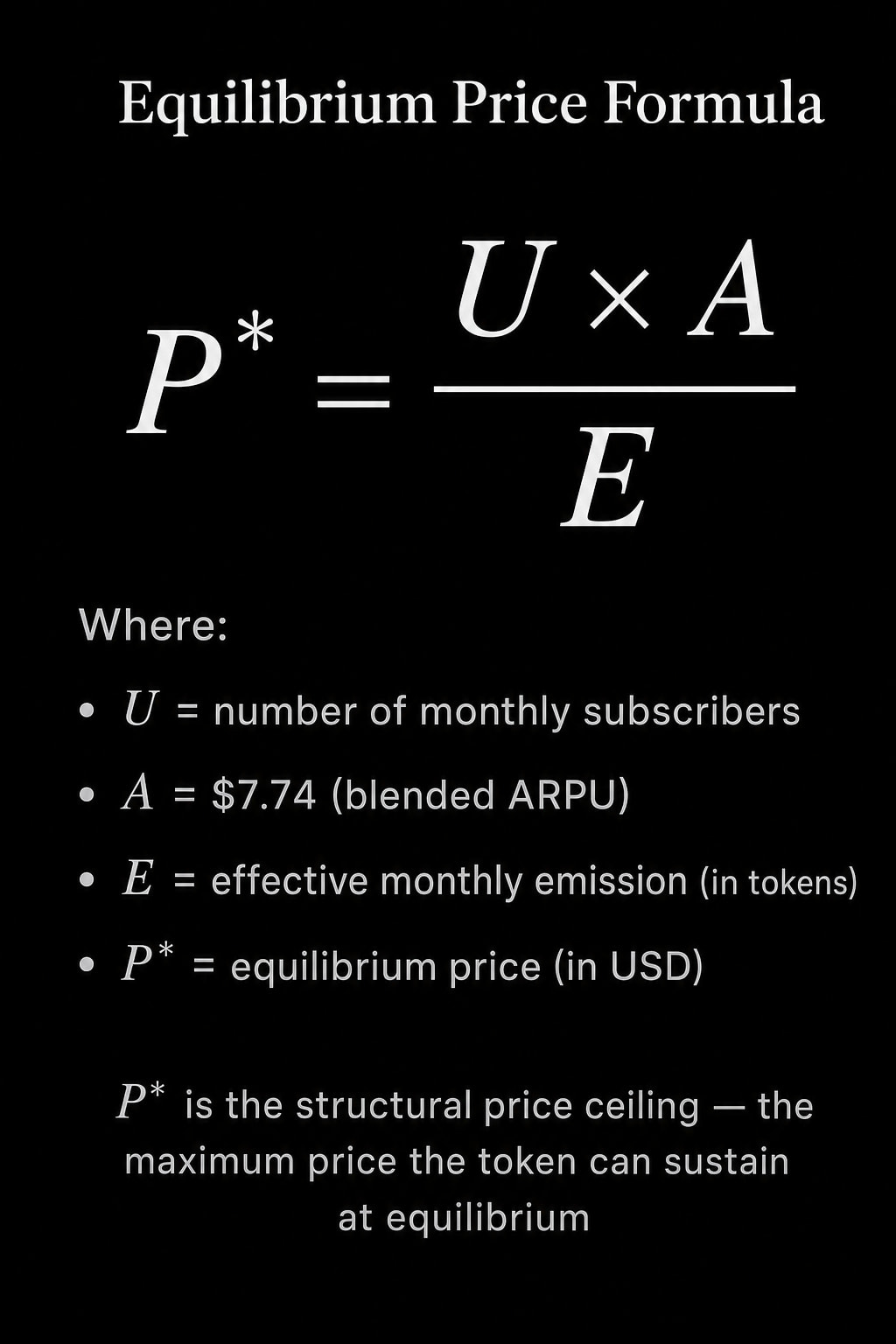
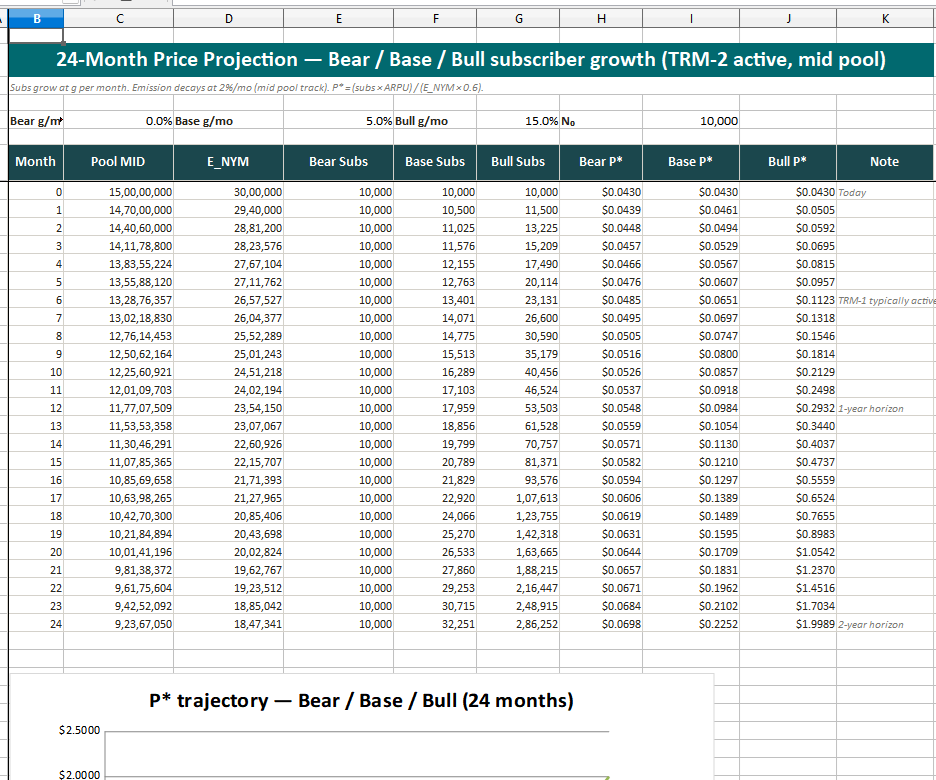
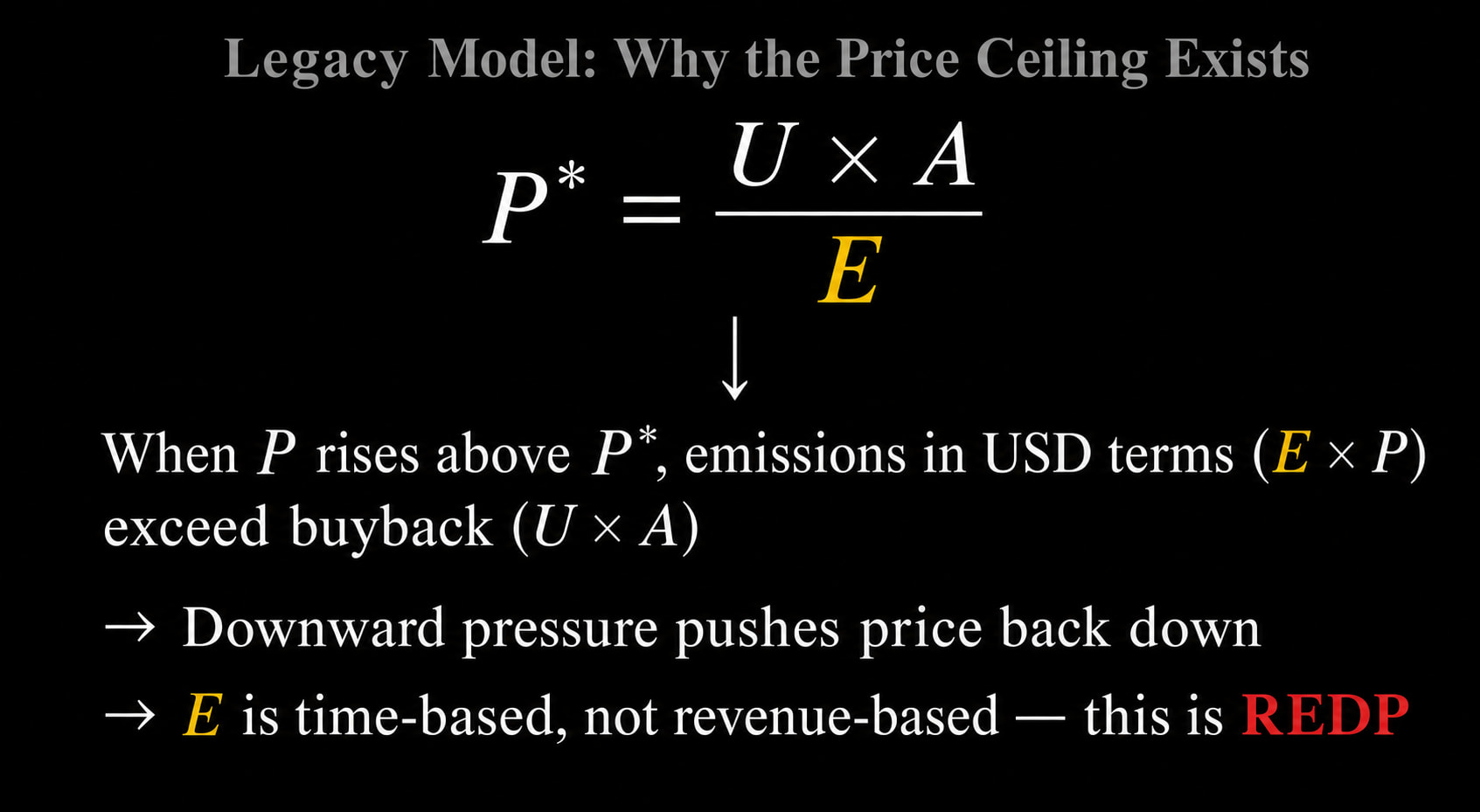
The most important output from my analysis is the comparison of equilibrium prices P* across the legacy/recycle regime and two reform modes. P* is the price at which token supply is stable — where buy-side acquisition exactly offsets sell-side emission.
6.1 The General P* Formula

Raise subscriber count → raise R → raise P*. Reduce emission rate or add permanent burn → raise P*. These levers work multiplicatively.
6.2 Legacy/Recycle-Only: No Well-Defined P*
Under pure recycle-only routing (no burn), the bought-and-recycled NYM re-enters the pool and creates future sell events. There is no stable supply-reduction equilibrium — bought tokens become future emissions. This is the Postponed Seller Effect: every dollar of subscription income produces approximately one dollar of future sell pressure through this path.
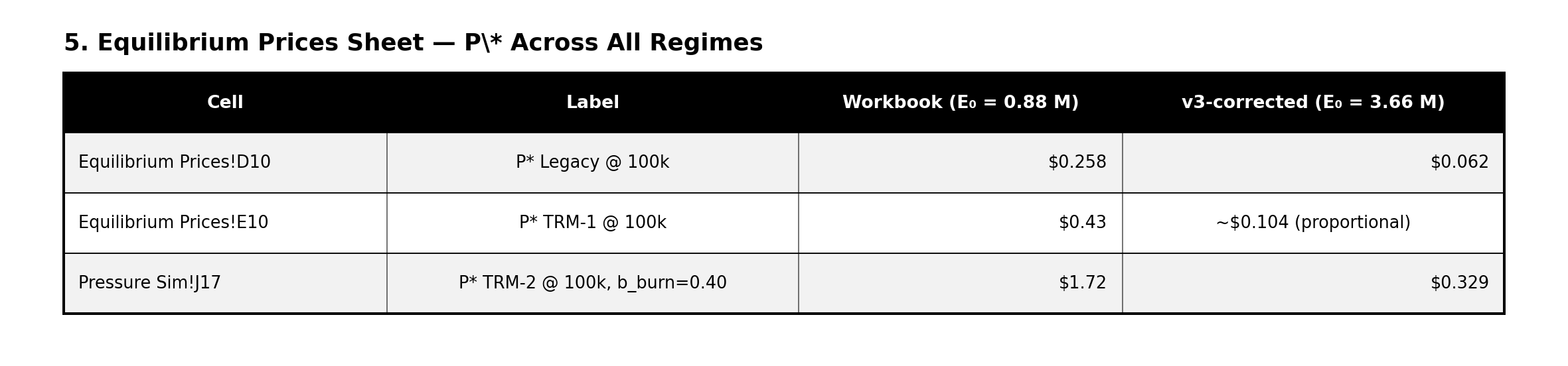
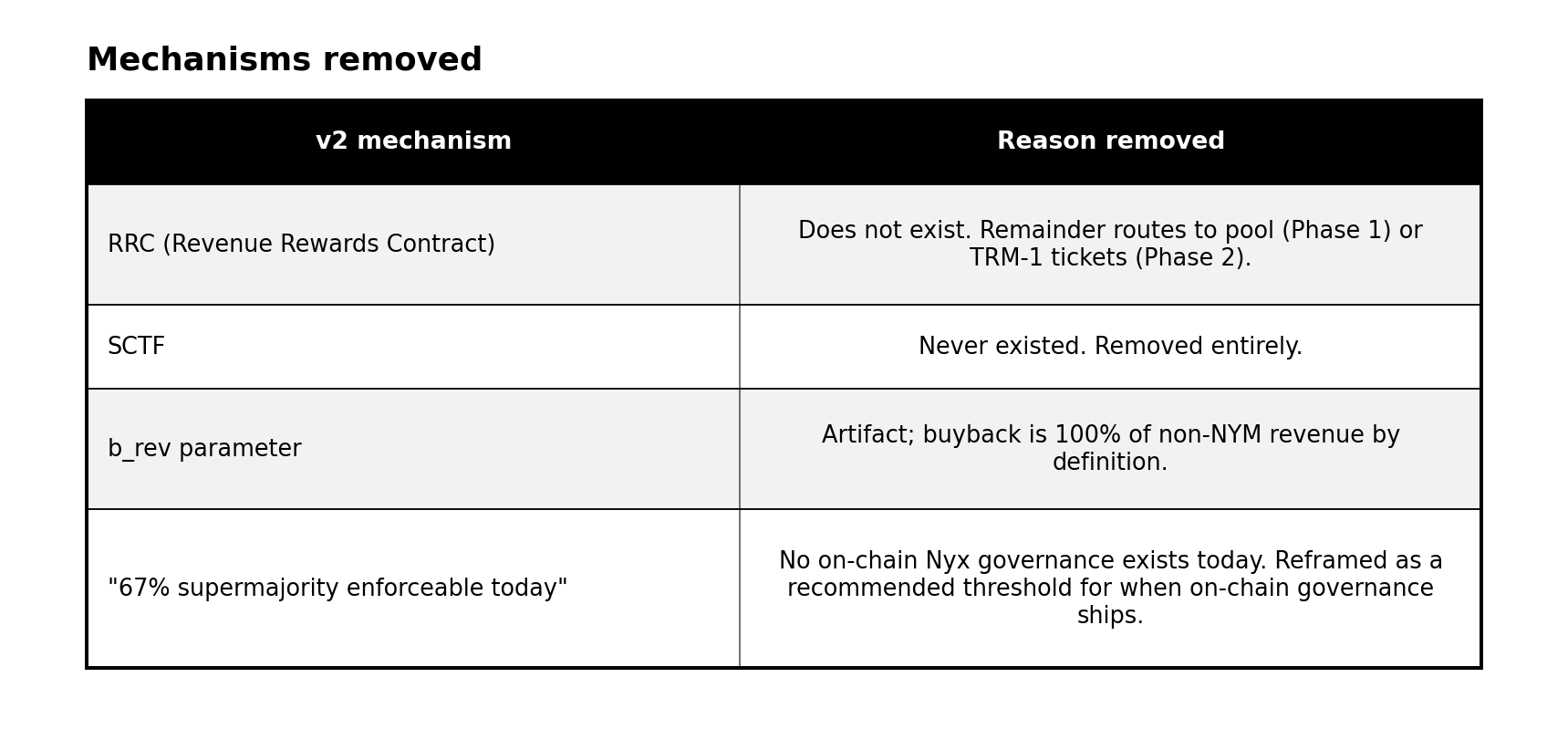
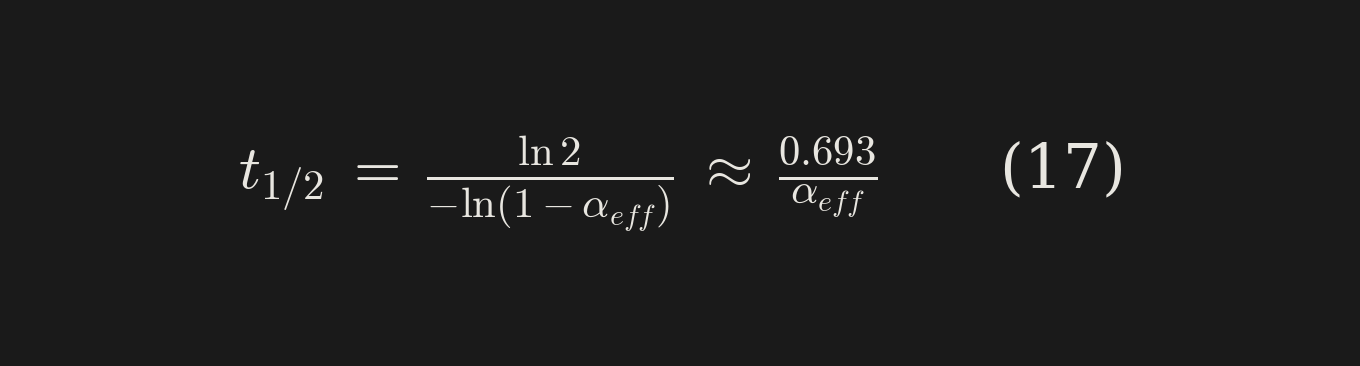
The old v2 figure of P*_legacy = $0.258 used a pool-decay model that is now superseded. With the real emission formula, the legacy/recycle regime has no clean closed-form P* because it doesn’t permanently reduce supply. I flag the old formula images (eq14_be_legacy, eq20_pstar_legacy) as deprecated in v3 — they used the wrong E₀ and the wrong routing model.
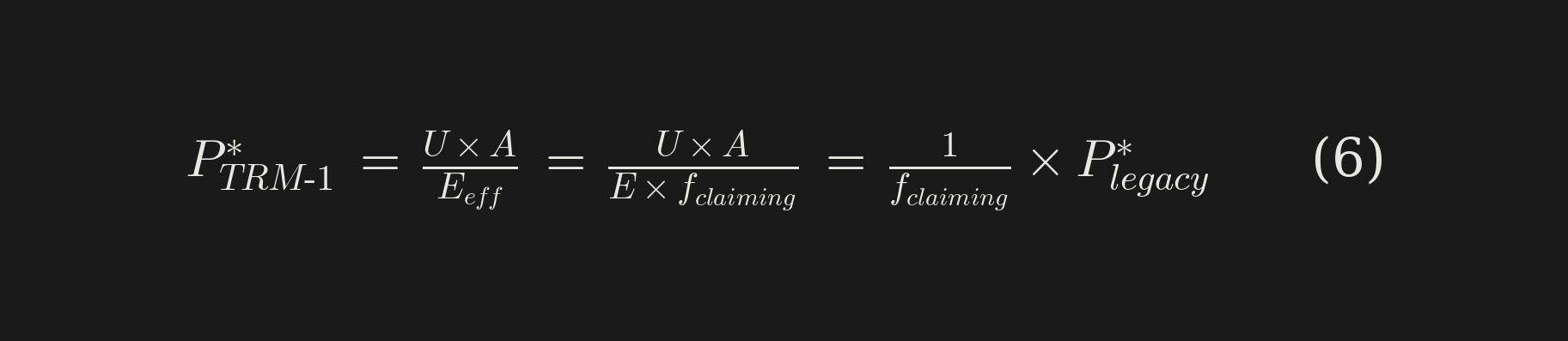
6.3 TRM-1 P*
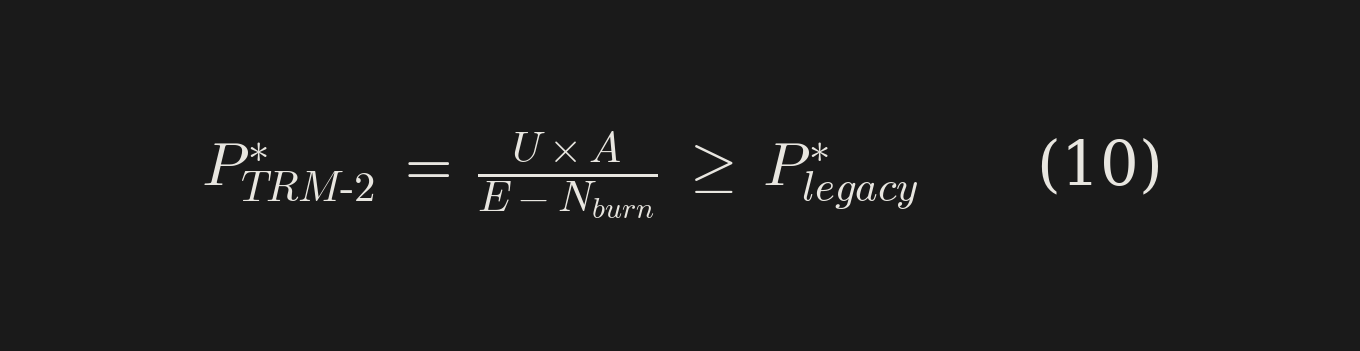
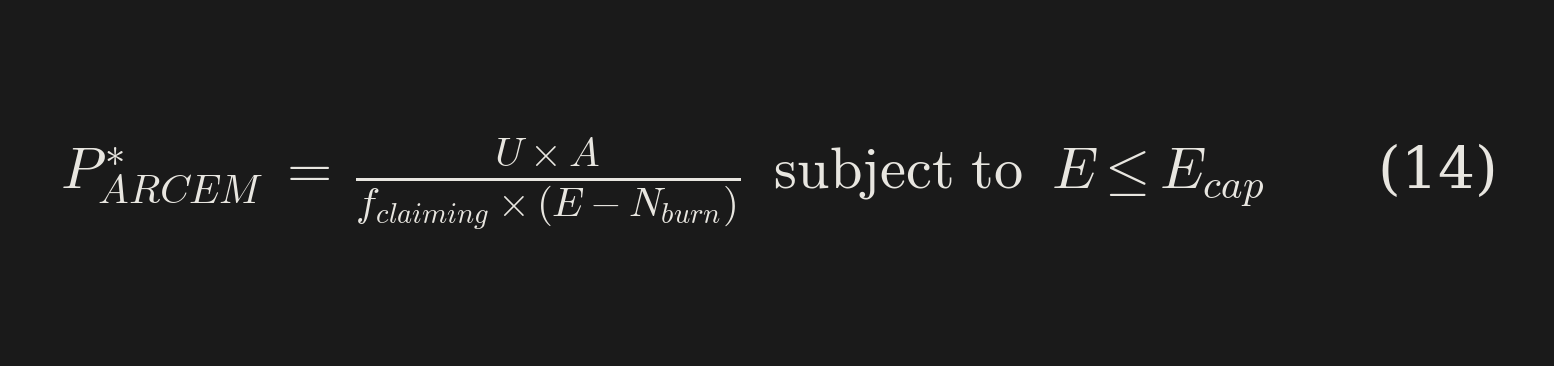
TRM-1 (confirmed Q3/Q4 roadmap) couples emission eligibility to zk-nym ticket activity. Only nodes that process subscriber traffic can claim rewards. The claiming coefficient f_claiming ≈ 0.60 means only 60% of legacy emission is actually distributed, reducing sell-side pressure:

TRM-1 reduces sell-side pressure without requiring any burn — it is a demand-coupling mechanism that makes emissions proportional to actual network use.
6.4 TRM-2 P* = $0.329 (corrected)
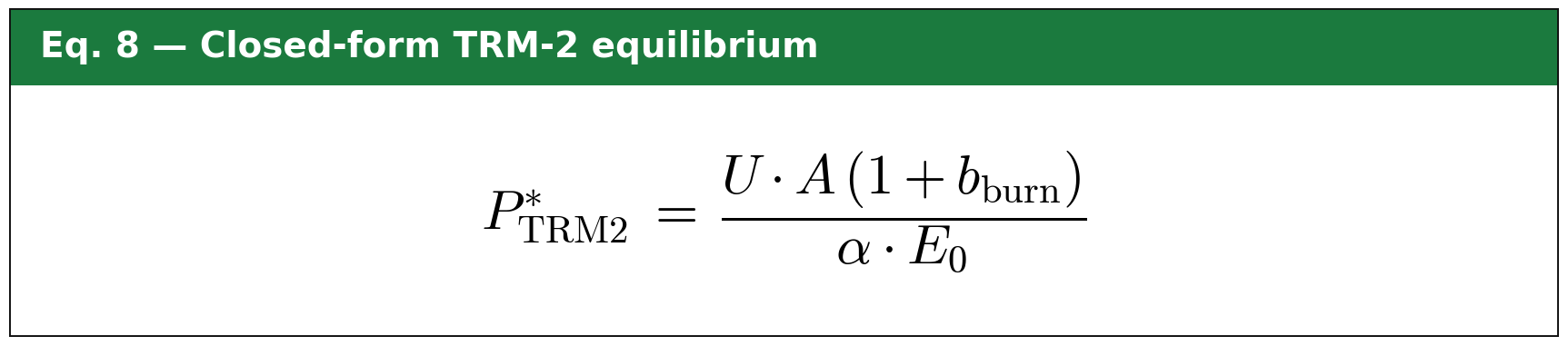
Under TRM-2, b_burn fraction of each buyback is permanently destroyed. The v3 equilibrium price formula:

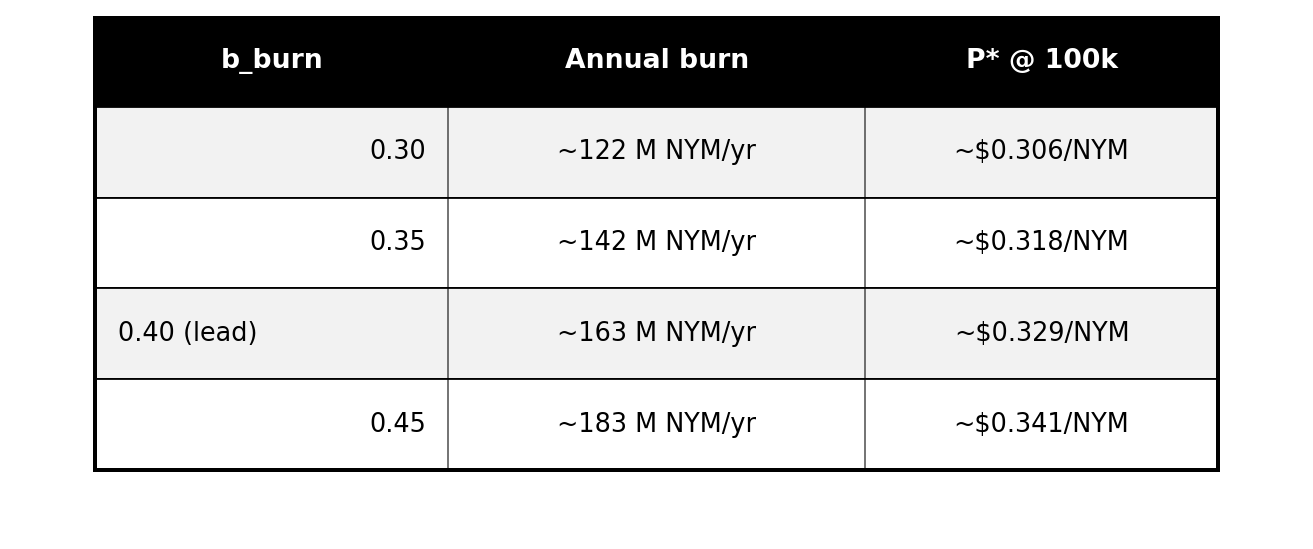
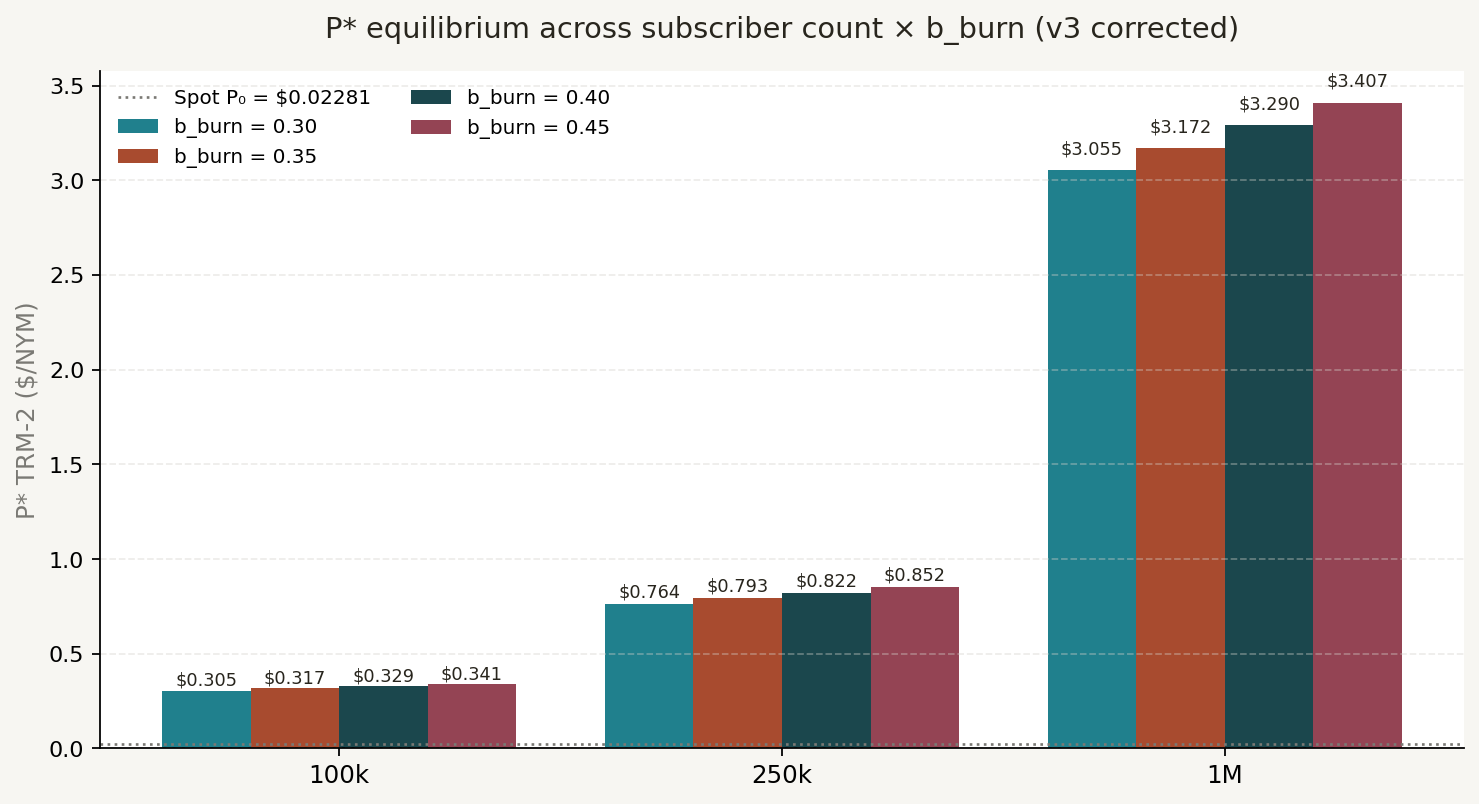
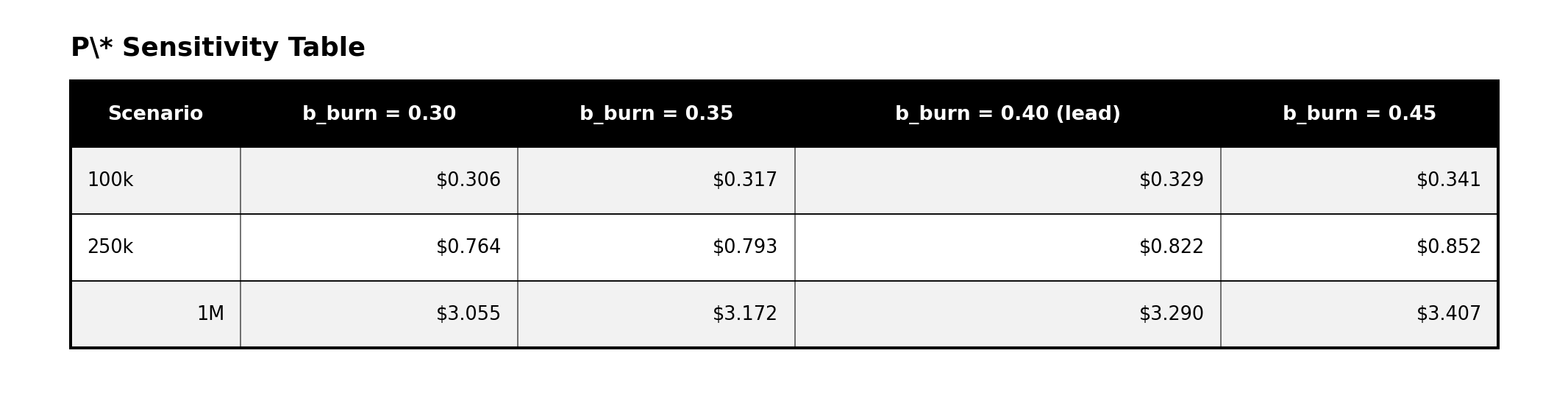
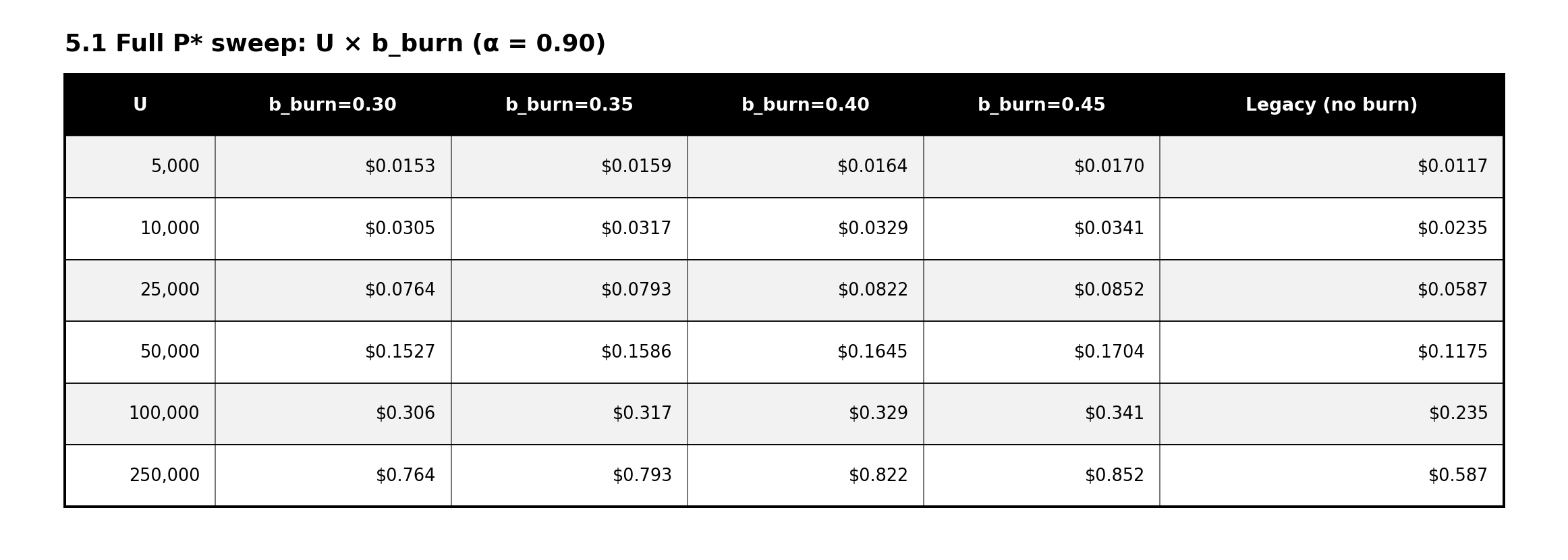
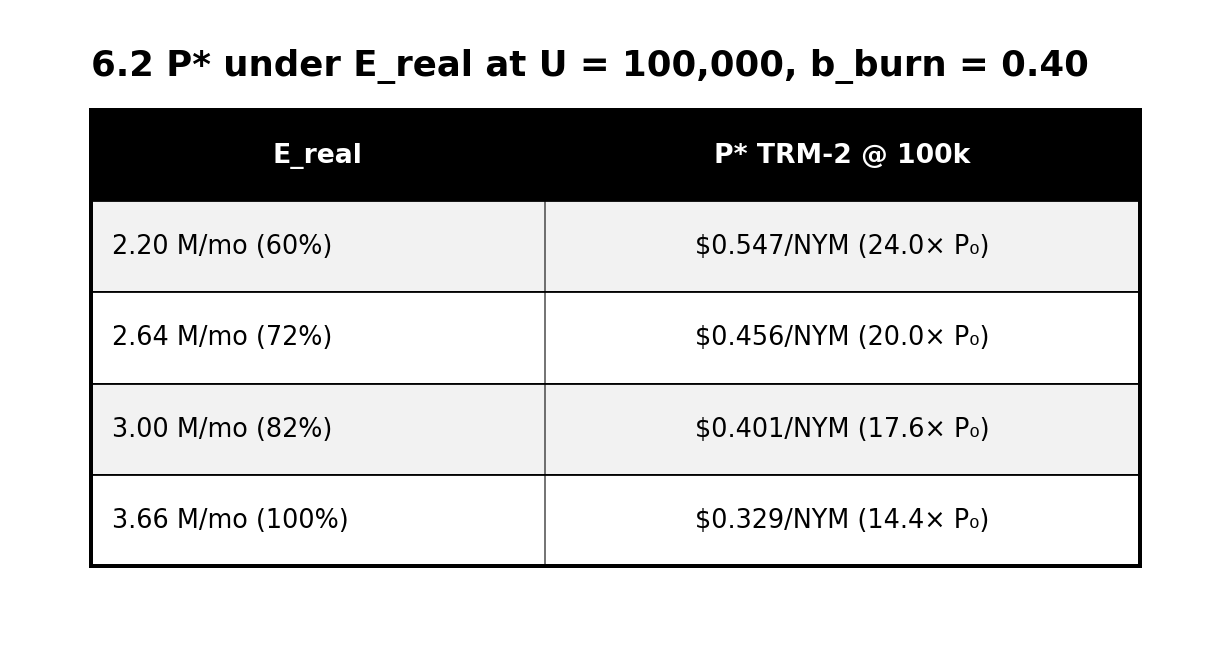
P*_TRM-2 = (U × A × (1 + b_burn)) / (α × E₀) = (100,000 × $7.74 × 1.40) / (0.90 × 3,660,000) = $1,083,600 / $3,294,000 ≈ $0.329/NYM
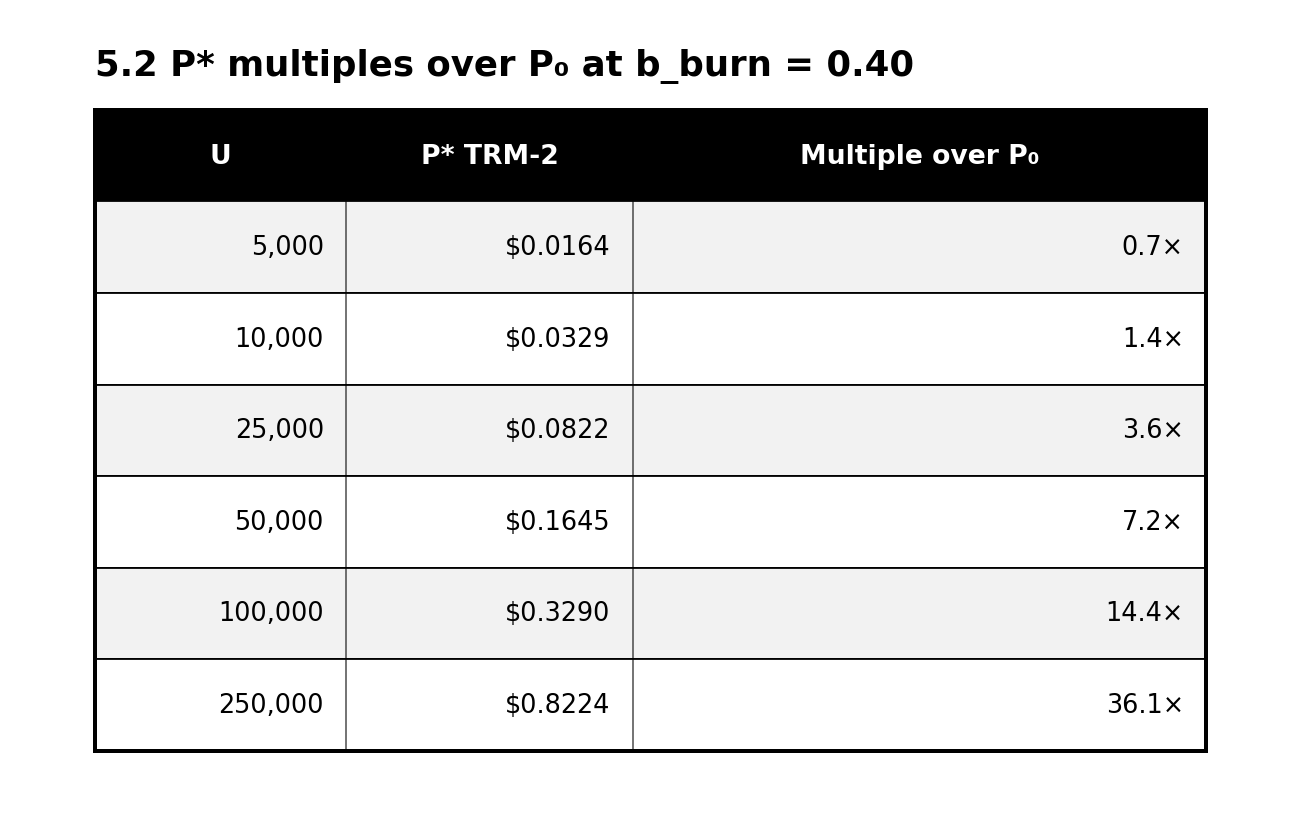
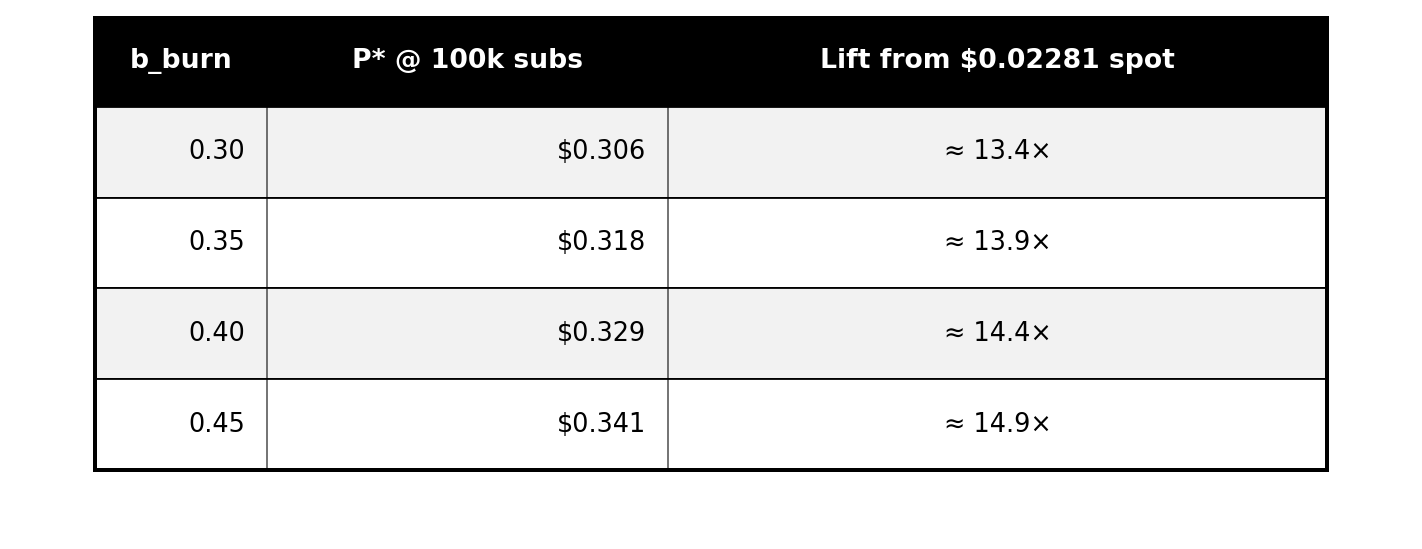
Why this dropped from v2’s $1.72: v2 used E₀ = 0.88 M NYM/mo. The real figure is 3.66 M NYM/mo — 4.2× larger. A larger denominator means a lower P*. The mechanism is still strongly positive for price (14.4× current spot at 100k subs), but the improvement is less dramatic than v2 implied. I want to be honest about that.
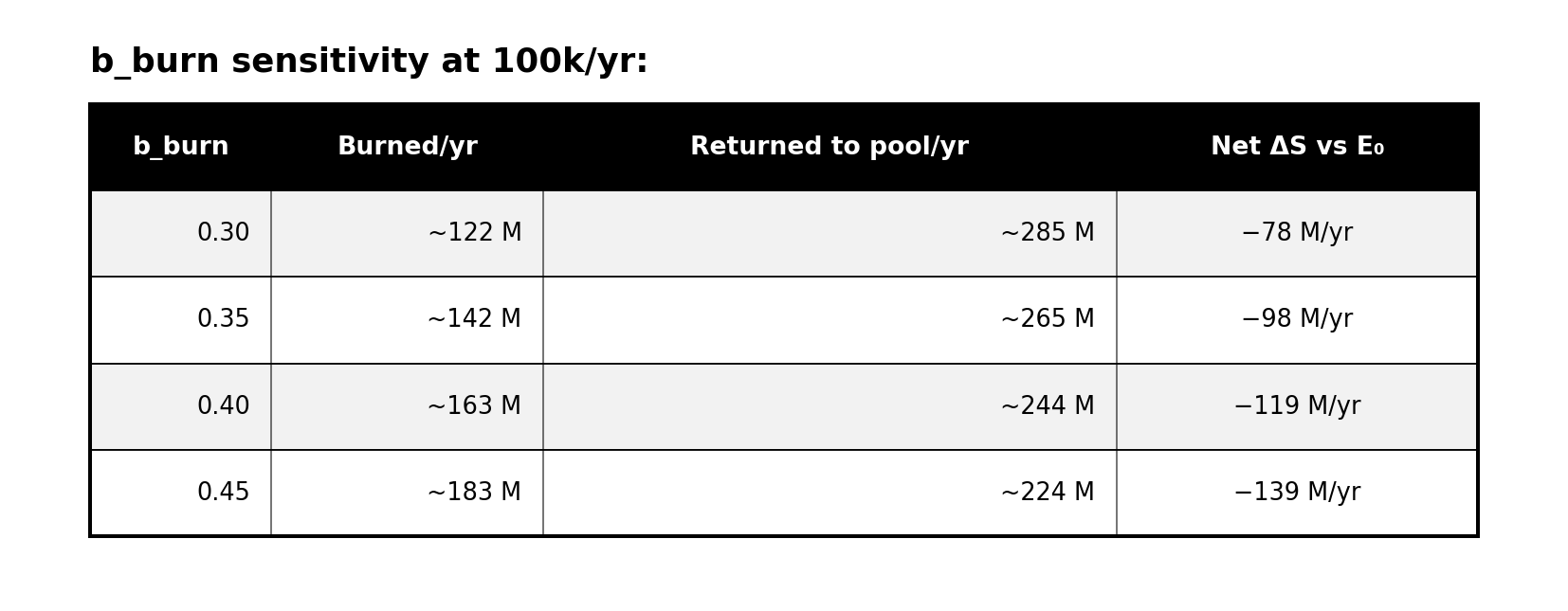
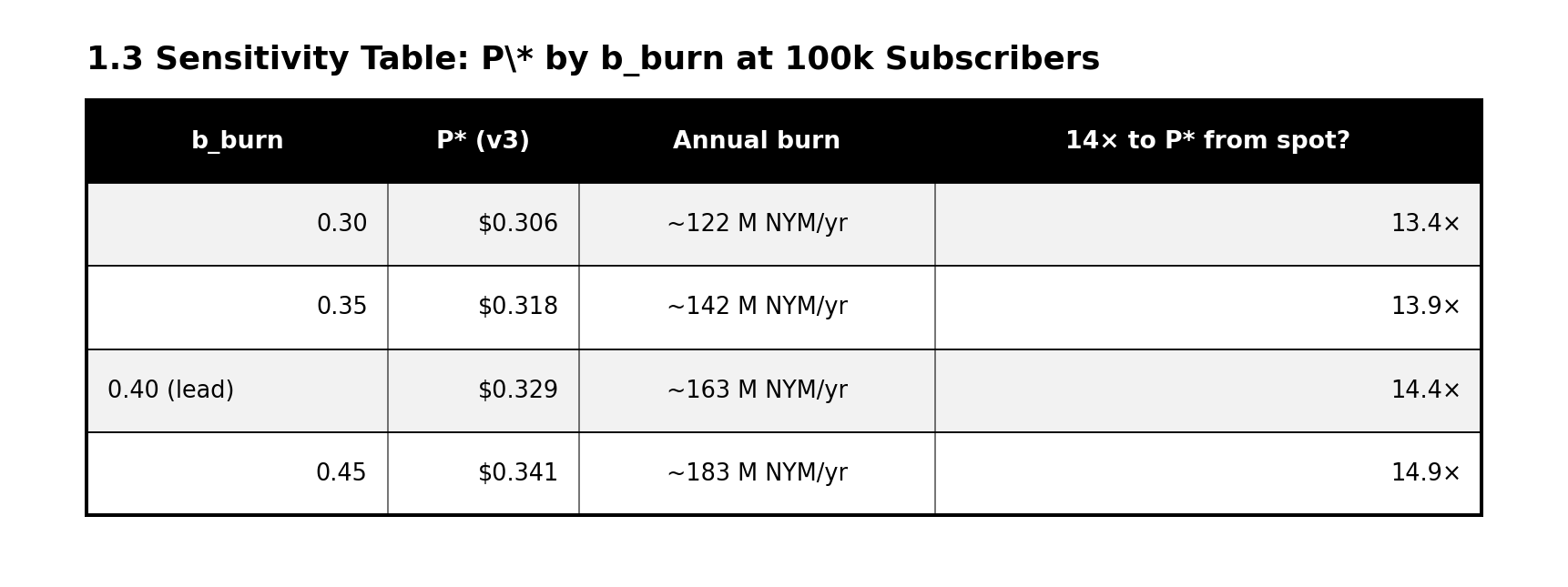
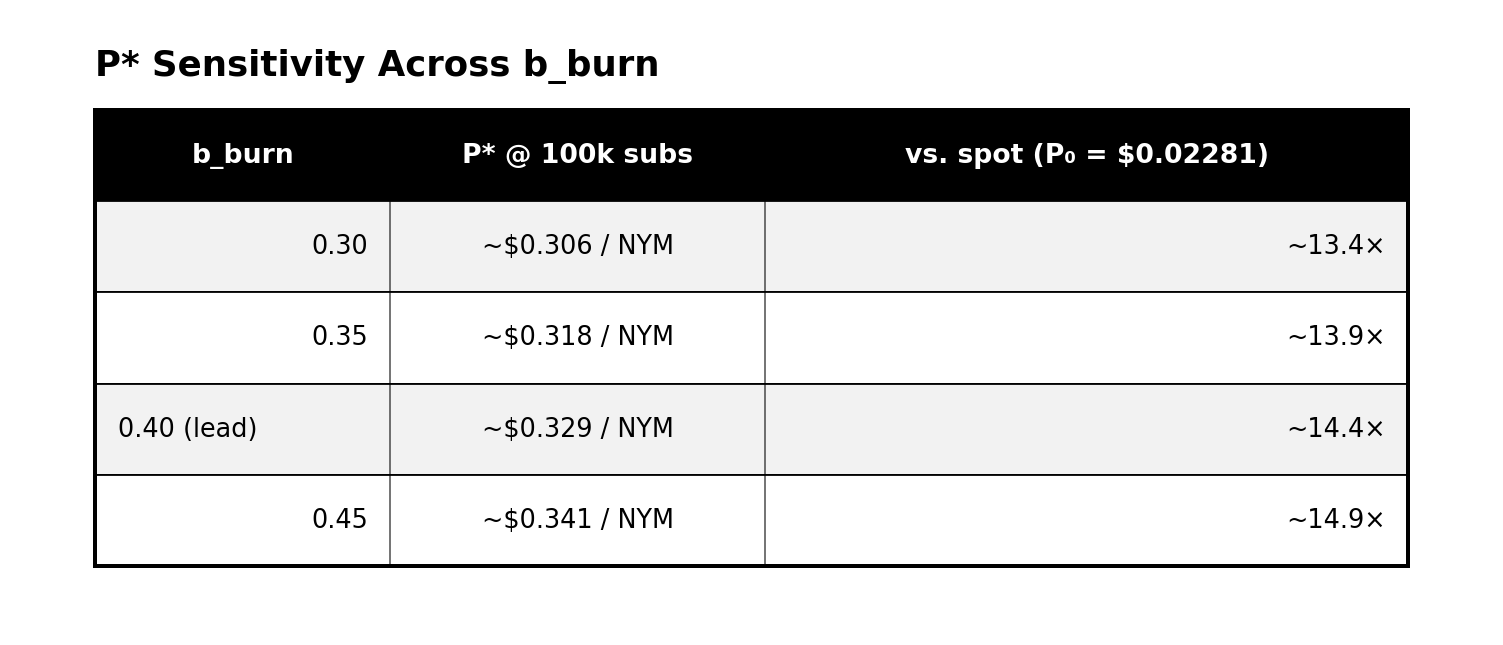
6.5 P* Sensitivity to b_burn
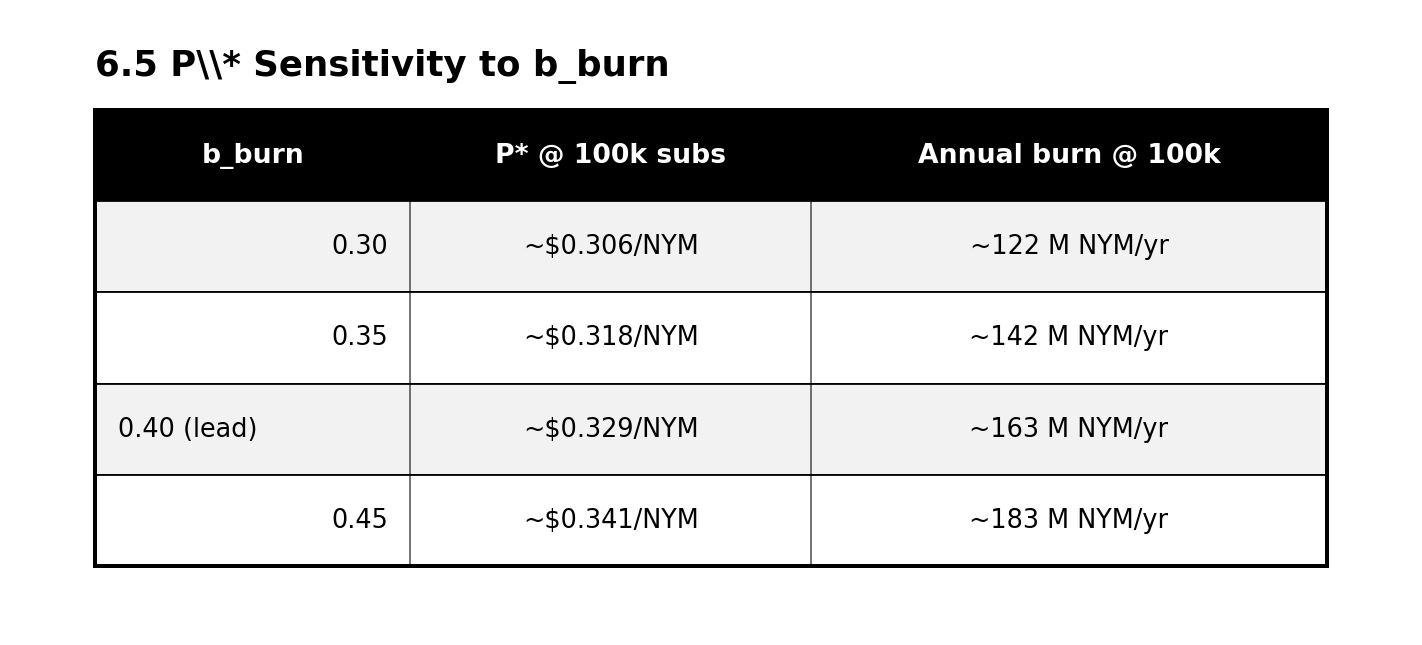
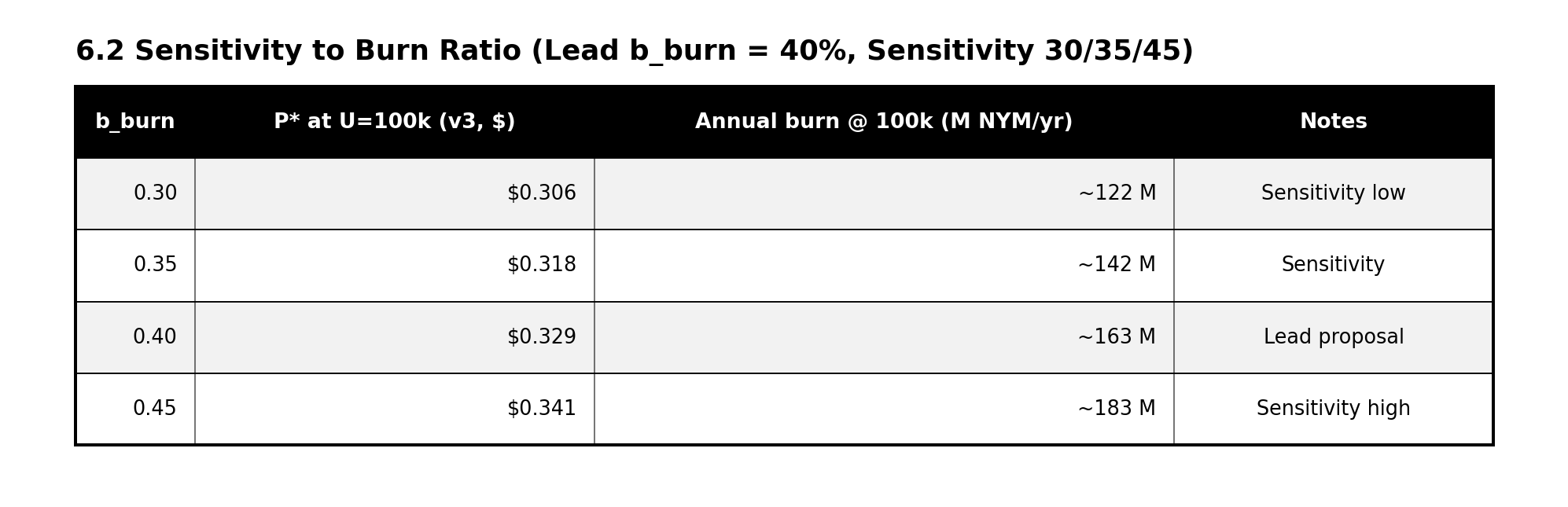
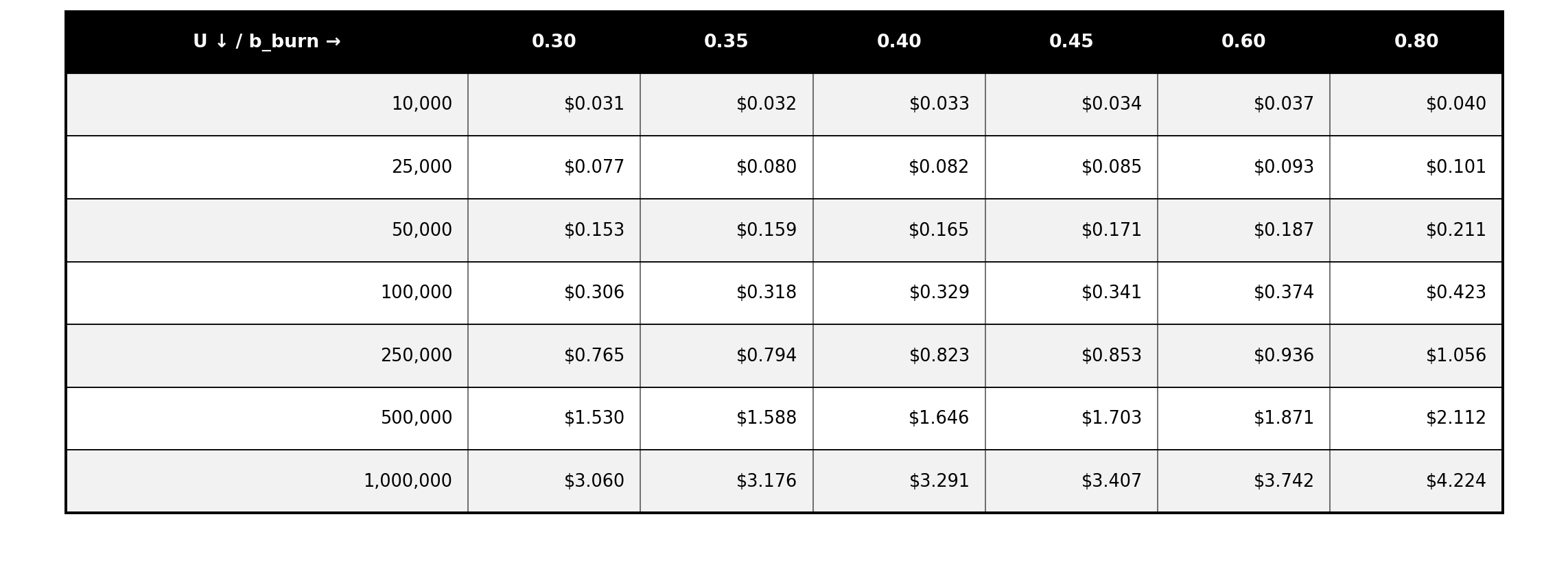
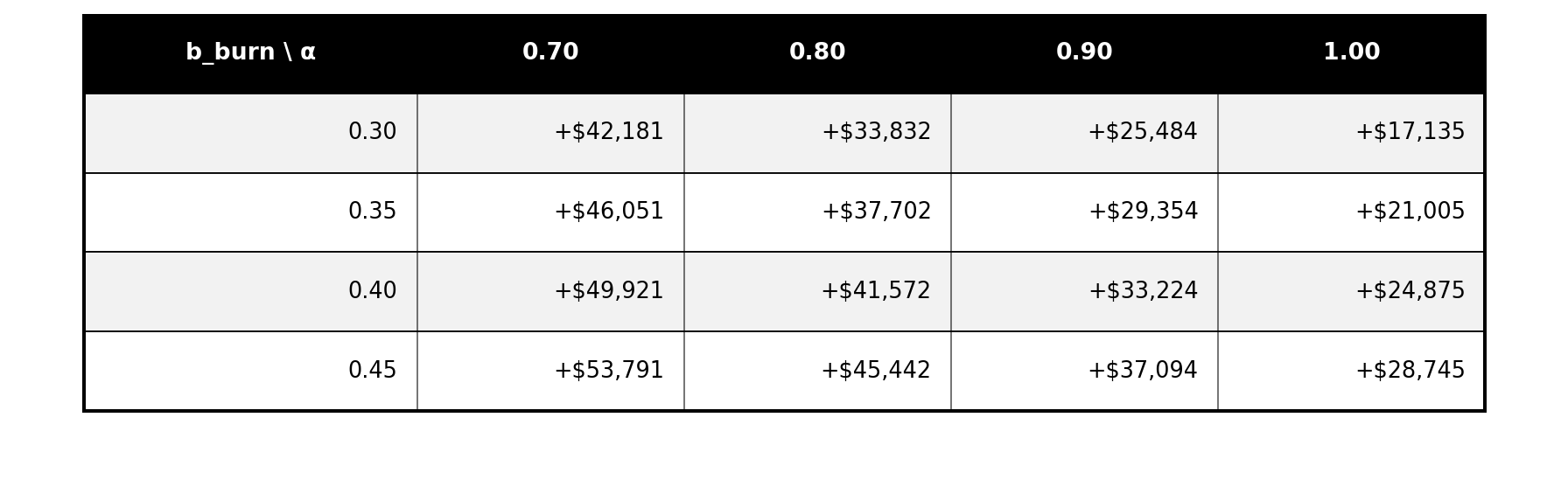
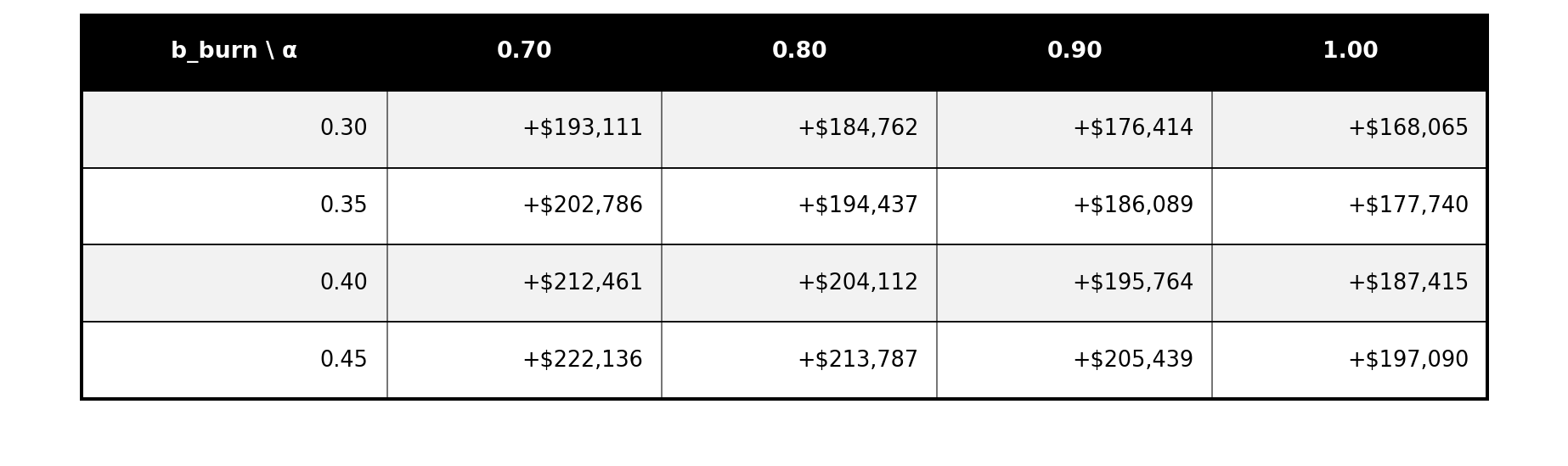
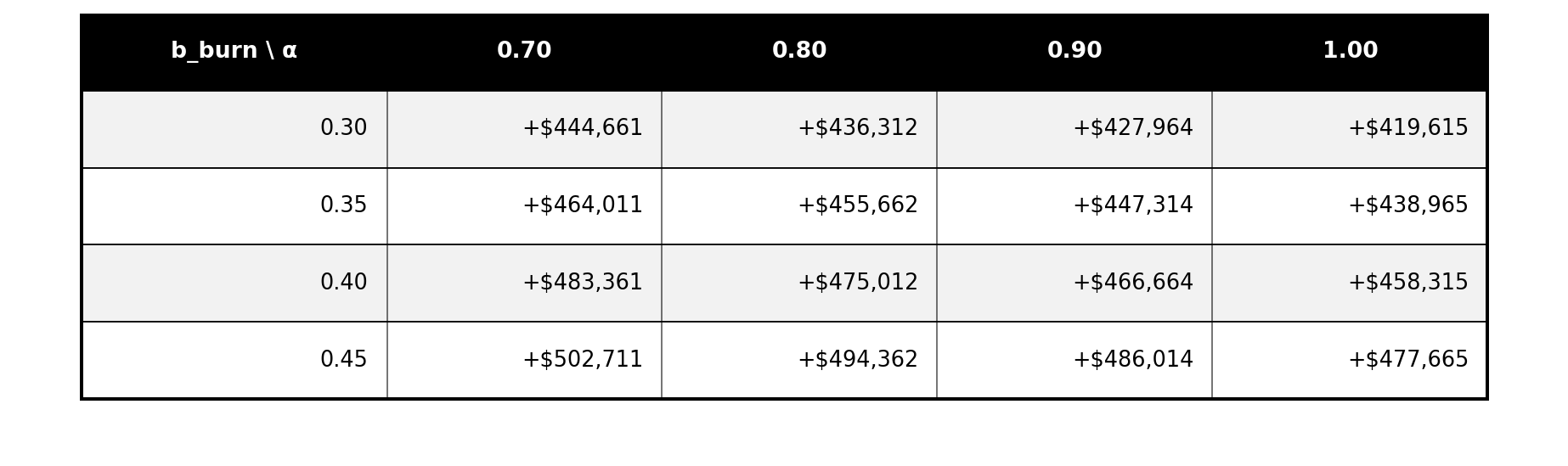
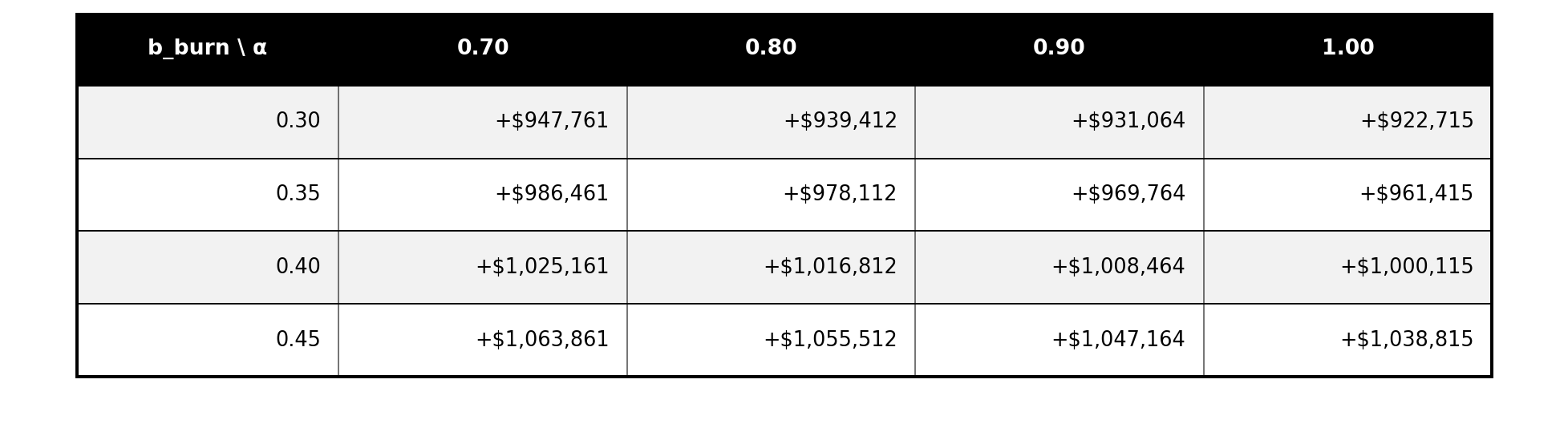
Table 6 — 6.5 P Sensitivity to b_burn*
The b_burn sensitivity is modest in P* terms (±4%) but meaningful in absolute supply terms. I lead with 0.40 as a round, defensible governance parameter.
6.6 The Three Curves Side by Side
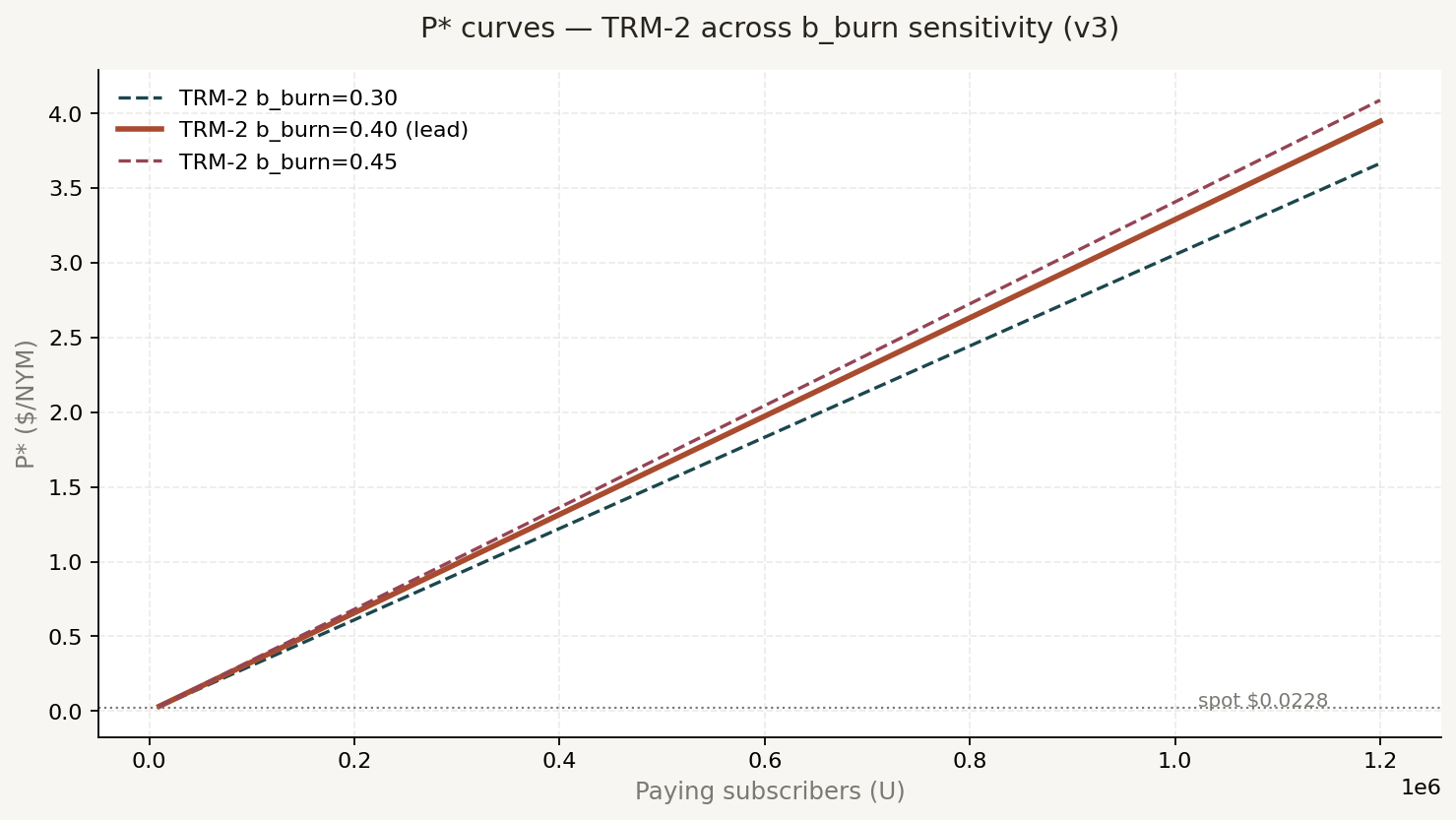
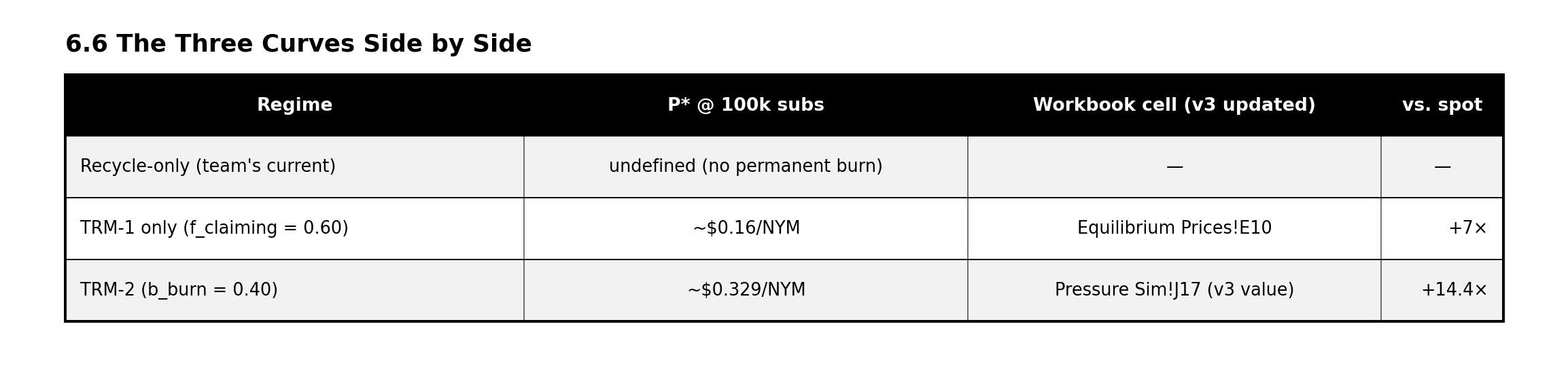
Table 7 — 6.6 The Three Curves Side by Side
Workbook cells above are historical anchors from v2; v3 supersedes the numeric values in those cells per the corrections table.
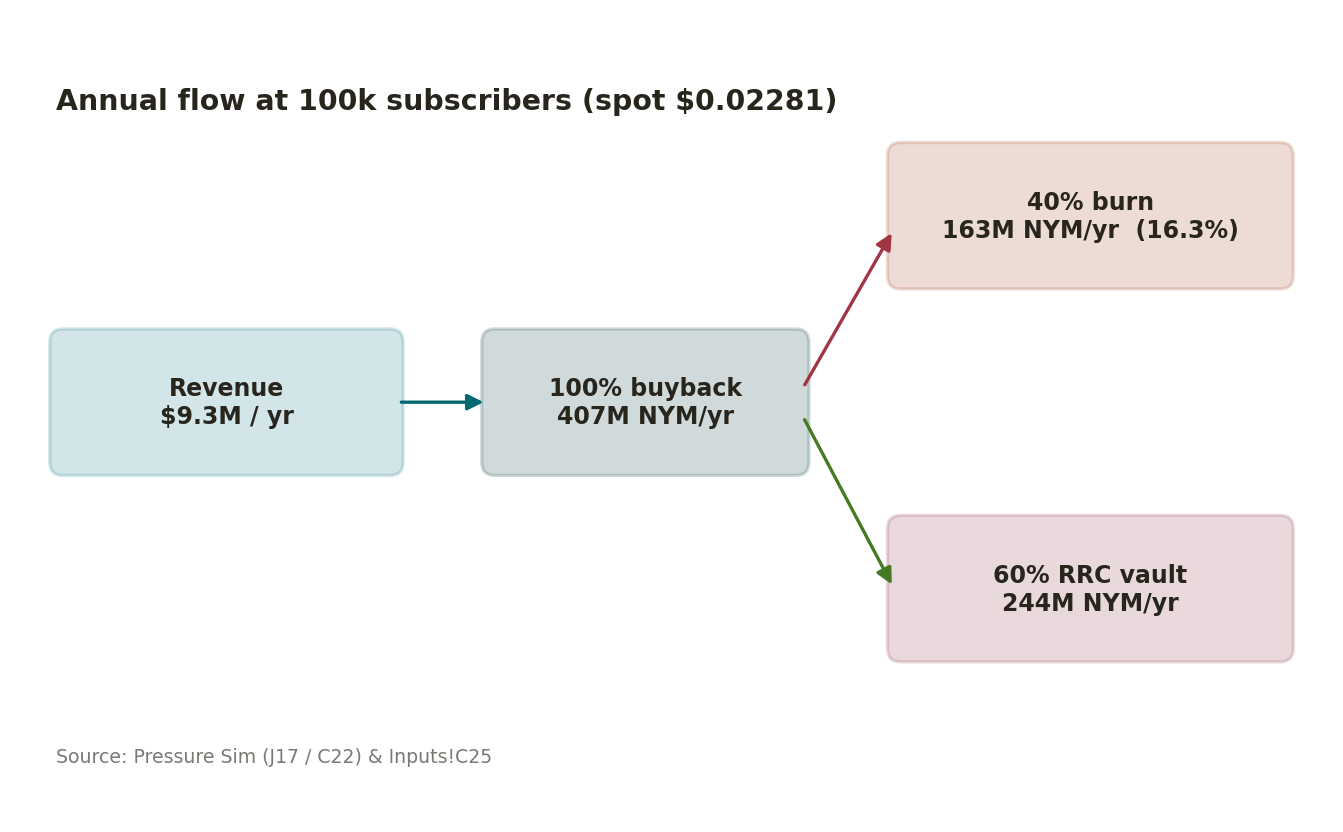
7. Annual Supply Impact at 100,000 Subscribers
7.1 What 100% Buyback Actually Does to Supply
At 100,000 subscribers, $0.02281 spot price:
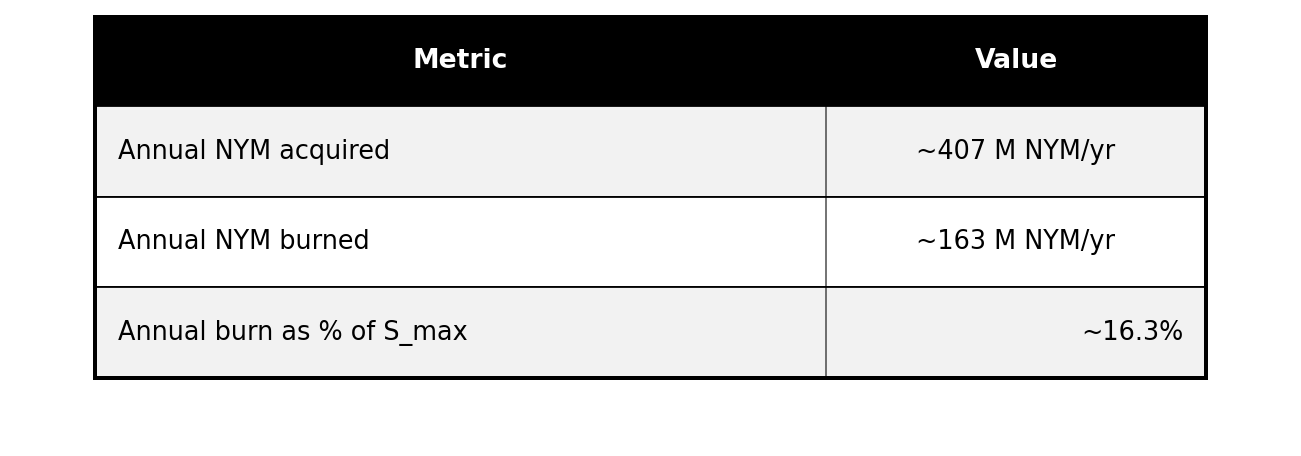
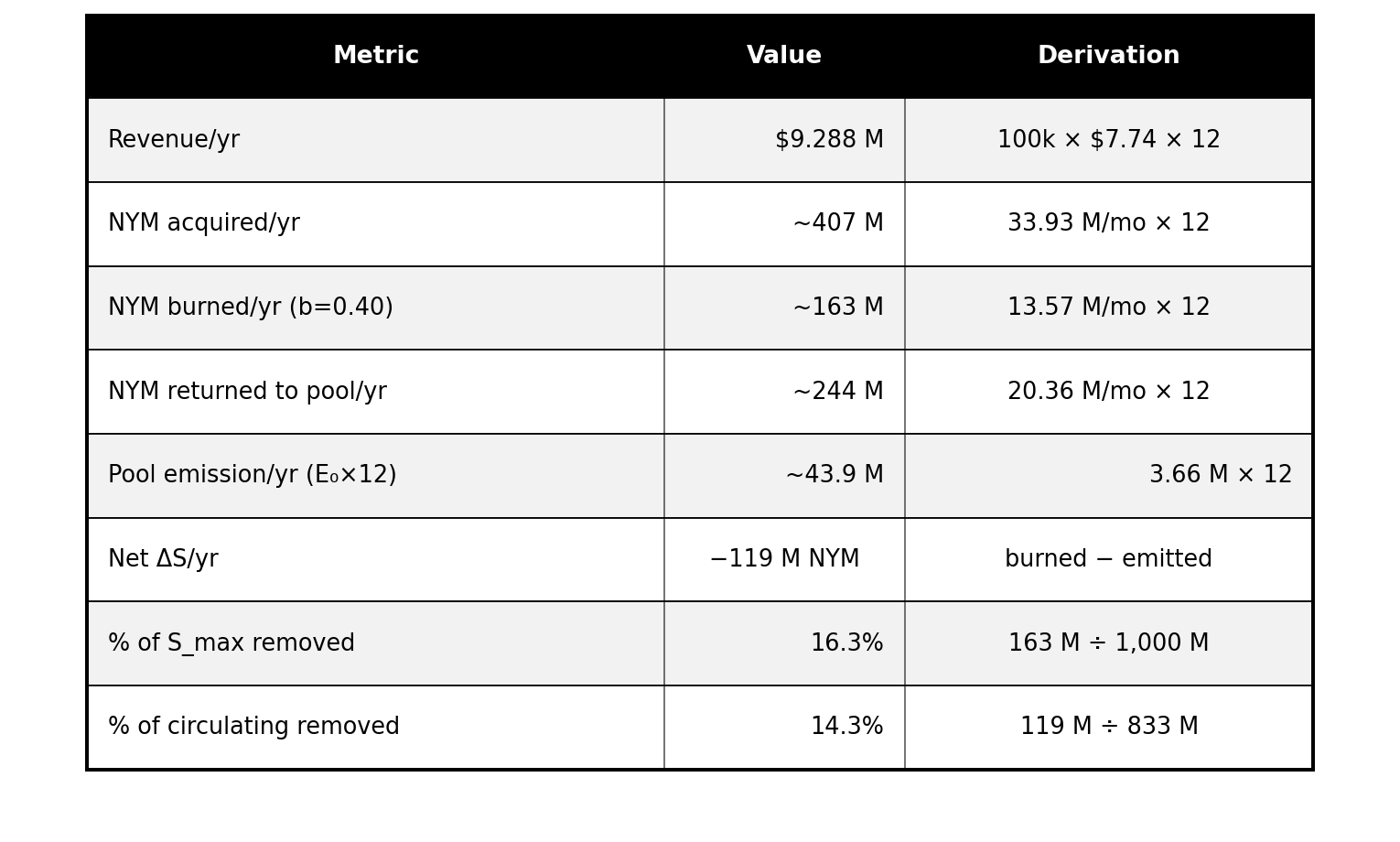
Annual revenue: R_annual = 100,000 × $7.74 × 12 = $9,288,000/yr
Annual NYM acquired via buyback:
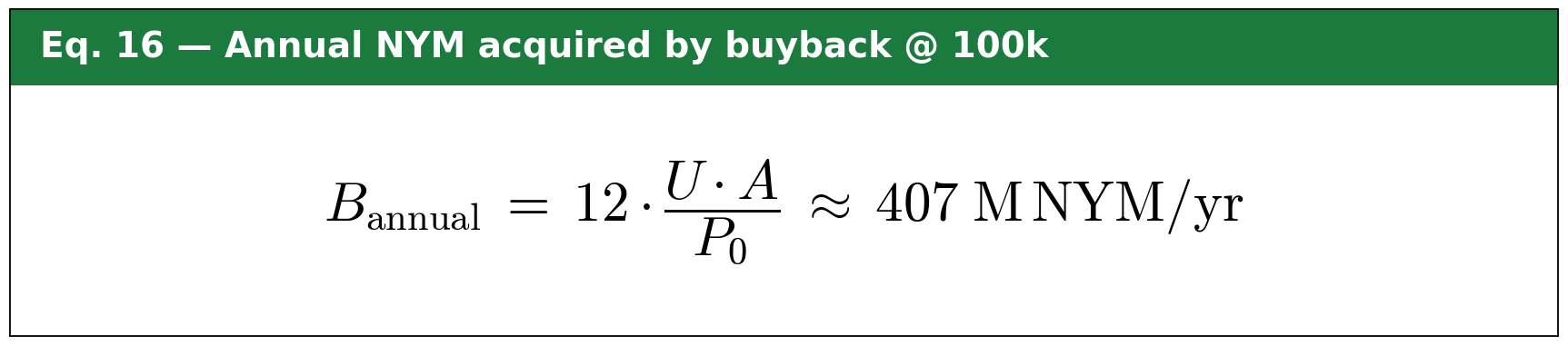
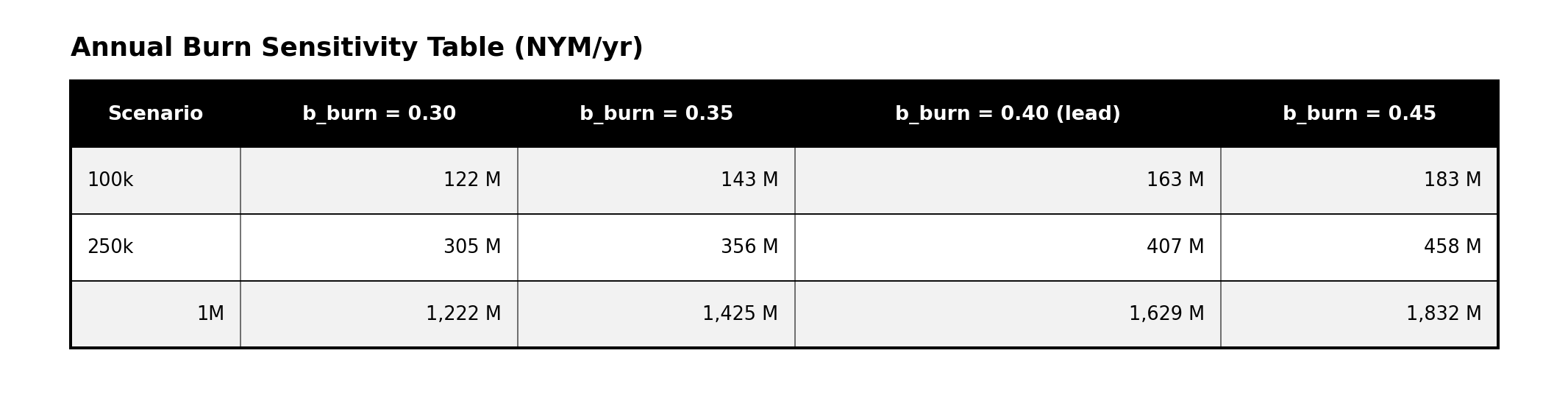
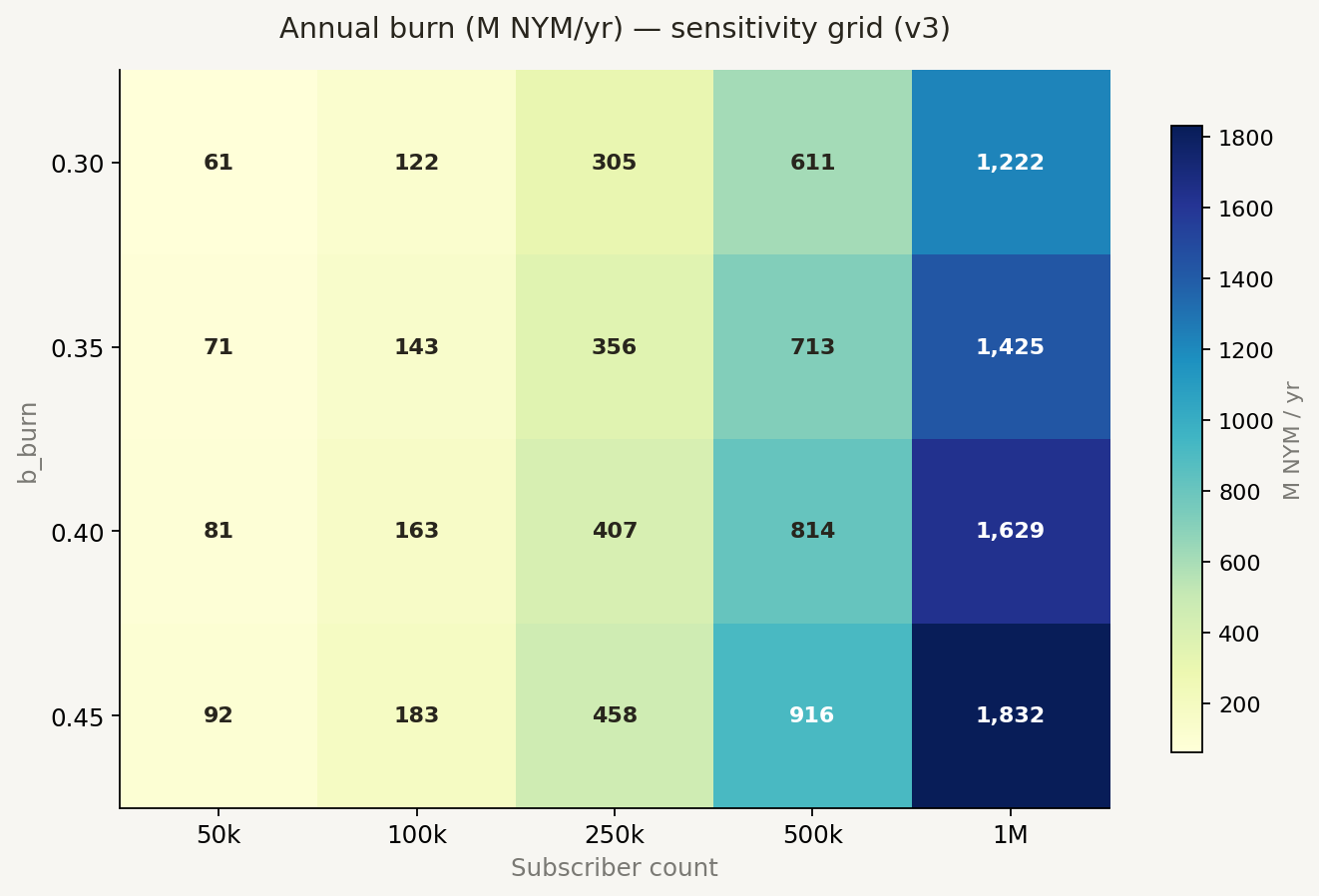
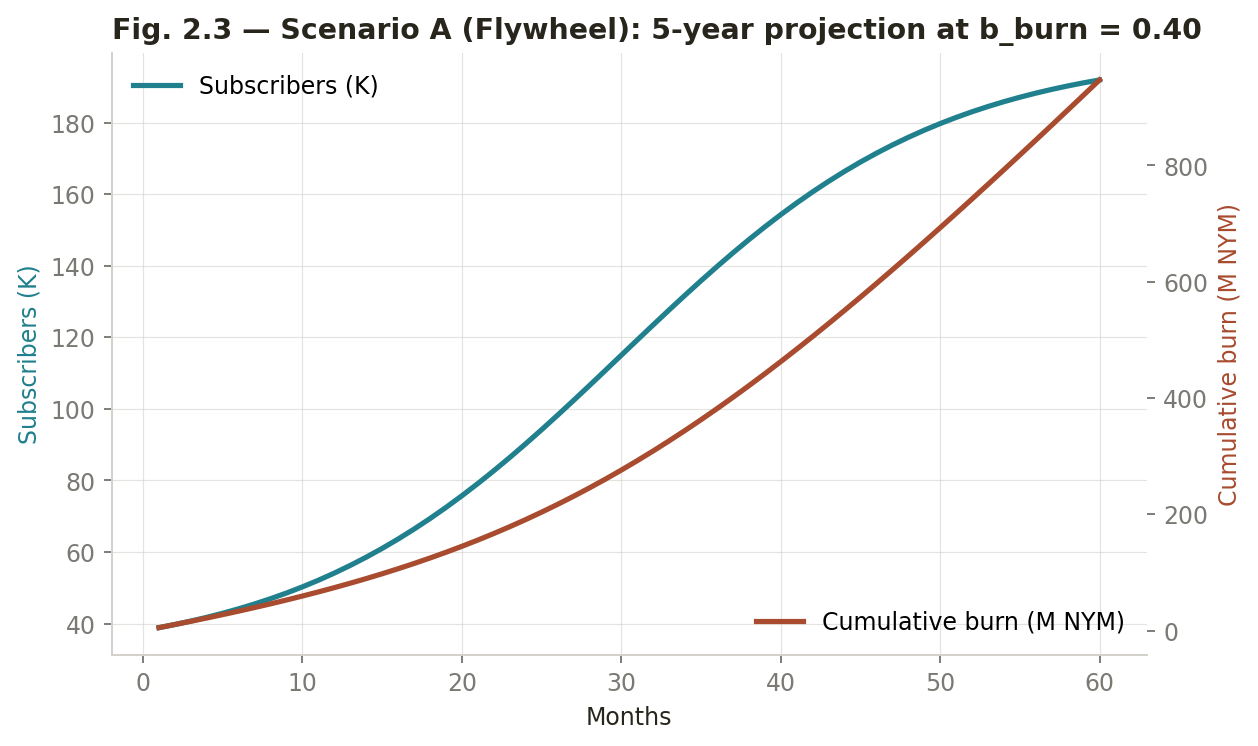
$9,288,000 / $0.02281 ≈ 407 M NYM/yr — 40.7% of S_max, acquired in a single year at current spot.
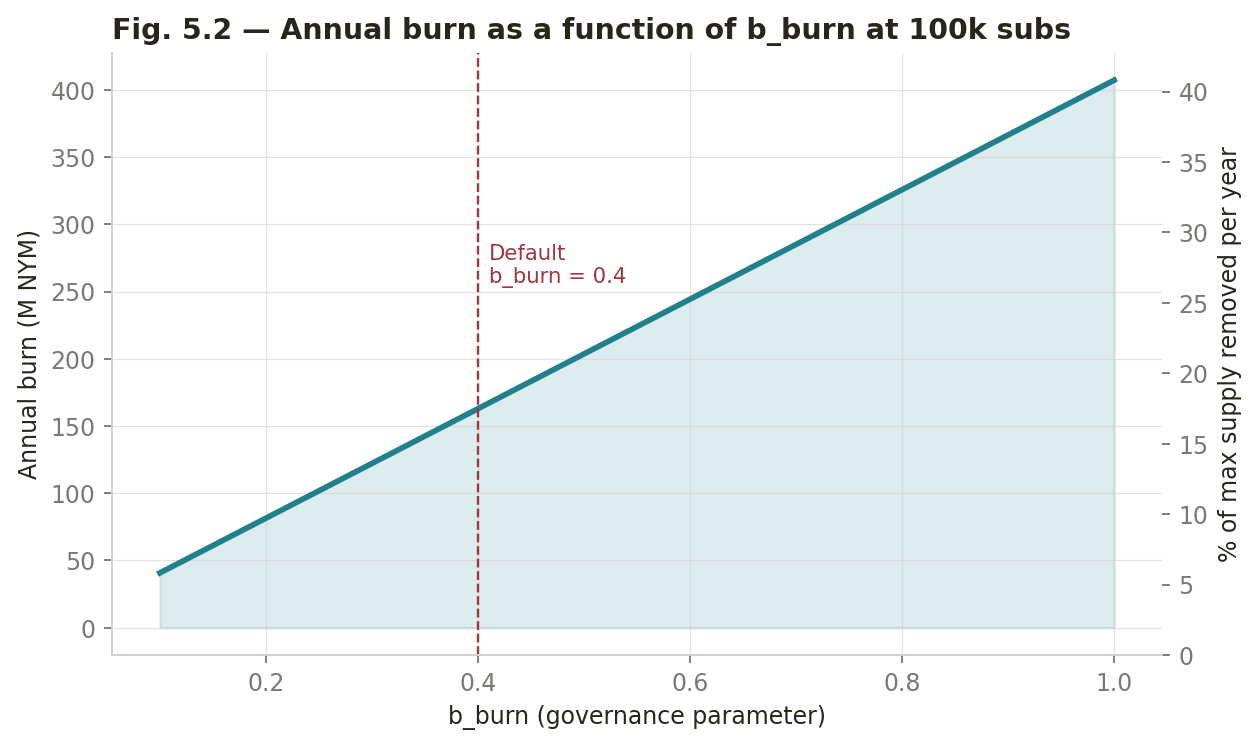
Annual NYM burned (b_burn = 0.40):
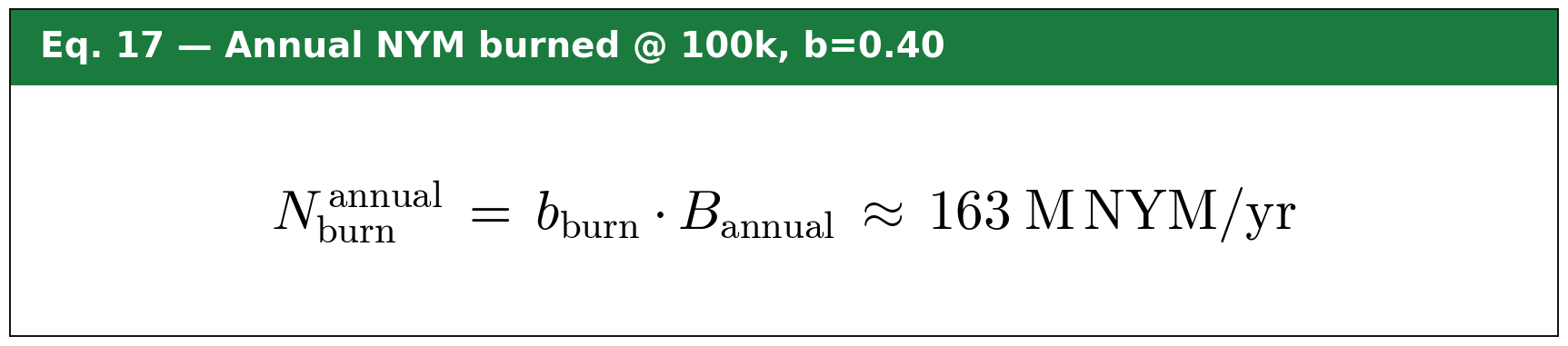
0.40 × 407 M ≈ 163 M NYM/yr permanently retired.
As a fraction of maximum supply:

163 M / 1,000 M = 16.3% of S_max removed every year at current spot. This is a deflationary force with no precedent in the VPN sector.
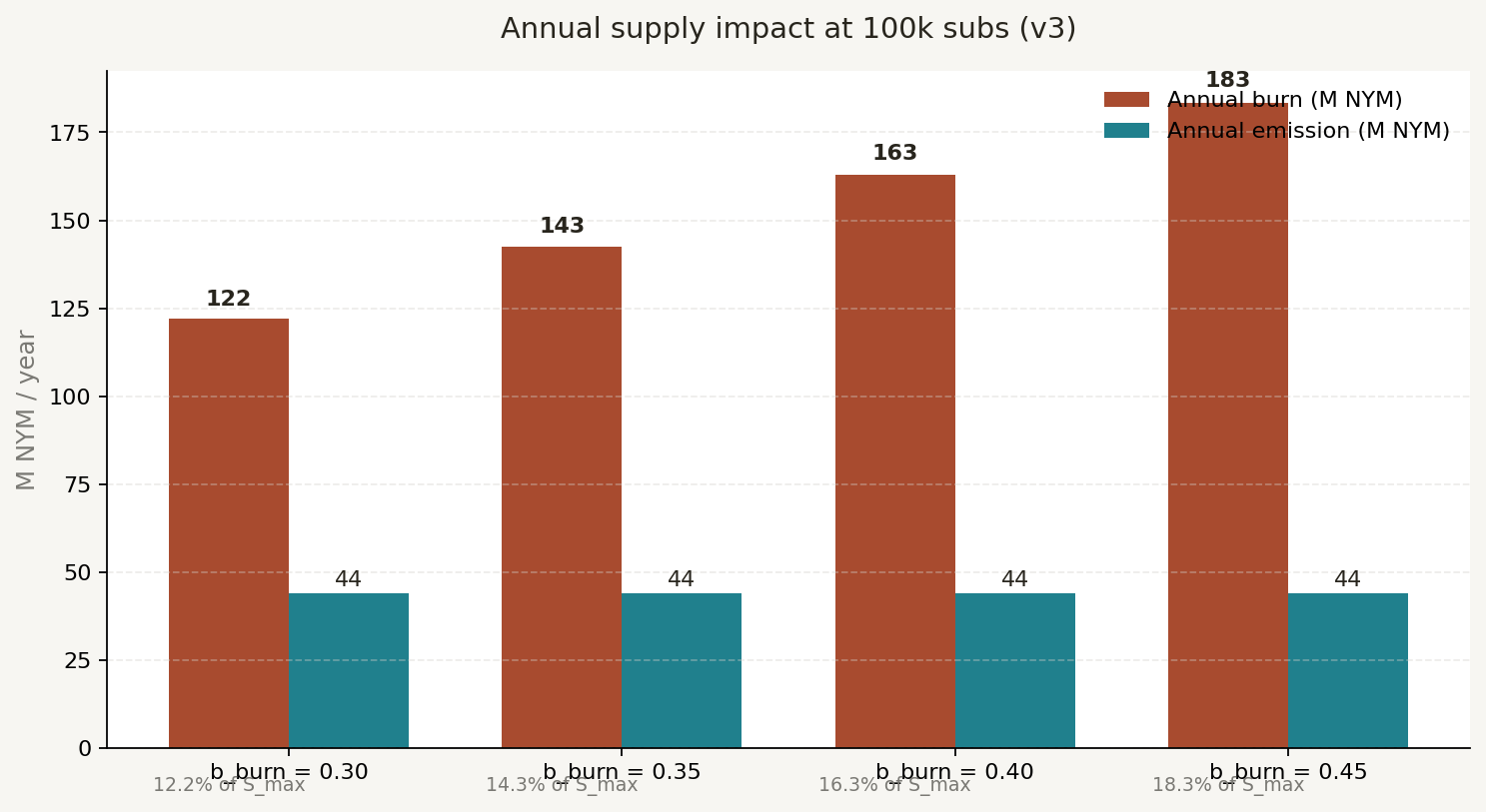
Annual network-wide emission under the real Nym formula = ~44.5 M NYM/yr. The burn-to-emission ratio at 100k subs with b_burn = 0.40 is roughly 3.7:1. (v2 reported ~15:1, based on the wrong E₀ of 0.88 M/mo. The correct ratio is lower but still strongly deflationary.)
Important caveat: These figures use the static spot price P₀ = $0.02281. As price rises toward P*, the same dollar revenue acquires fewer NYM, so the annual burn in NYM terms declines. This is a self-limiting feature — the mechanism gets less aggressive as price recovers.
8. The Pressure-Flow Architecture
8.1 Why Recycle-Only Fails Structurally
Three distinct failure modes remain in the recycle-only configuration:
Problem 1 — Revenue–Emission Disconnect (REDP). Under recycle-only routing, token emissions (5,080 NYM/hr, demand-agnostic) and subscription revenue are structurally disconnected. Subscriber growth does not mechanically translate into net supply reduction. The 99.6% drawdown from ATH is the empirical record of REDP playing out over 48 months.
Problem 2 — Postponed Seller Effect (PSE). Buyback NYM recycled into the mixmining pool creates a future sell event. Every token bought and recycled returns to the emission schedule. The permanent burn fraction b_burn converts that fraction from a deferred sell event into a permanent retirement, breaking the PSE cycle. The recycle-only routing does not break the PSE at all.
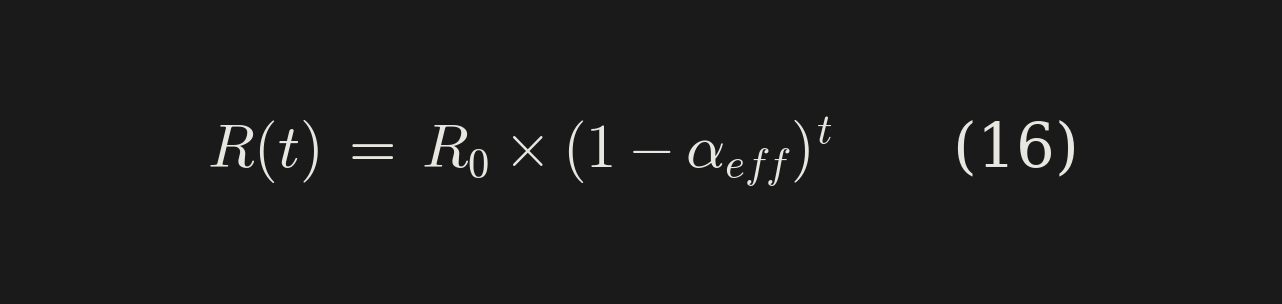
Problem 3 — Compounding Pool Problem (CPP). When buybacks increase the mixmining pool, the hourly 5,080 NYM/hr network-wide emission continues at its fixed rate — but the pool grows, extending the emission runway without proportional buy-side offset. TRM-3 (ARCEM cap, κ = 0.85) addresses this by bounding emission per epoch to κ × R / P.
8.2 The Money Flow
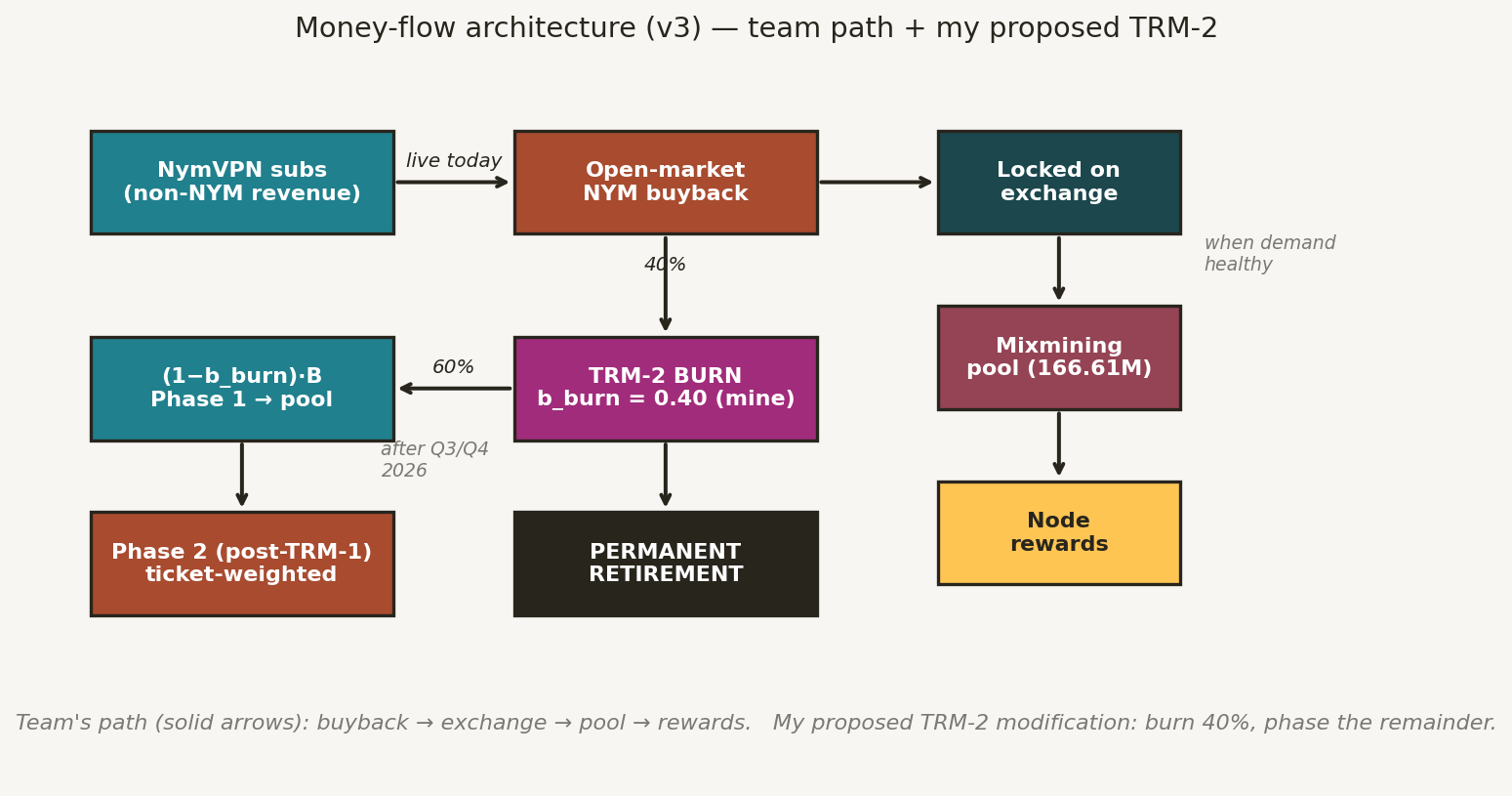
Under TRM-2, every subscription dollar splits: b_burn fraction (40%) goes to permanent NYM retirement; (1 − b_burn) fraction (60%) routes to the mixmining pool now, shifting to ticket-weighted rewards (TRM-1 stream) once TRM-1 ships in Q3/Q4. Under the team’s current recycle-only routing, 100% of bought NYM returns to the pool — no permanent retirement.
9. The Reward Concentration Problem
9.1 Legacy Emissions Are Demand-Agnostic
The core diagnosis in plain English: under the current regime, node operators receive NYM emissions at 5,080 NYM/hr network-wide, regardless of how much traffic they route or how many subscribers the network has. The hourly emission schedule continues whether Nym has 100 paying subscribers or 100,000.
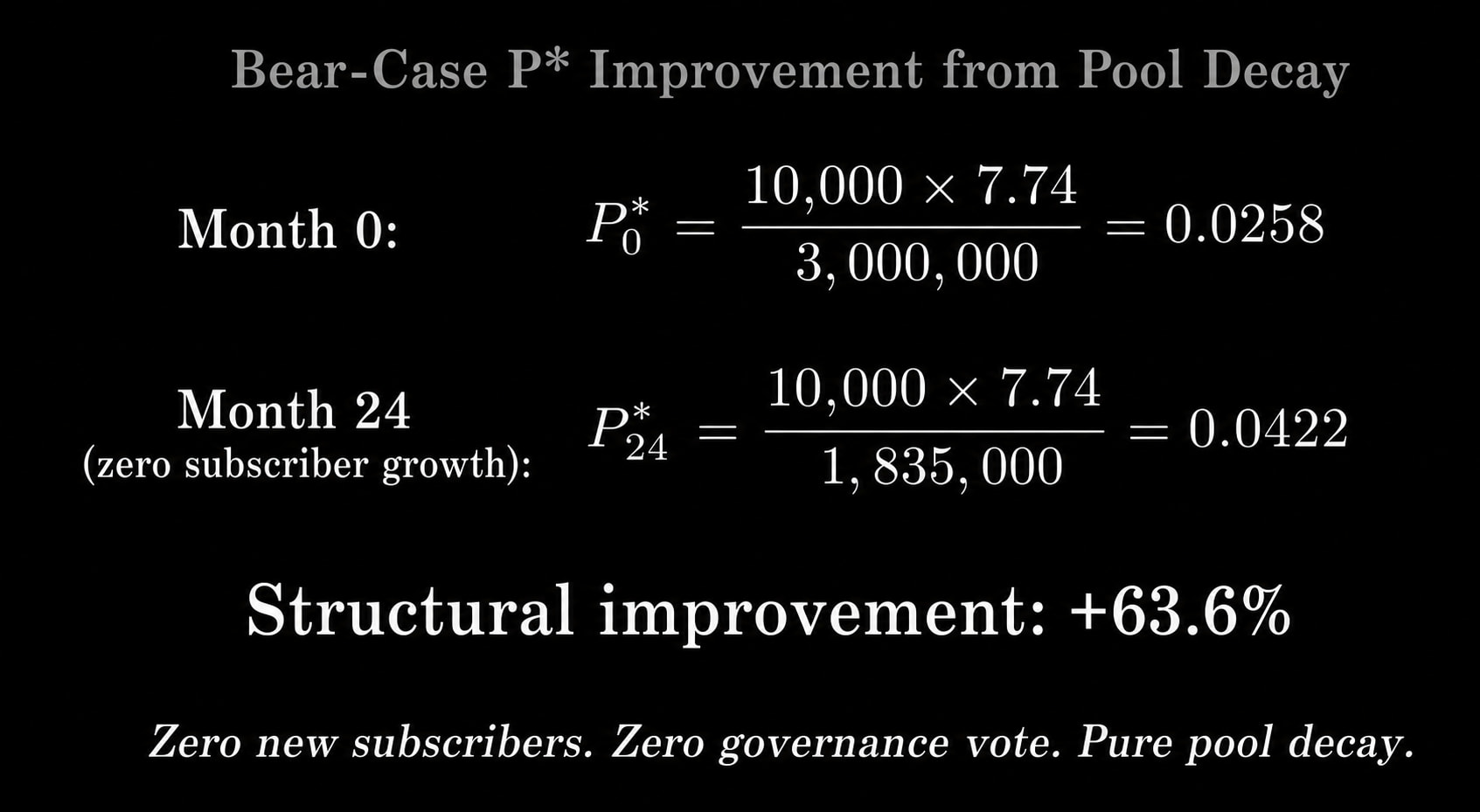
This means sell-side pressure is essentially fixed in NYM terms per month, while buy-side pressure scales linearly with subscriber count. Below ~9,711 subscribers (recycle-only) or ~2,775 (TRM-2), the sell side wins every month.
9.2 Concentration Under TRM-1
TRM-1 addresses the demand-decoupling problem by gating emissions to ticket activity. But it introduces a second-order problem: nodes with high traffic capture disproportionately more emissions. Under a power-law routing distribution, top-decile nodes receive far more than 10% of total emissions.
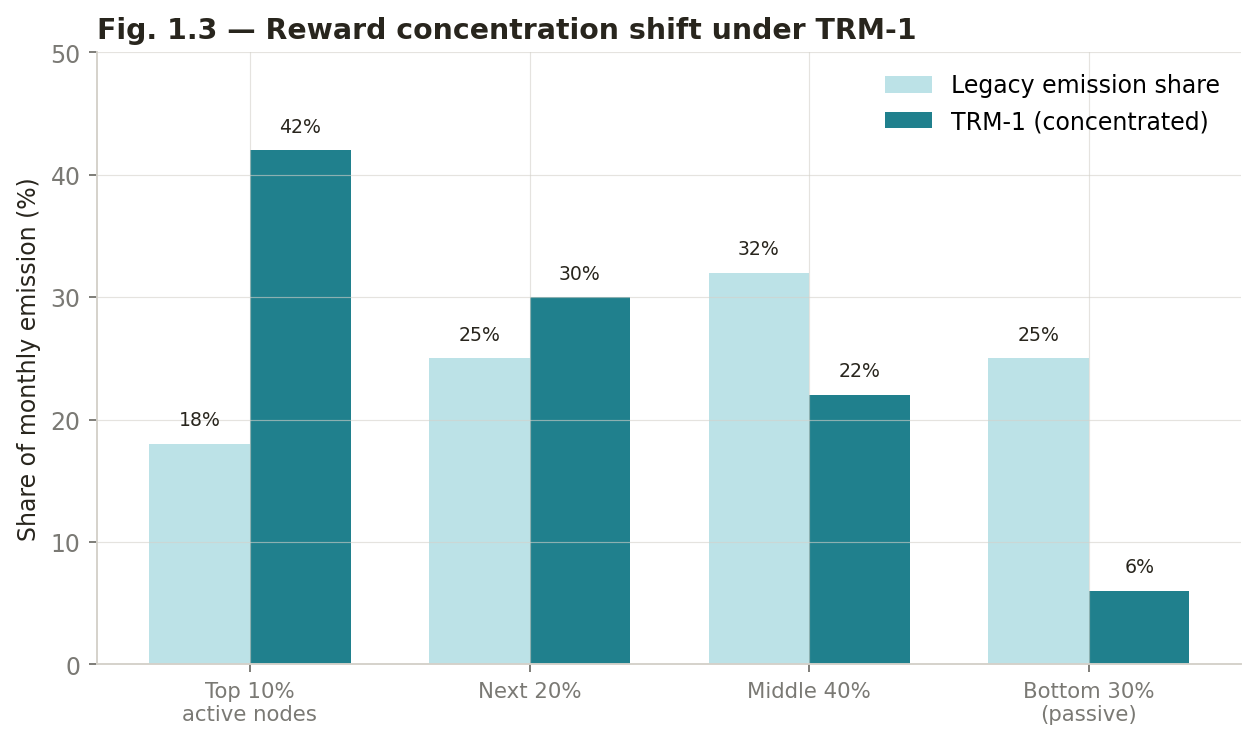
The Lorenz curve above quantifies the concentration penalty. This is not fatal — the permanent burn fraction (TRM-2) ensures structural supply reduction regardless of which nodes are selling. But it does mean TRM-1 alone is not a full fix; TRM-2 and TRM-3 are needed to close the loop.
10. The Mechanism vs. Marketing Argument
Under recycle-only mechanics, if subscriber count doubles from 5,000 to 10,000, net sell pressure decreases but there is no permanent supply removal. The improvement in price equilibrium from 5k to 10k subscribers under recycle-only is essentially nil in P* terms, because recycled tokens return to the emission schedule.
The math is not punishing because growth doesn’t matter. Growth matters enormously under TRM-2 — the P* curve reaches 14.4× spot at 100k subs and continues rising. The math is punishing under recycle-only because bought tokens keep re-entering the sell side.
The recycle-only regime is not a product problem. It is a mechanism problem. And mechanism design is solvable via governance.
11. What This Means
Three conclusions I’d ask the community to sit with:
1. The protocol is almost certainly operating below break-even right now. The break-even under recycle-only routing is ~9,711 paying subscribers. Nym has not publicly disclosed subscriber counts. Given the price action — near-ATL on May 2, 2026 — it seems probable that Π < 0. That means the community is asking subscribers to fund a mechanism that, by design, cannot translate their payments into net supply reduction until the count crosses ~10k.
2. The fix is not expensive. TRM-2 requires a governance decision to activate a burn parameter. The break-even drops from ~9,711 to ~2,775 subscribers — a 3.5× improvement — with a single governance action. TRM-1 is already confirmed for Q3/Q4. The pieces are in place.
3. The supply math is compelling even at the corrected numbers. At 100k subscribers, the buyback engine removes 16.3% of S_max every year at current prices, against an annual emission rate of ~44.5 M NYM/yr (4.45% of S_max). The net supply direction under TRM-2 is strongly deflationary at any realistic subscriber scale.
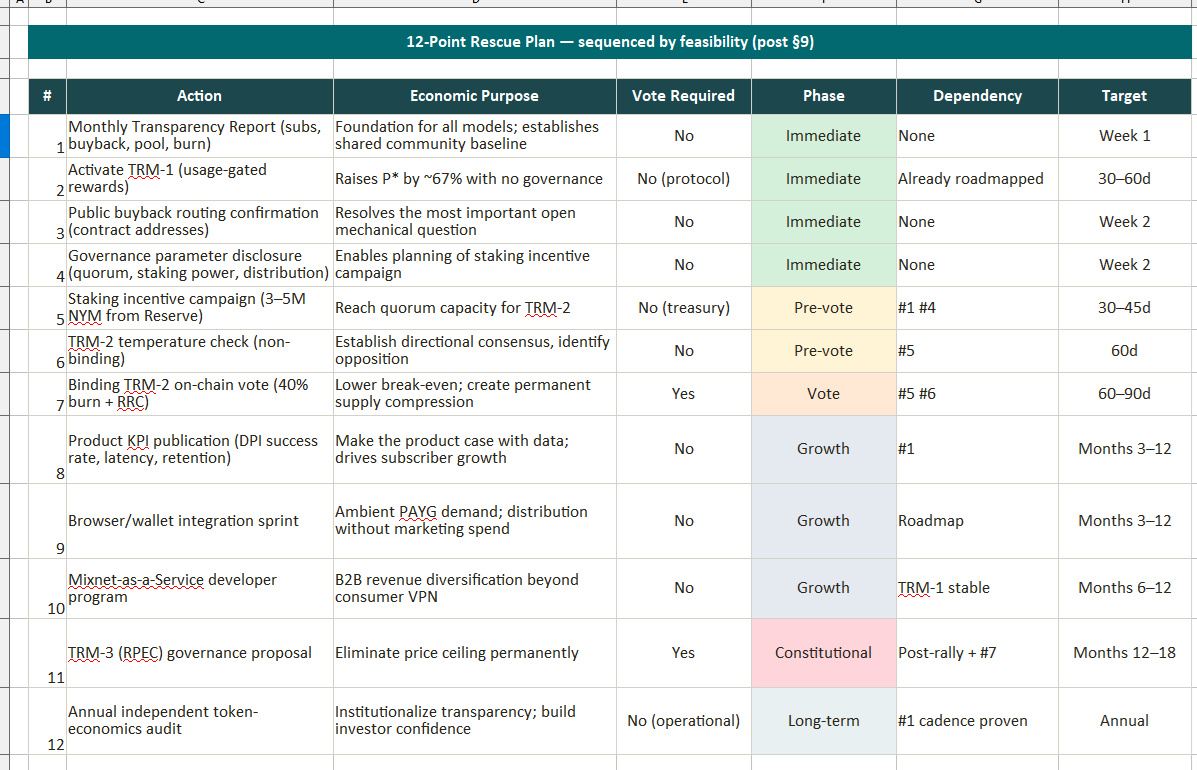
Sequencing: What Ships Before TRM-1
Before I close, I want to acknowledge something the team made clear that I underweighted in v3: TRM-1 (ticket-based rewarding) is not a calendar event that arrives in isolation. The team flagged that TRM-1 is scheduled for Q3/Q4 2026, precise date TBC, because other things have to be in place first — things essential to improving network performance and security, and to driving NymVPN demand. Ticket-based rewarding only becomes meaningful once those prerequisites are landed.
I want to internalise this correctly and reflect it in my proposal.
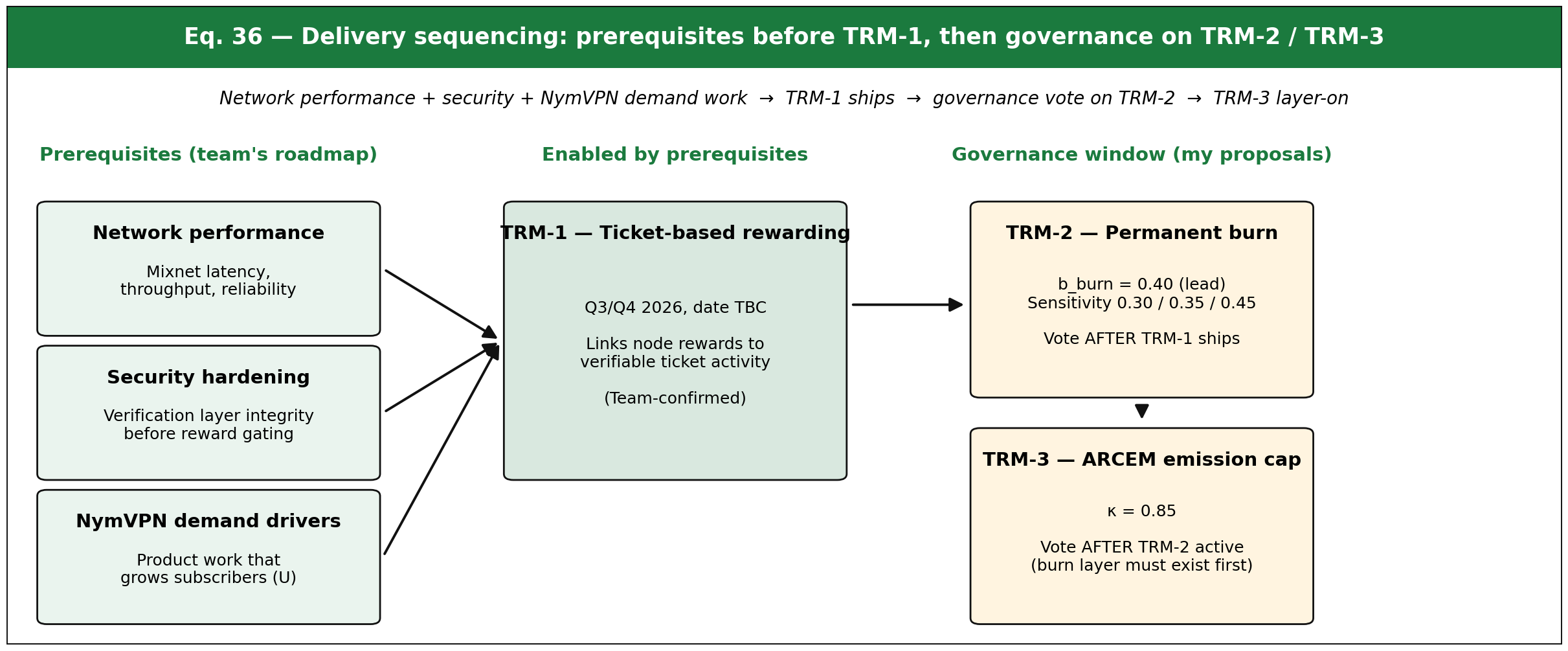
What ships before TRM-1 (team’s roadmap, not mine)
- Network performance work — mixnet latency, throughput, and reliability improvements. Ticket-based rewards only matter if there is traffic worth measuring and a network performant enough to attract that traffic.
- Security hardening — the verification layer that TRM-1 depends on must be sound before reward distribution can be gated on it. Rewarding nodes for verifiable work assumes the verification primitive itself is hardened.
- NymVPN demand drivers — the product work that grows subscribers (U). The entire revenue side of this audit — R = U × A — depends on NymVPN being a product people actually want. If subscriber growth is flat, every P* curve in this series is a theoretical exercise.
These three streams are the team’s domain, not mine. I am not asking the team to deprioritise any of them in order to ship TRM-1 sooner. The opposite — I am saying: ship them first, in the order the team judges right, and let TRM-1 land when the foundation is ready.
What this means for TRM-2 / TRM-3 timing
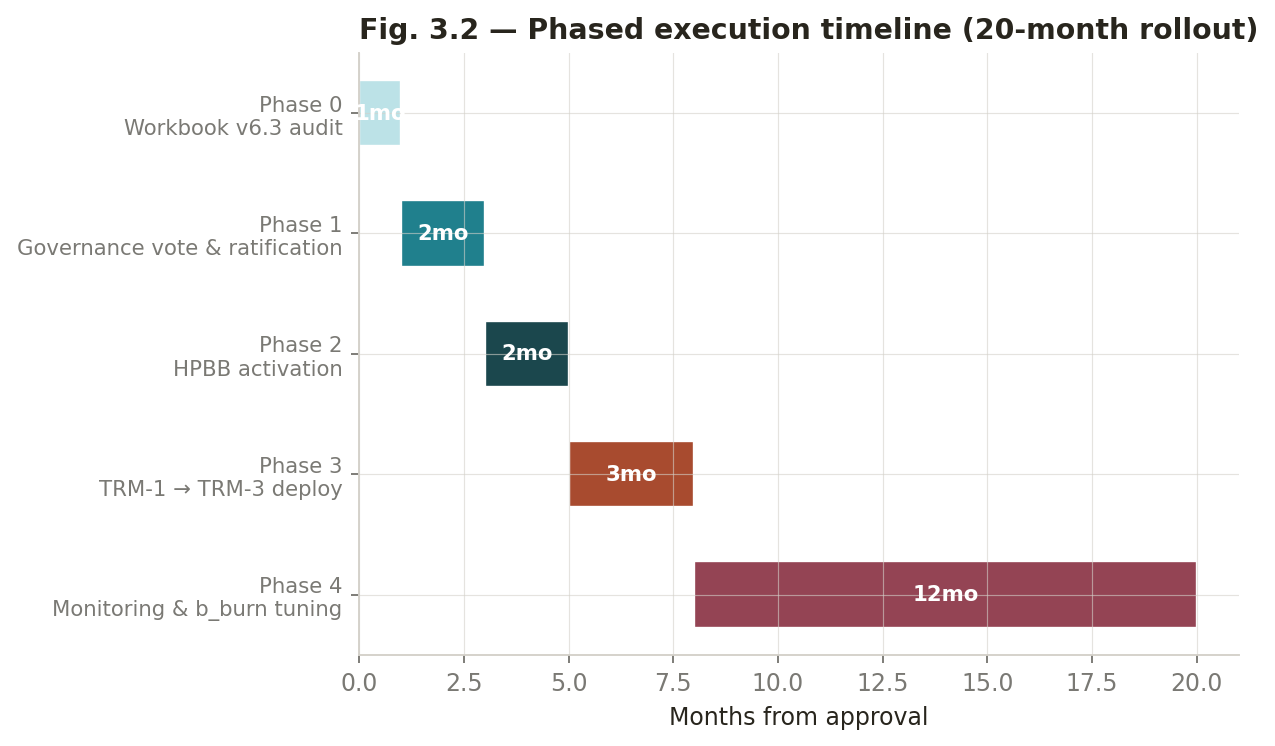
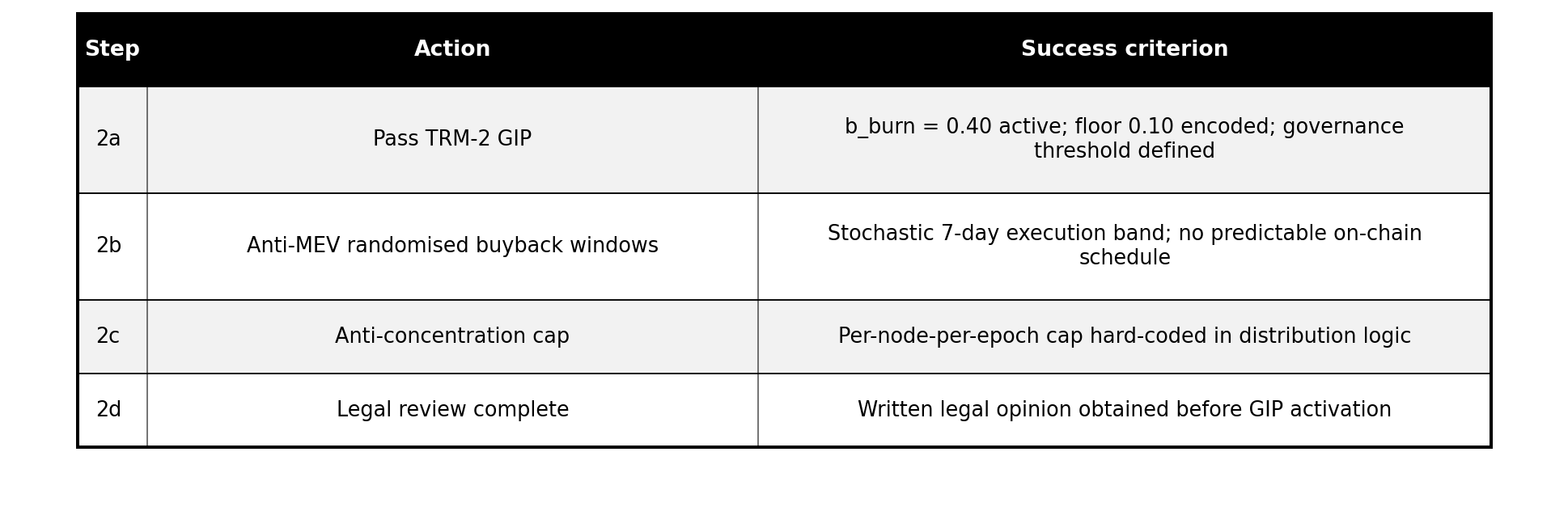
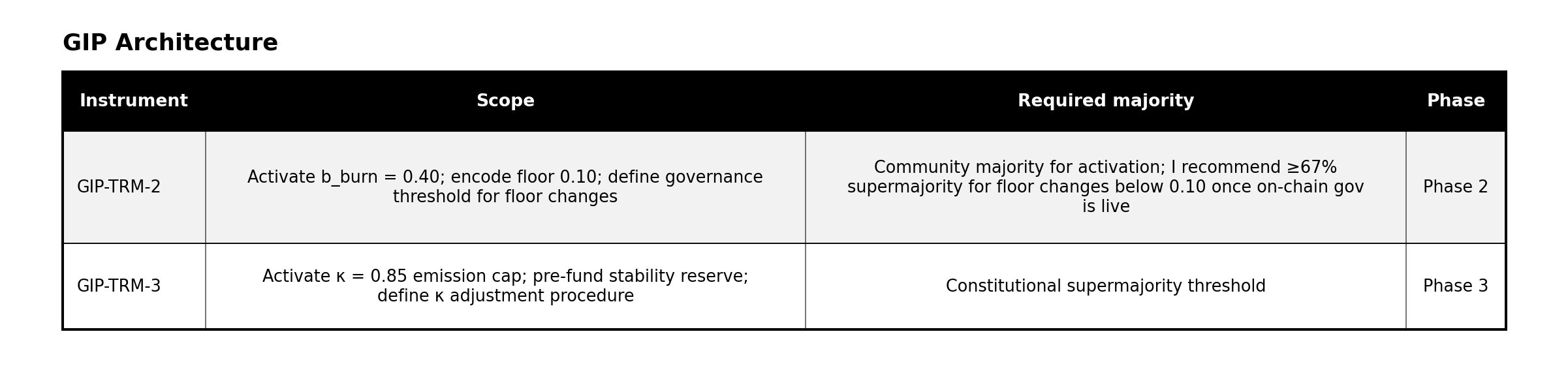
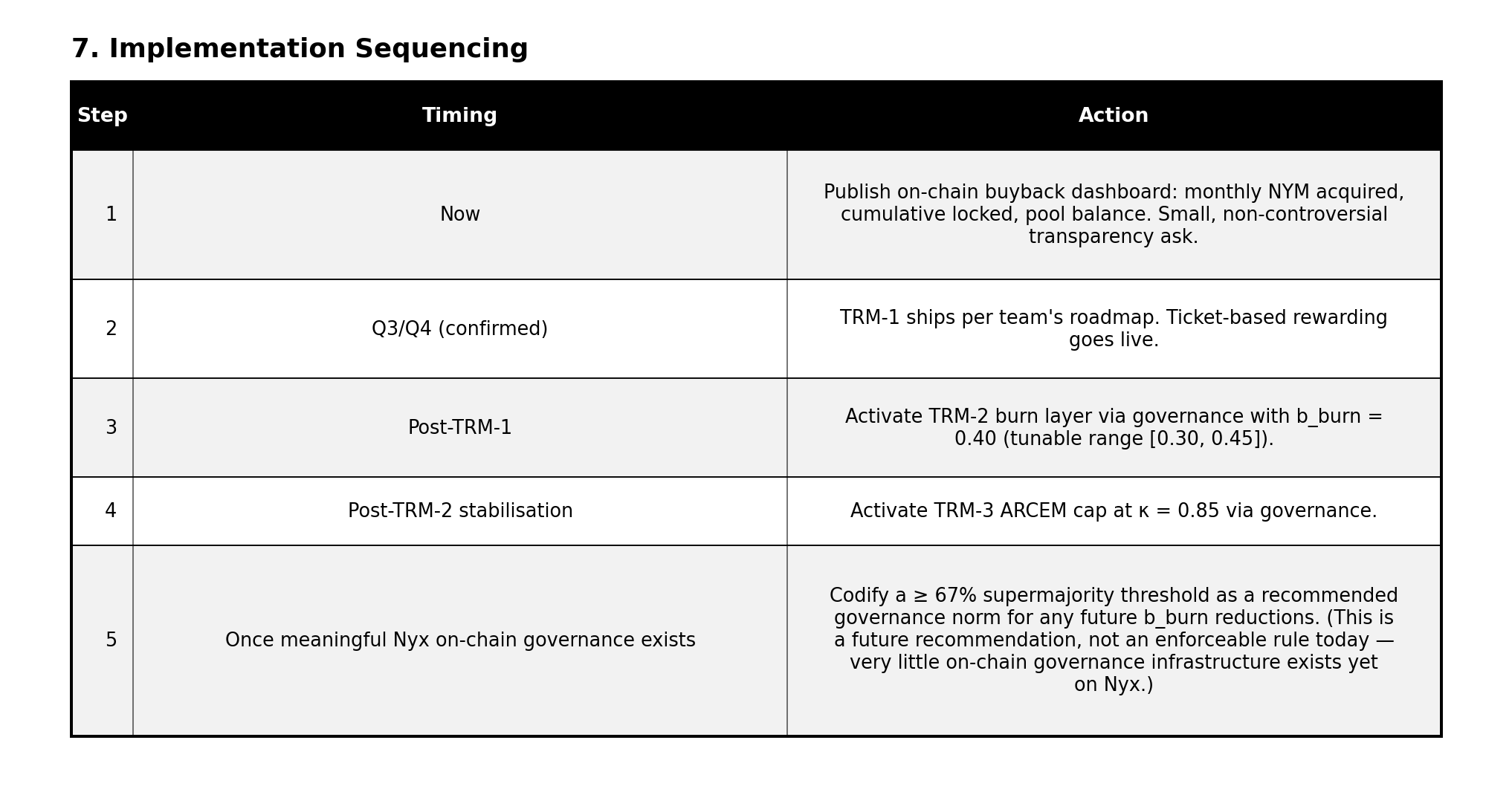
My proposals do not race ahead of the team’s roadmap. The sensible governance sequence is:
[Network performance + security + NymVPN demand work] ← team’s roadmap, ongoing
↓
TRM-1 ships (Q3/Q4, date TBC) ← team-confirmed
↓
Governance vote on TRM-2 (permanent burn) ← my proposal — vote AFTER TRM-1
↓
TRM-3 layer-on (ARCEM emission cap) ← vote AFTER TRM-2 is active
Two reasons TRM-2 should not be voted on before TRM-1 ships:
- Buyback volume is bounded by subscriber growth, which is bounded by the product/perf/sec work. Burning 40% of a small buyback stream produces a small absolute deflationary effect. The TRM-2 mechanism is correct in principle at any subscriber count, but its visible impact scales with U. Activating it before subscriber growth has matured means the deflationary signal is weak when it most needs to be visible.
- Phase 2 of my routing proposal — the (1 − b_burn) remainder shifting to ticket-weighted node rewards — literally requires TRM-1 to be live. Activating TRM-2 before TRM-1 ships forces Phase 1 (route remainder back to mixmining pool) to run indefinitely. That is fine — it matches the team’s current routing — but the full mechanism only realises its design once TRM-1 is operational underneath.
What I am asking the team to consider, not now, but later
I am not asking for a vote today. I am asking the team and community to keep TRM-2 + TRM-3 on the table as the natural next governance step once TRM-1 has shipped and bedded in. The math in this audit will still hold then — the equations don’t expire — and by that point we will have:
- Real ticket-activity data to calibrate the (1 − b_burn) Phase 2 routing
- Real subscriber numbers to confirm whether U has crossed the recycle-only break-even (~9,711)
- Real network performance baselines so TRM-3’s emission cap κ can be tuned against observed conditions, not estimates
In other words: the team’s prerequisite work is what gives my proposal real teeth. I do not see TRM-2/TRM-3 as competing with the perf + security + product roadmap — I see them as the governance layer that becomes activatable once that roadmap delivers.
Credit where due: the team is sequencing the right things in the right order. My job as a community researcher is to make sure the mechanism design is ready to bolt on cleanly when the foundation is in place.
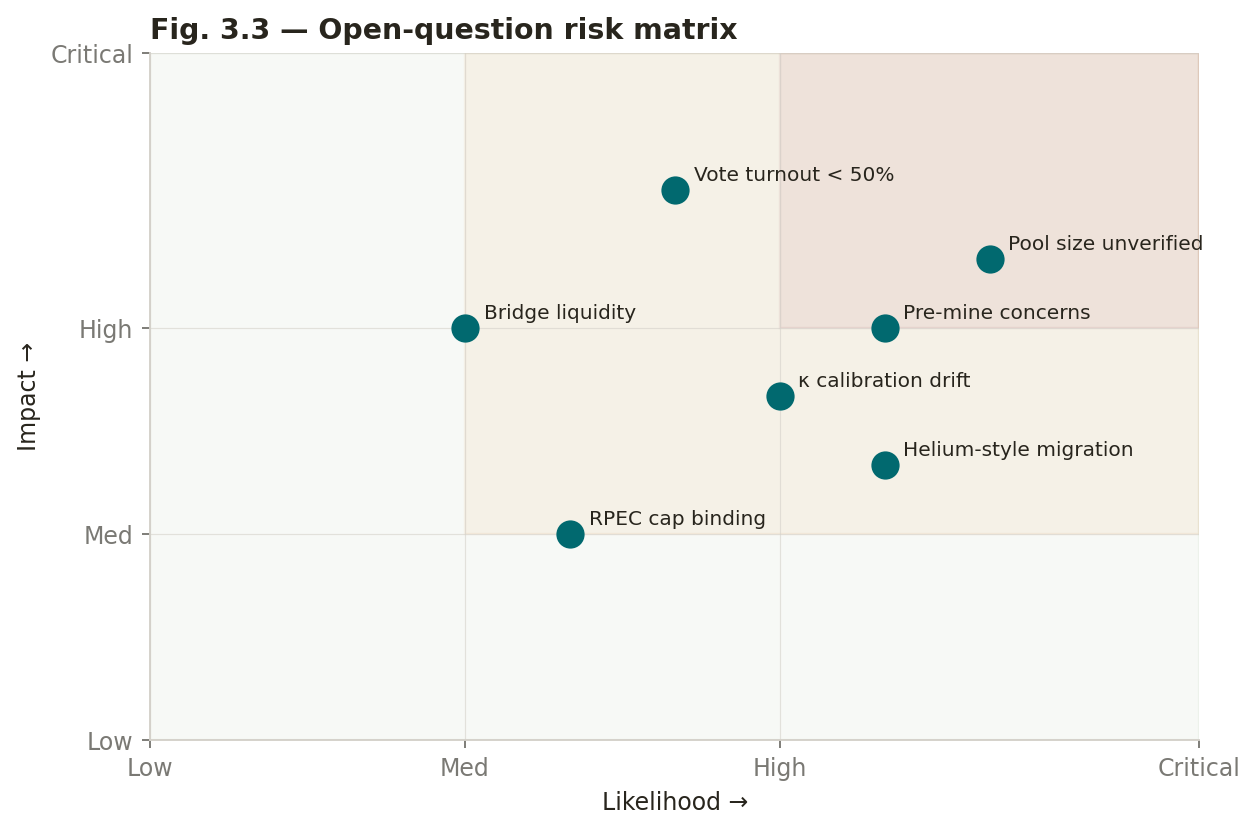
12. Caveats and Open Questions
- Pool size is now confirmed. Validator API gives 166.61 M NYM. The pool-size uncertainty from v2 is resolved.
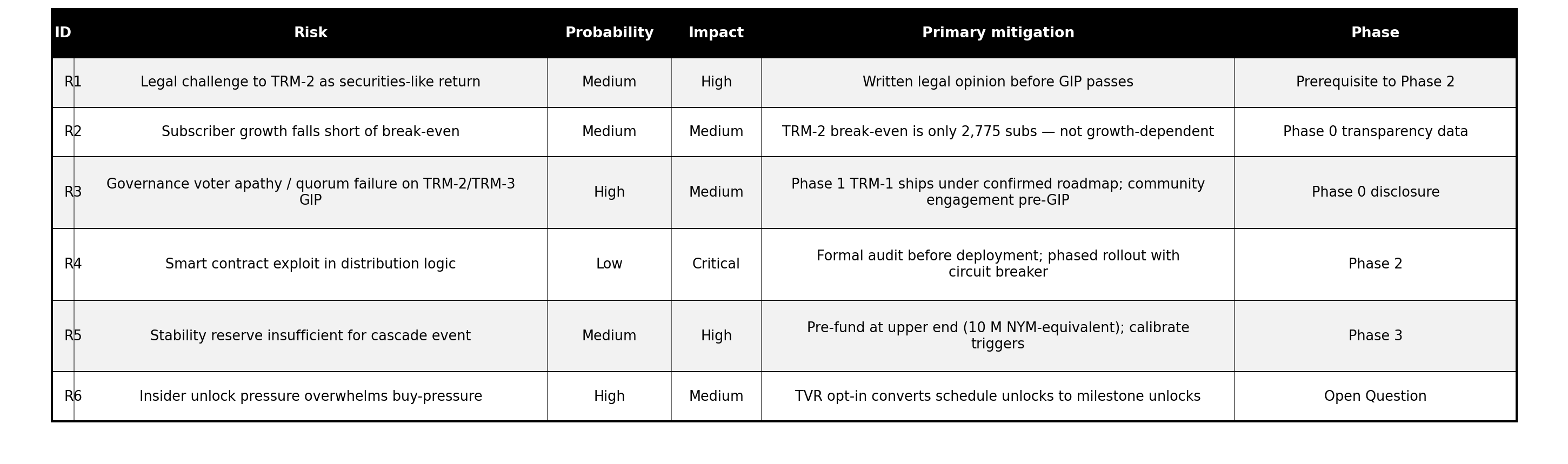
- Actual subscriber count is not public. The most important number in this entire analysis is one Nym hasn’t disclosed. I’m asking the team to share it, or at minimum confirm whether the protocol has crossed the ~9,711 recycle-only break-even.
- Buyback routing is partially confirmed. The team confirmed: bought NYM is locked on exchange, returns to pool when demand is healthy. On-chain verification of the exact routing mechanism would allow this to be ratified via GIP as a constitutional floor.
- α = 0.90 is an estimate. The sell-side effective emission uses α = 0.90. That 10% retained-by-operators assumption is conservative and has no public data source; actual operator sell behaviour may differ.
- ARCU (actual subscriber count) is the key unknown. Everything else in this analysis is derivable from first principles. The subscriber count is the only input I cannot compute.
Posts in This Series
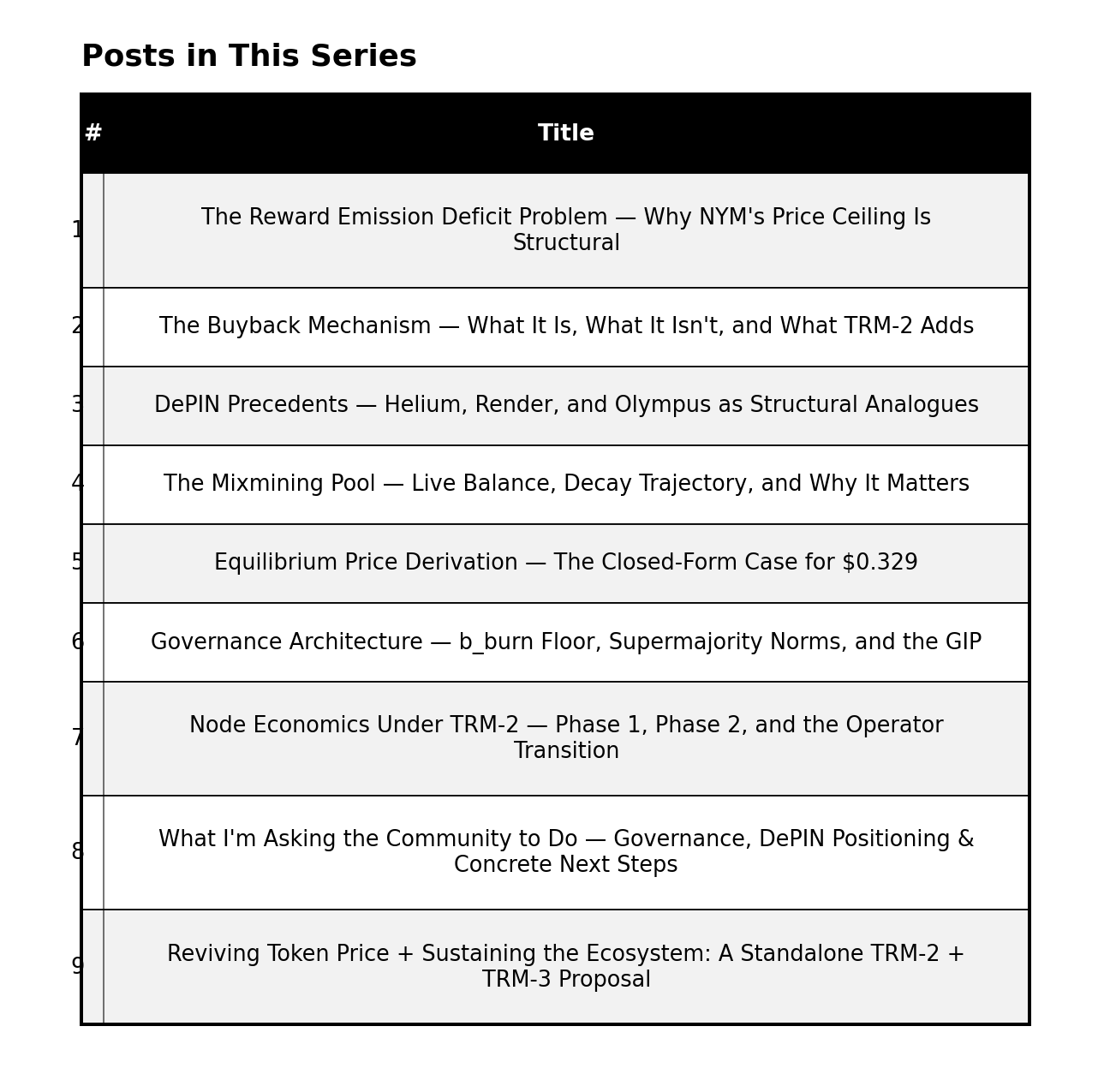
This is post 1 of 8. The series covers:
- Post 1 (this post): Diagnosis — what is broken and why
- Post 2: Reform architecture — TRM-1, TRM-2, TRM-3, ARCEM, HPBB, phased routing
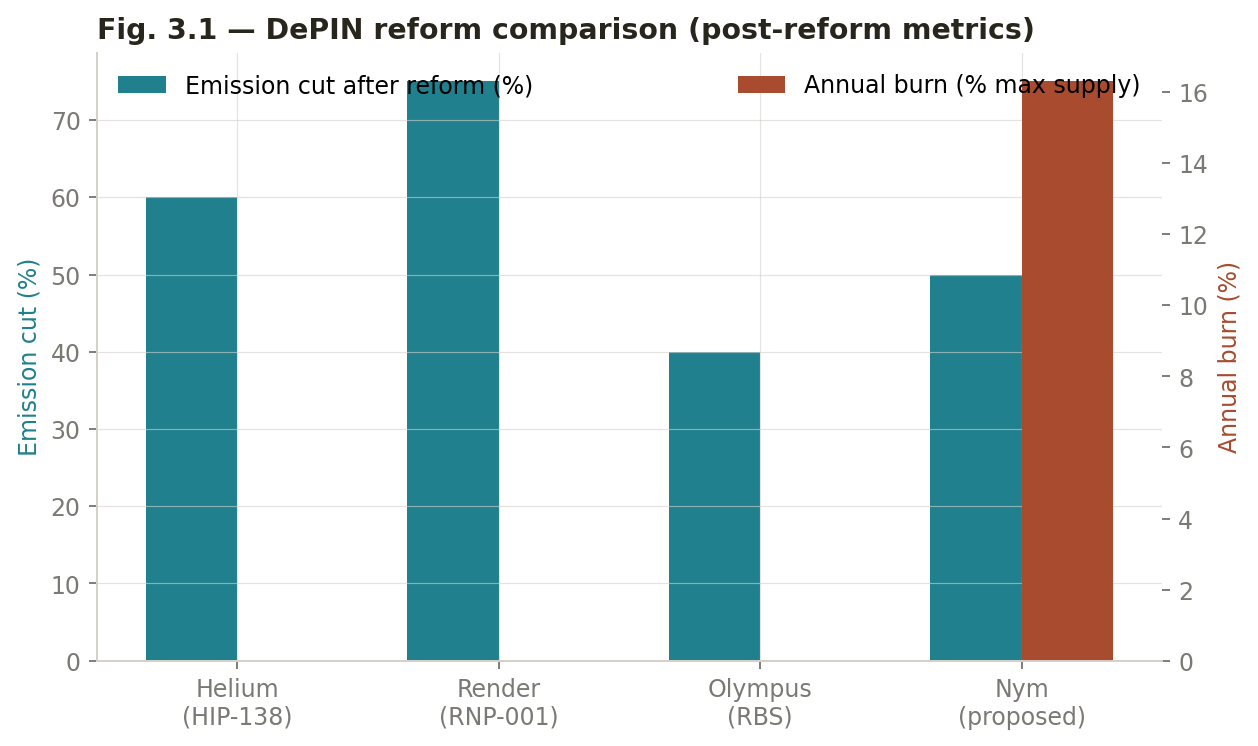
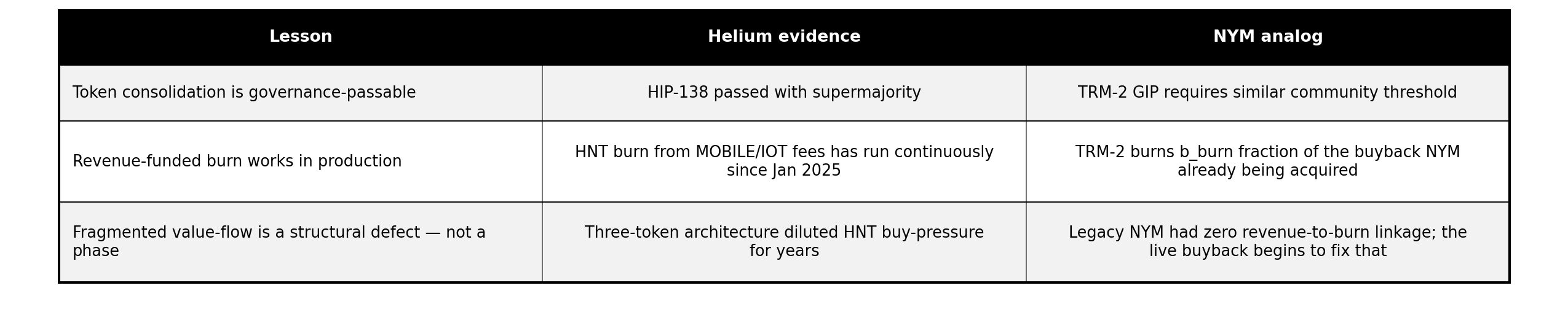
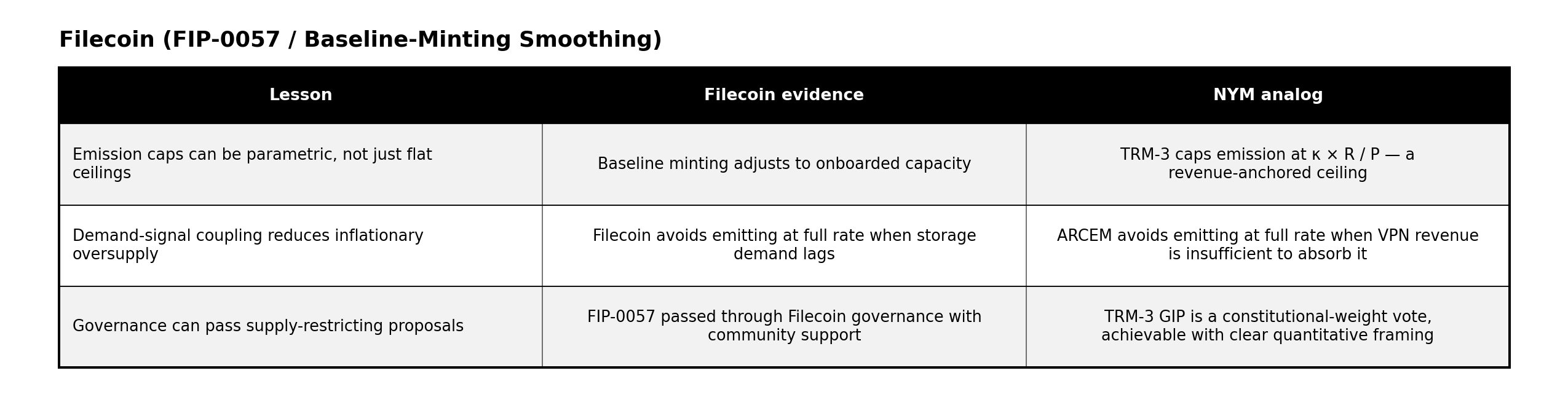
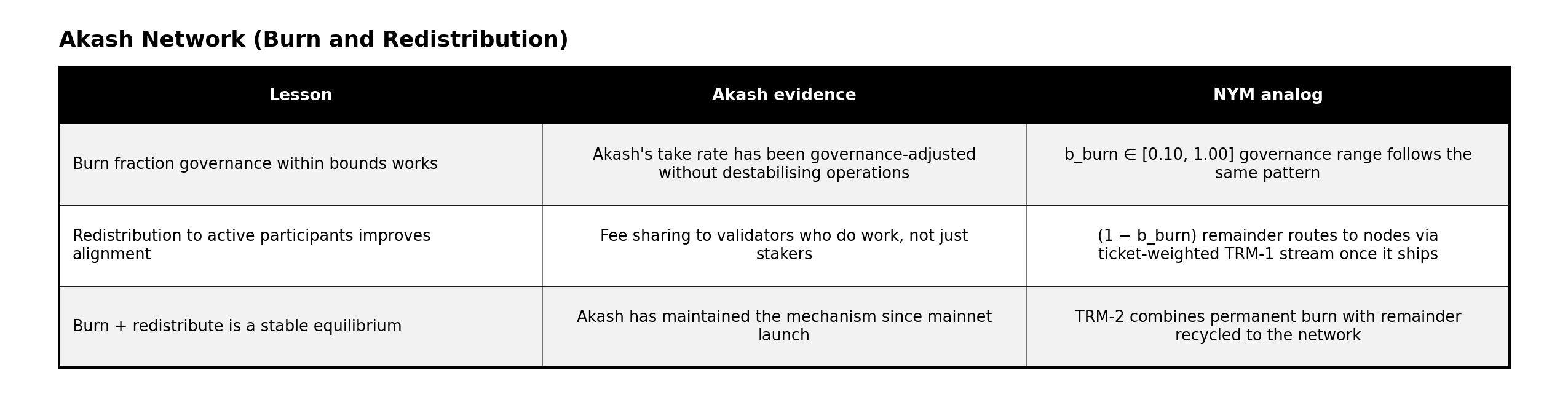
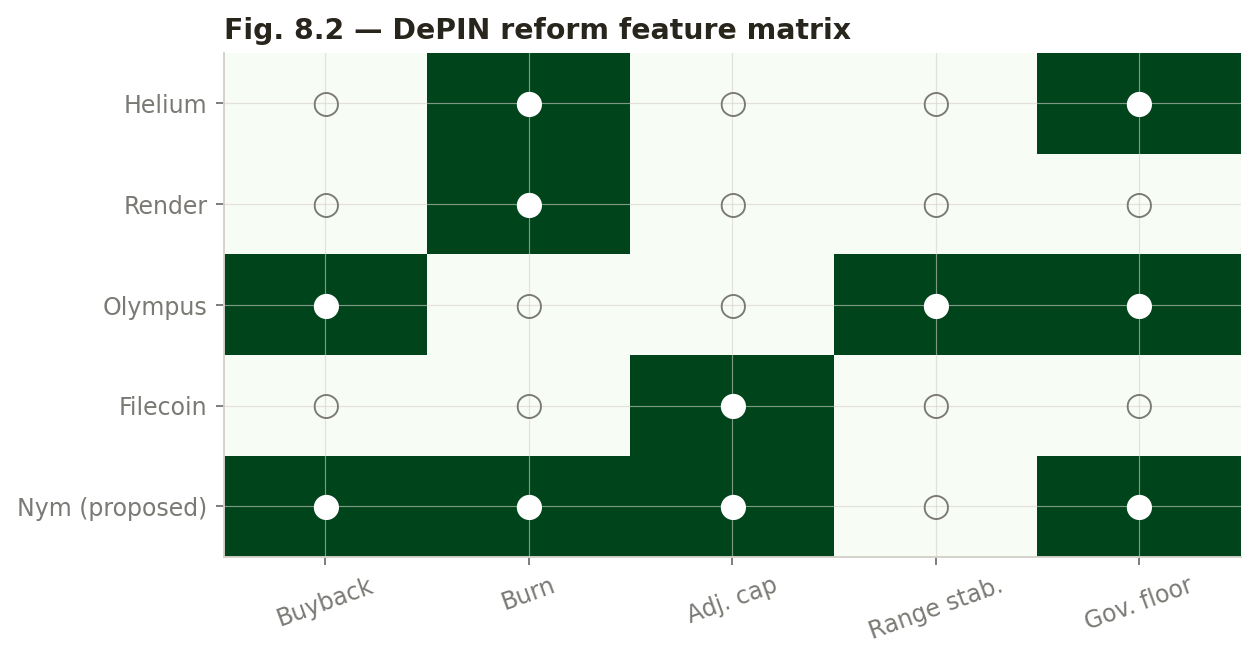
- Post 3: Execution — GIP sequencing, Phase 0/1/2 timelines, DePIN comparisons
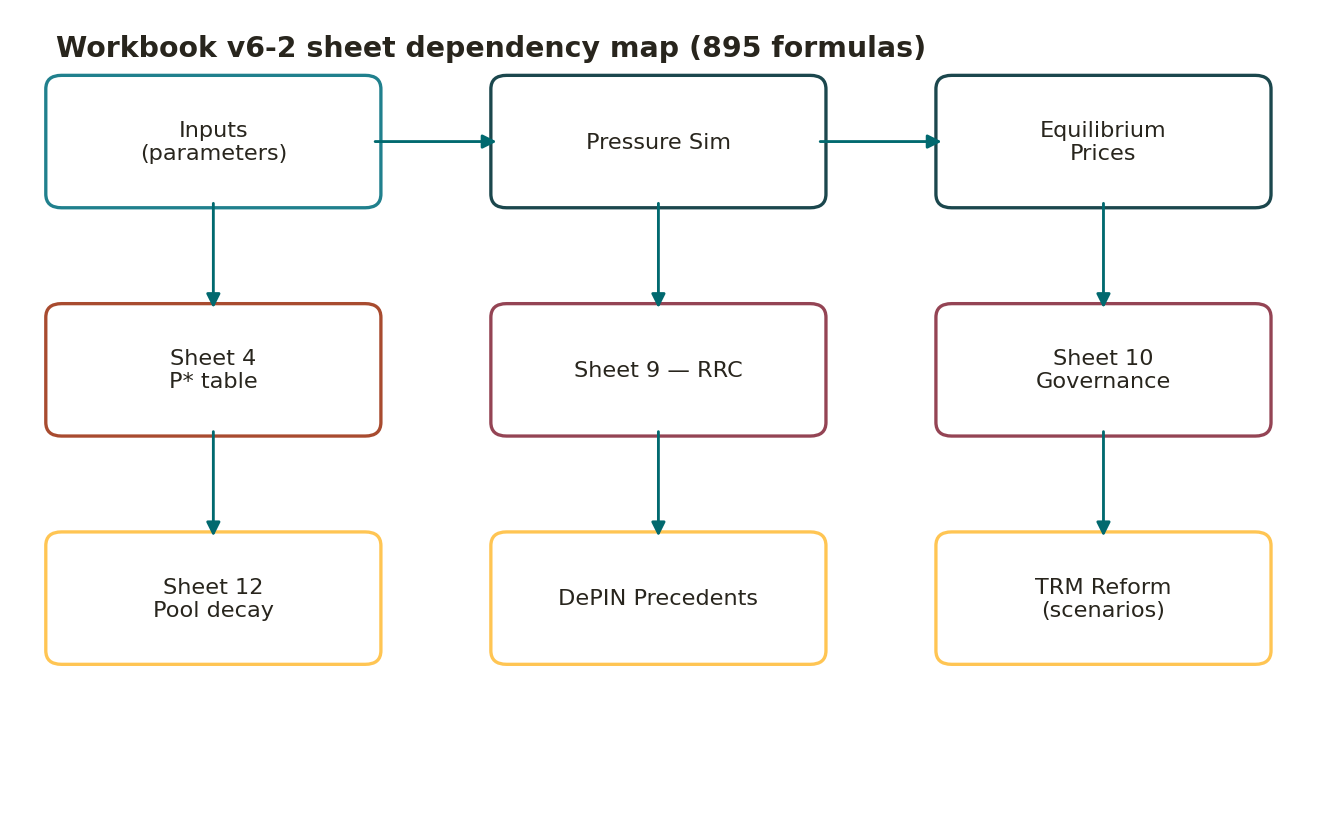
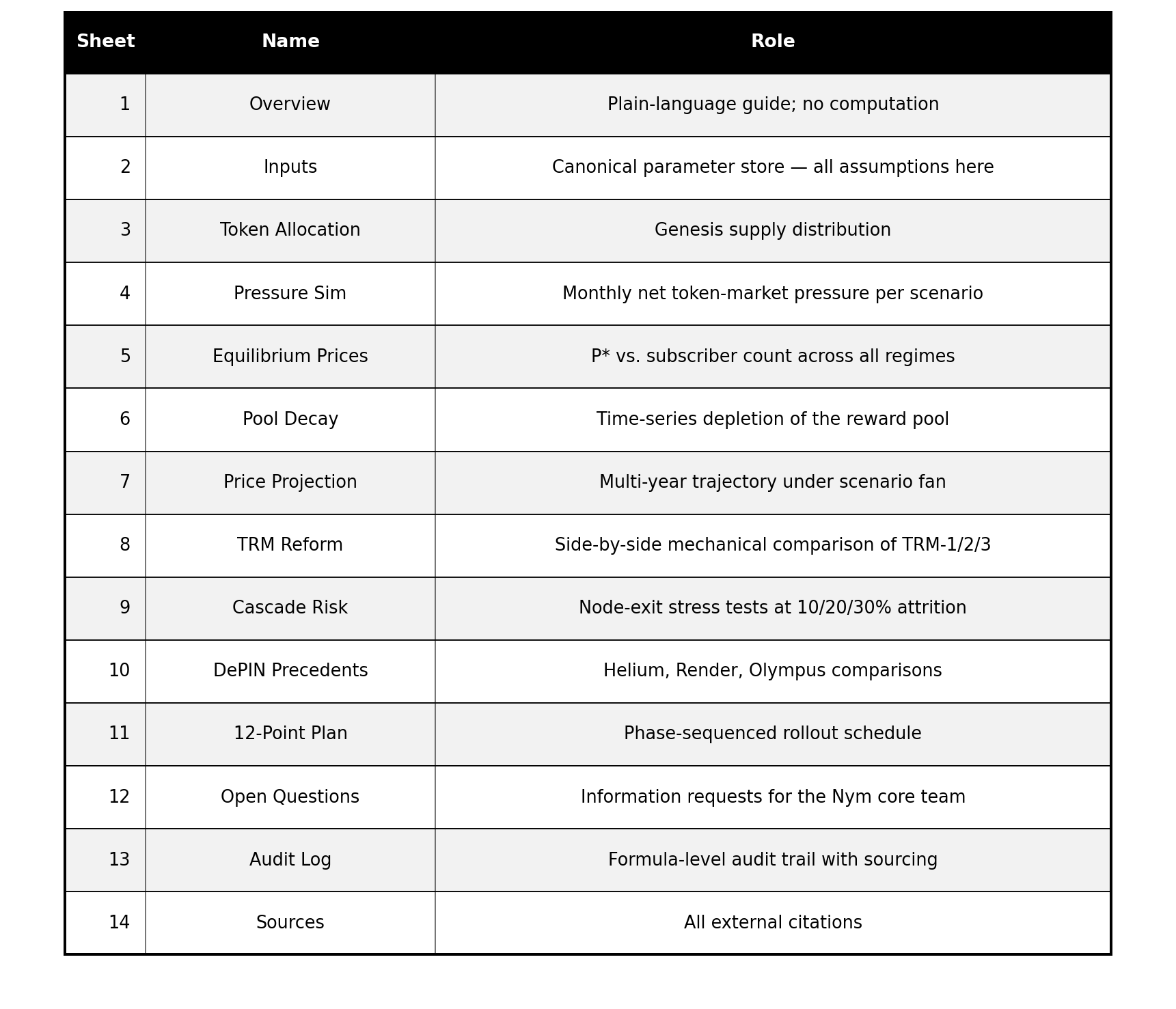
- Post 4: Workbook walkthrough — sheet-by-sheet structure and how to use it
- Post 5: Full mathematical derivations for all equations
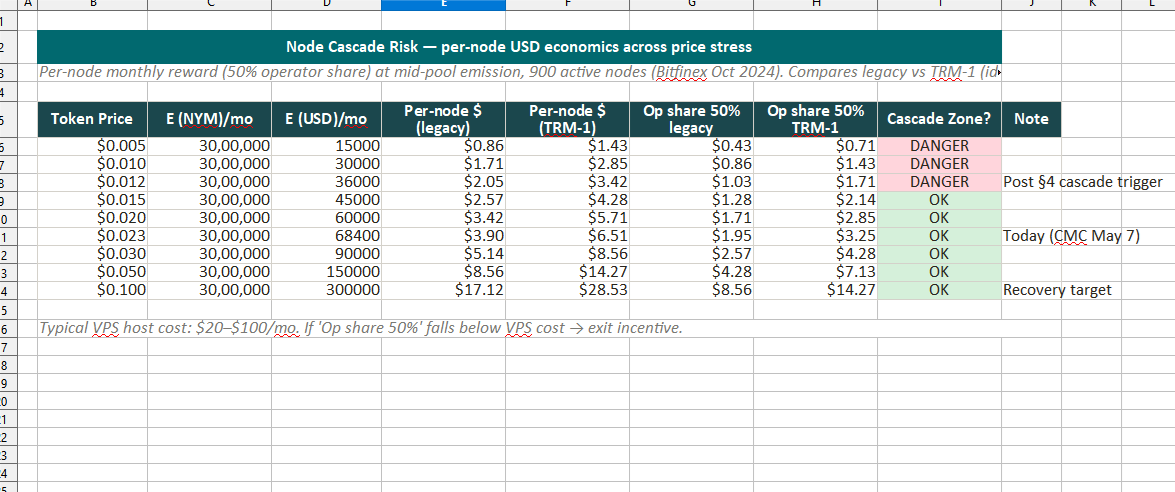
- Post 6: Scenario cascade analysis — 100k, 250k, 1M subscribers
- Post 7: Pressure simulation deep-dive
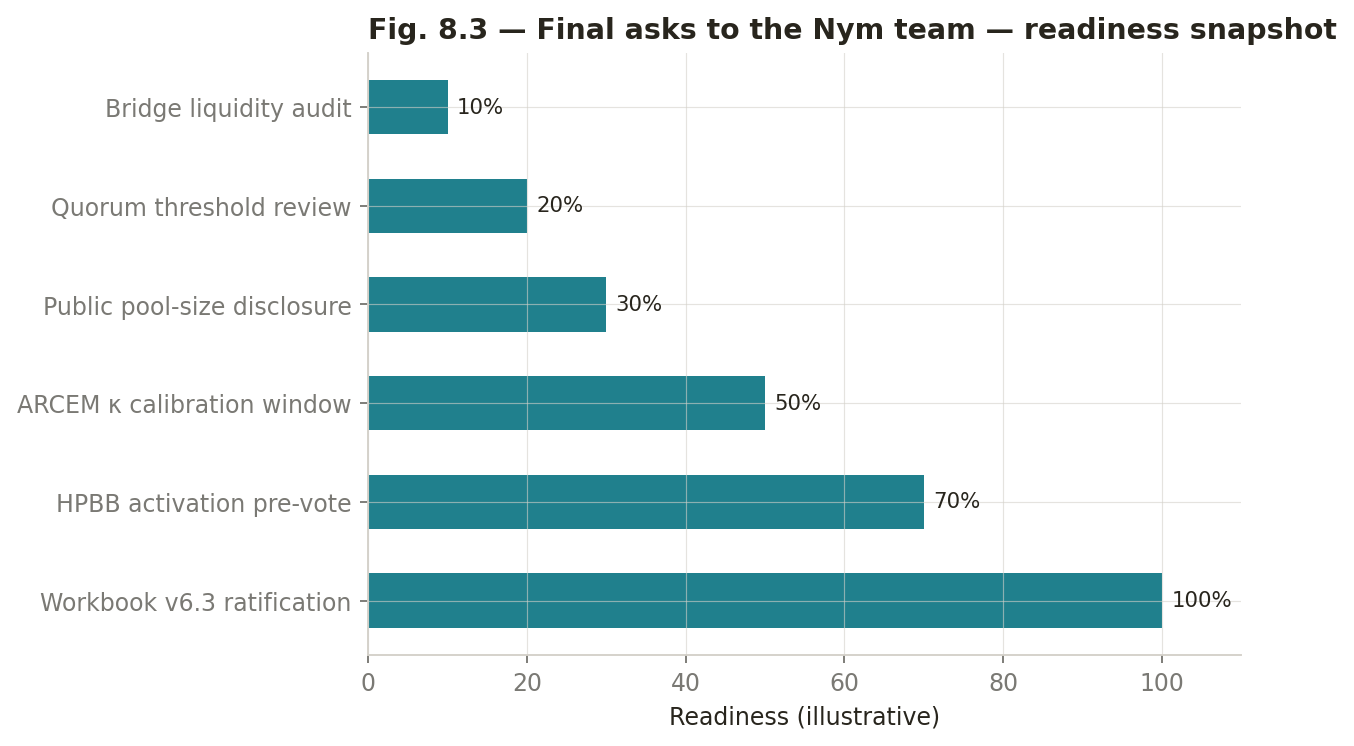
- Post 8: Governance asks and closing
- Post 9 (standalone): TRM-2 + TRM-3 formal proposal
Each post stands alone — you don’t need the others to follow the argument in this one.
References
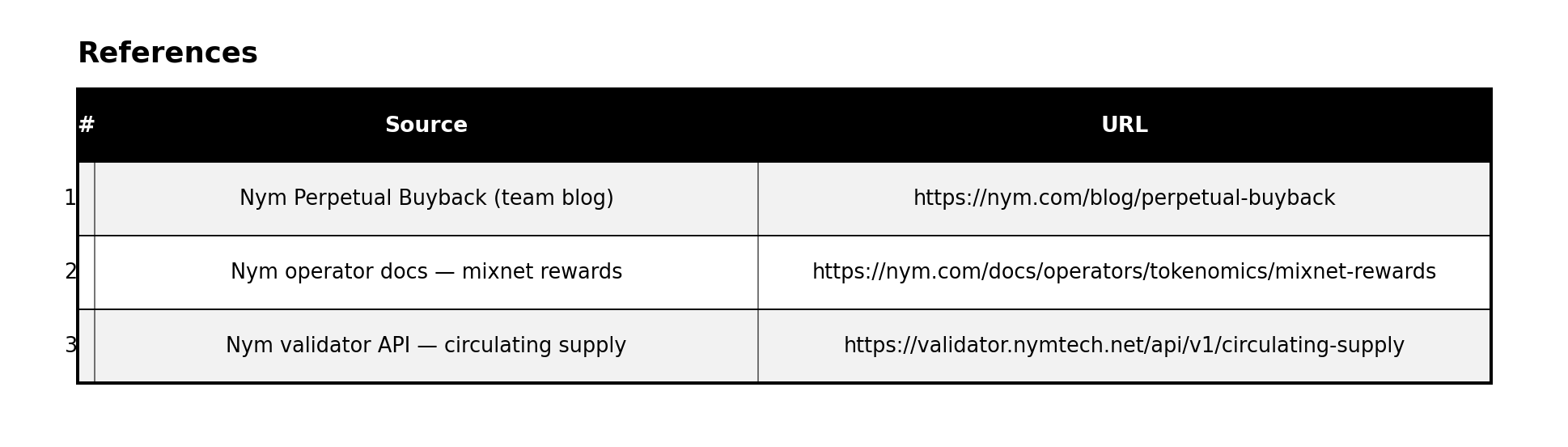
- Nym Technologies (2024). Nym Perpetual Buyback announcement. [https://nym.com/blog/Nym-perpetual-buyback](https://nym.com/blog/Nym-perpetual-buyback](https://nym.com/blog/Nym-perpetual-buyback))
- Nym Technologies (2024). NYM Token Buyback — November/December 2024 test. [https://nym.com/blog/nym-token-buyback](https://nym.com/blog/nym-token-buyback](https://nym.com/blog/nym-token-buyback))
- Nym Technologies (2022). Staking in Nym: Introducing Mainnet Mixmining. [https://nym.com/blog/staking-in-nym-introducing-mainnet-mixmining](https://nym.com/blog/staking-in-nym-introducing-mainnet-mixmining](https://nym.com/blog/staking-in-nym-introducing-mainnet-mixmining))
- Nym Technologies. Mixnet operator tokenomics — reward formula. [https://nym.com/docs/operators/tokenomics/mixnet-rewards](https://nym.com/docs/operators/tokenomics/mixnet-rewards](https://nym.com/docs/operators/tokenomics/mixnet-rewards))
- Nym validator API — circulating supply endpoint. [https://validator.nymtech.net/api/v1/circulating-supply](https://validator.nymtech.net/api/v1/circulating-supply](https://validator.nymtech.net/api/v1/circulating-supply))
- CoinMarketCap (2026). NYM price and metrics. [https://coinmarketcap.com/currencies/nym/](https://coinmarketcap.com/currencies/nym/](https://coinmarketcap.com/currencies/nym/))
- Tokenomist.ai (2026). NYM token supply schedule. [https://tokenomist.ai/nym](https://tokenomist.ai/nym](https://tokenomist.ai/nym))
- NymVPN Support (2026). Subscription pricing. [https://support.nym.com/hc/en-us/articles/31880660962577](https://support.nym.com/hc/en-us/articles/31880660962577](https://support.nym.com/hc/en-us/articles/31880660962577))
- Companion workbook: NYM_Tokenomics_Simulation_v6-2
— Bikram (community researcher, Nym Network)




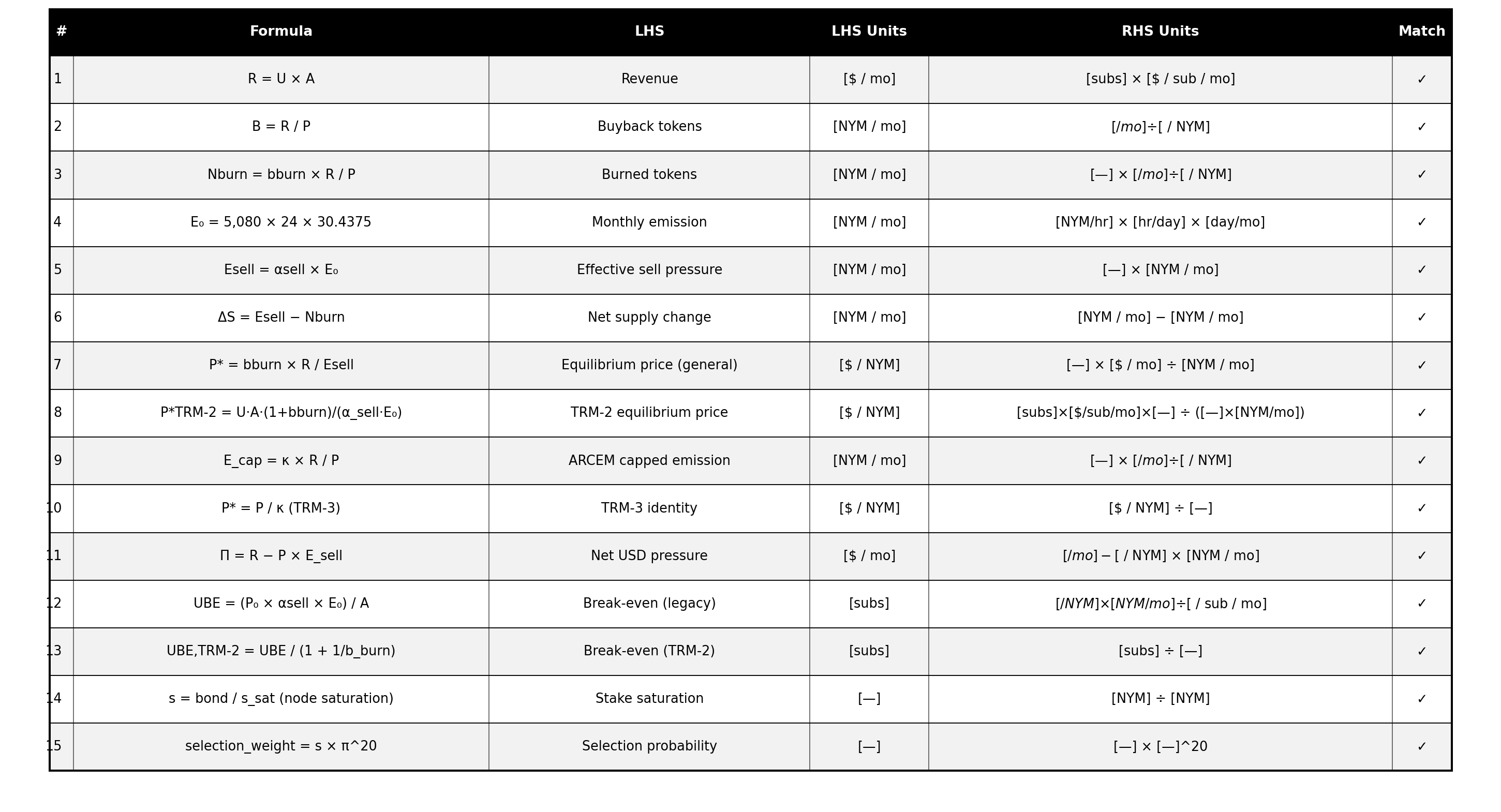
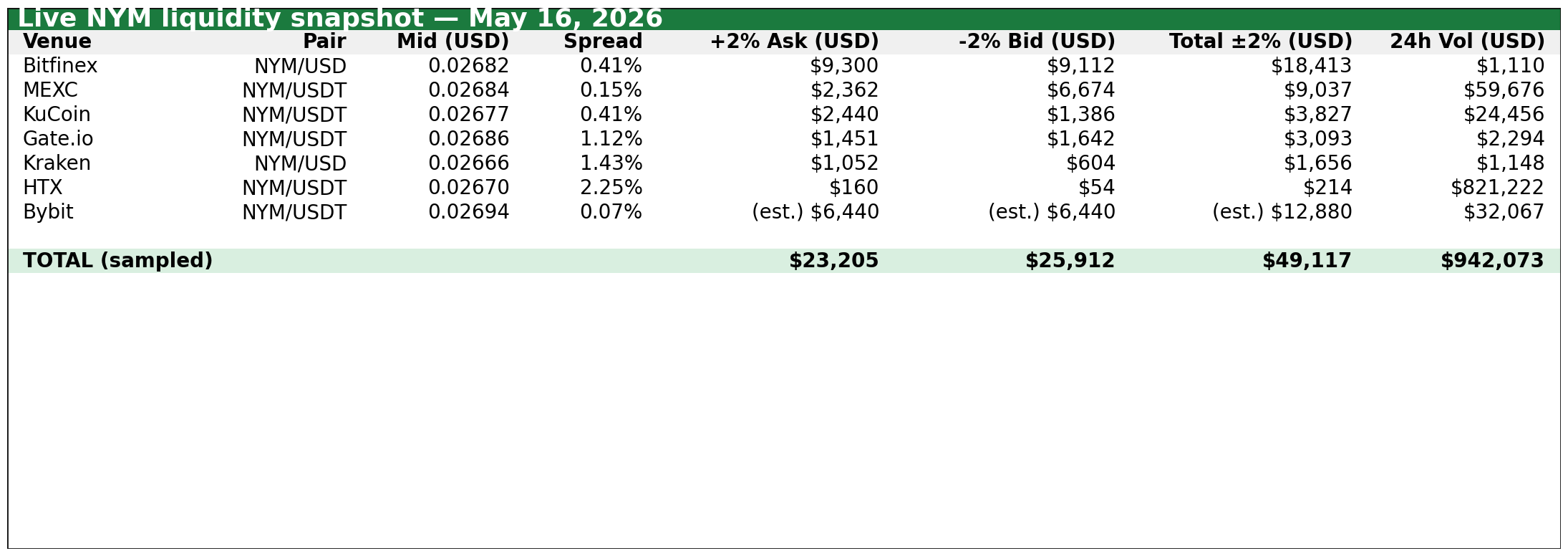
 v4 Physics Correction — Read Before Citing Any P* Number. Every P* derived in this appendix is a closed-form static ceiling (P*_static) — the algebraic equilibrium under the assumption that buyback always executes at spot P₀ and that order-book depth is infinite. The realised market price (P*_dynamic) is materially lower once price-feedback (B(P) = R/P shrinks as price rises) and finite ±2% ask-depth liquidity are included. At b_burn = 0.40, U = 100k: P*_static = $0.329/NYM (14.4× spot) vs P*_dynamic ≈ $0.092/NYM (4.1× spot). Full dynamic derivation: Addendum (Liquidity-Aware Reality Check), eq. 44, market-depth coefficient C ≈ 0.98. Every formula below is mathematically correct; the static-ceiling caveat governs how the numerical outputs should be interpreted. Not a price prediction.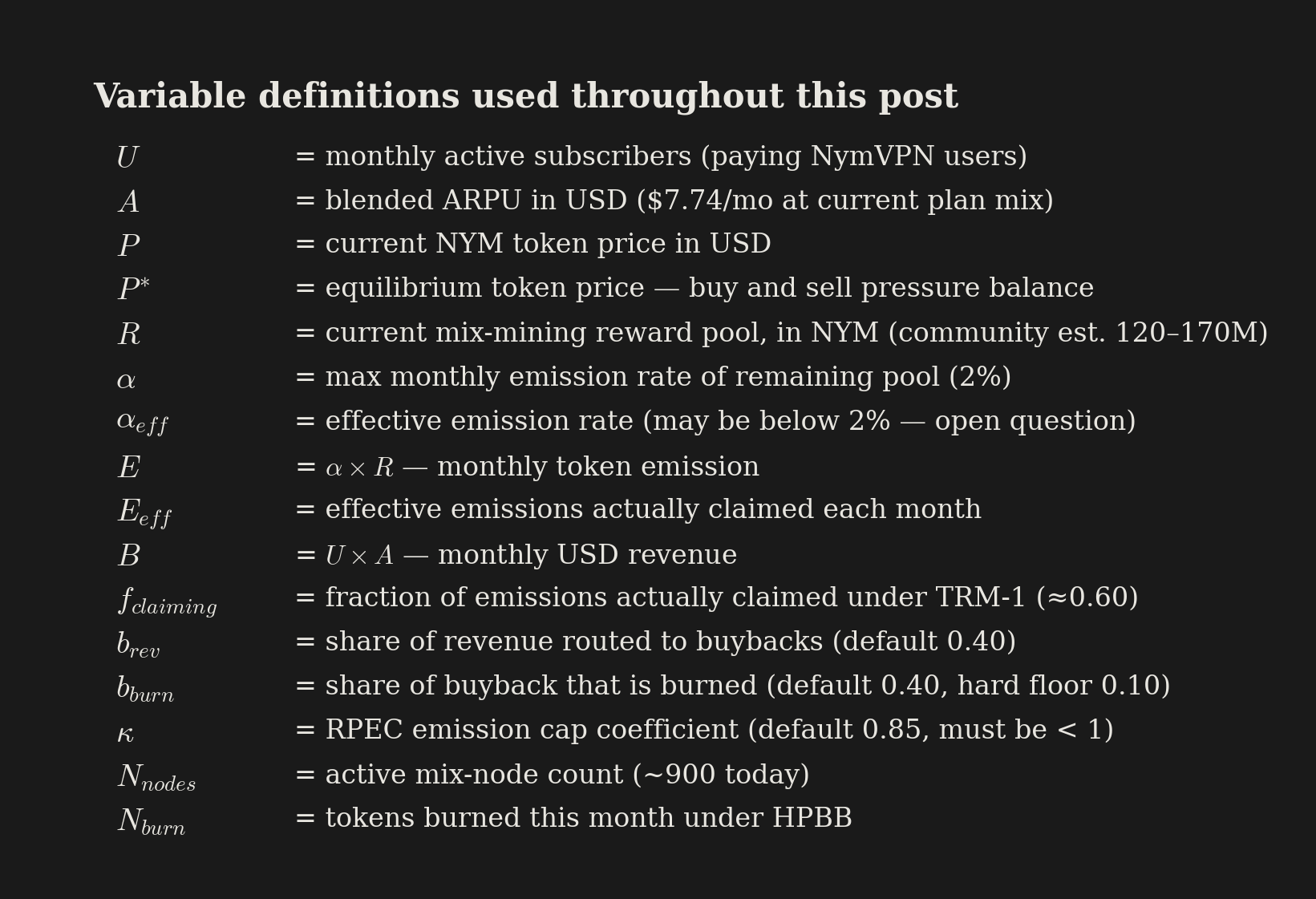








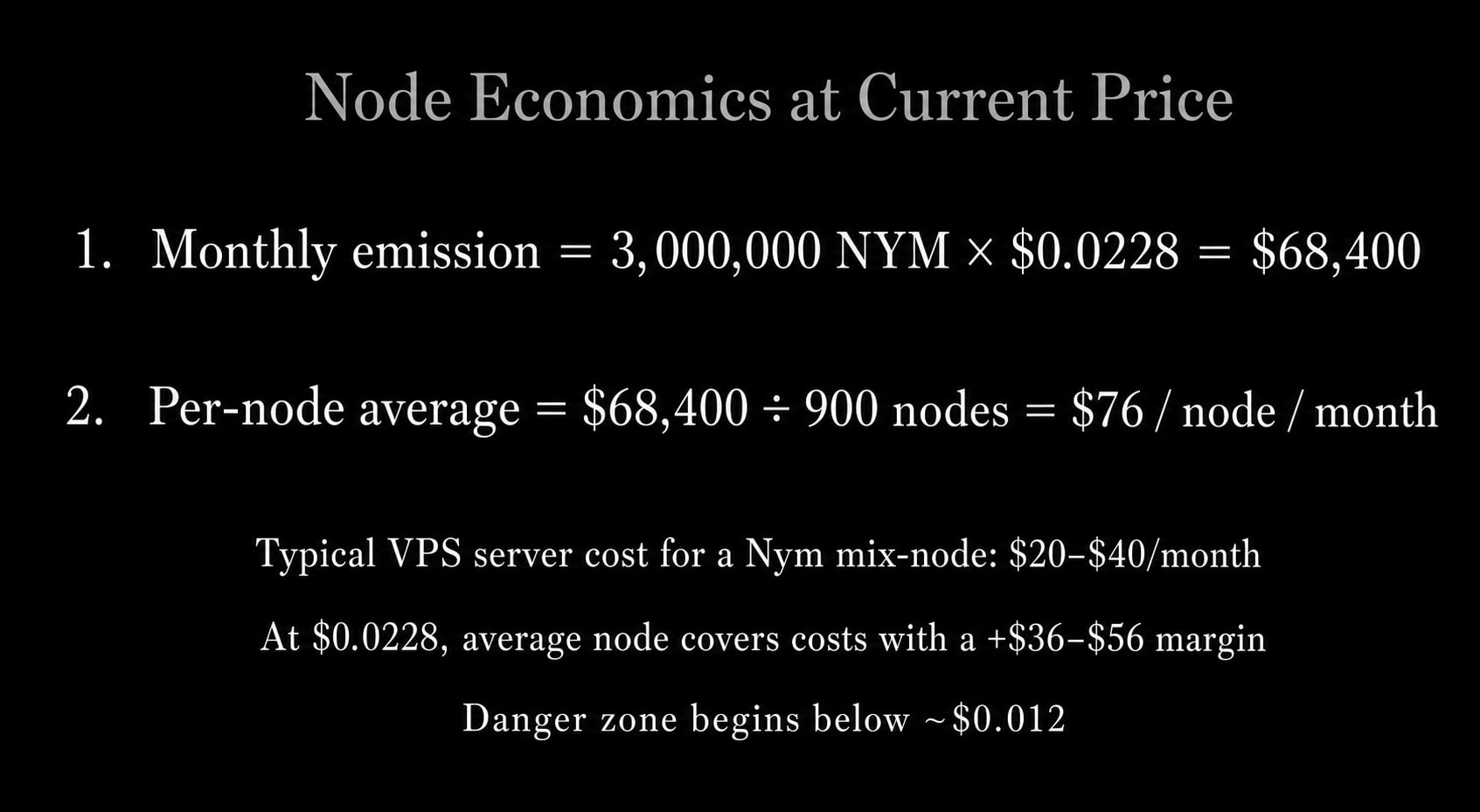
 Yes, +$46 margin
 Break-even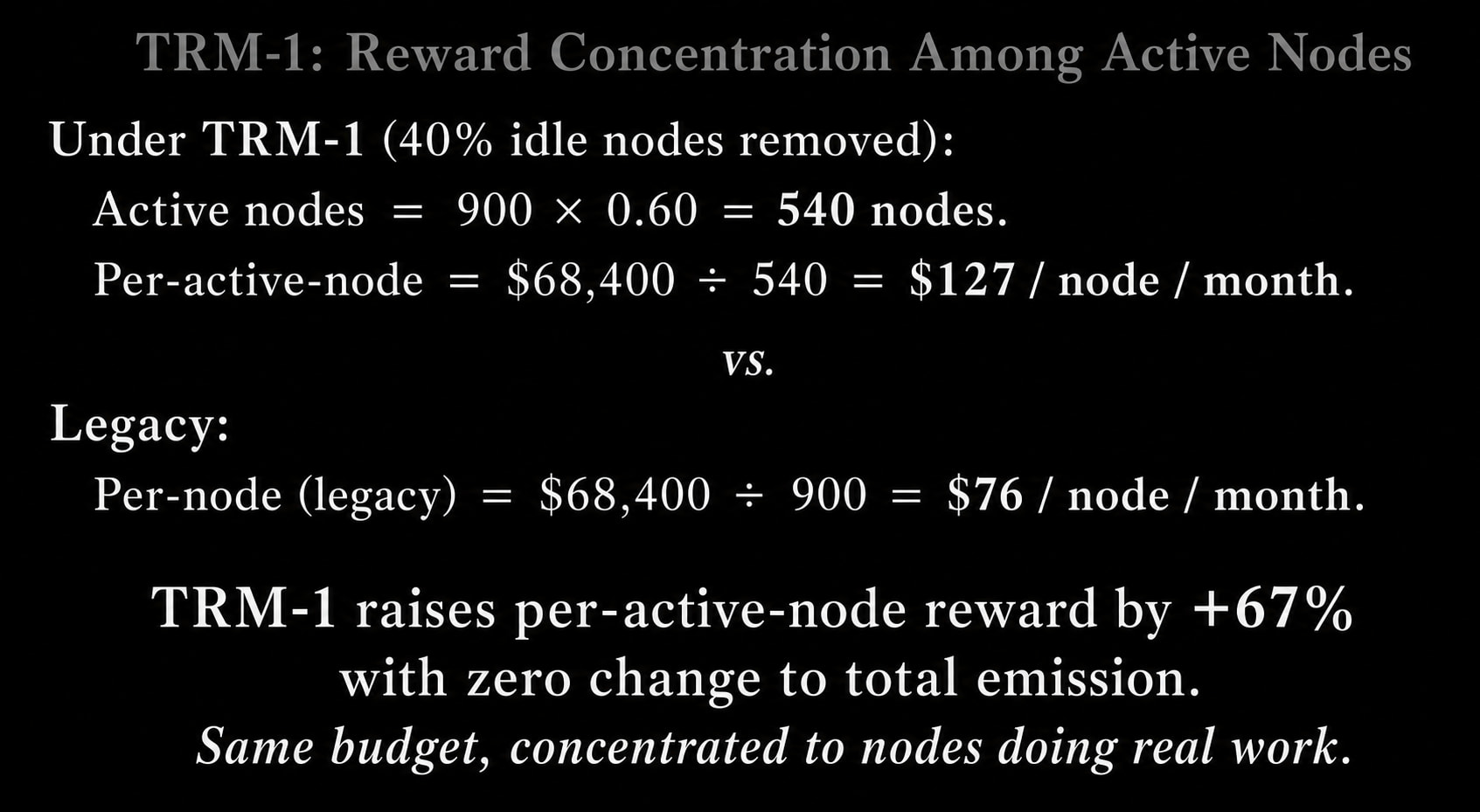
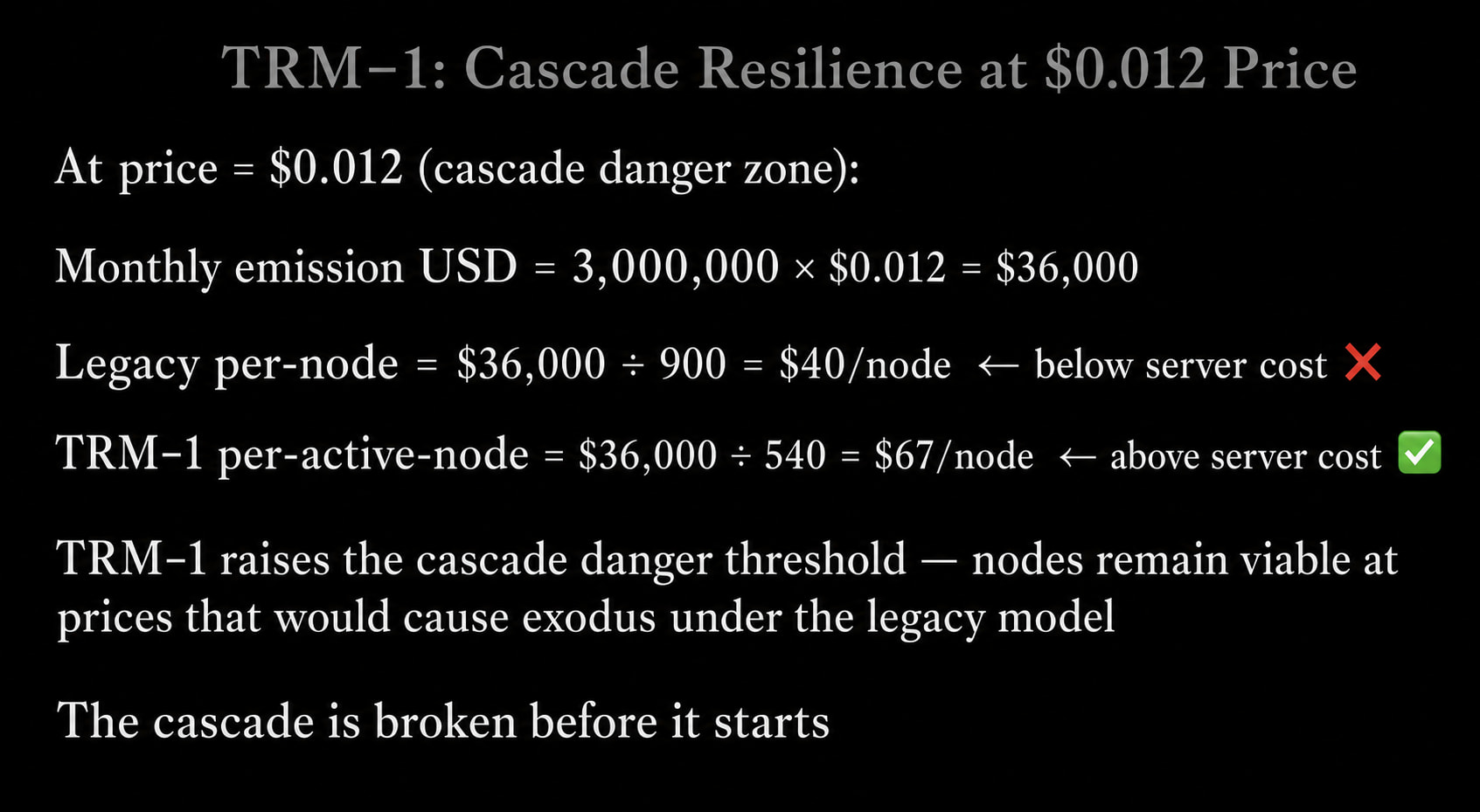
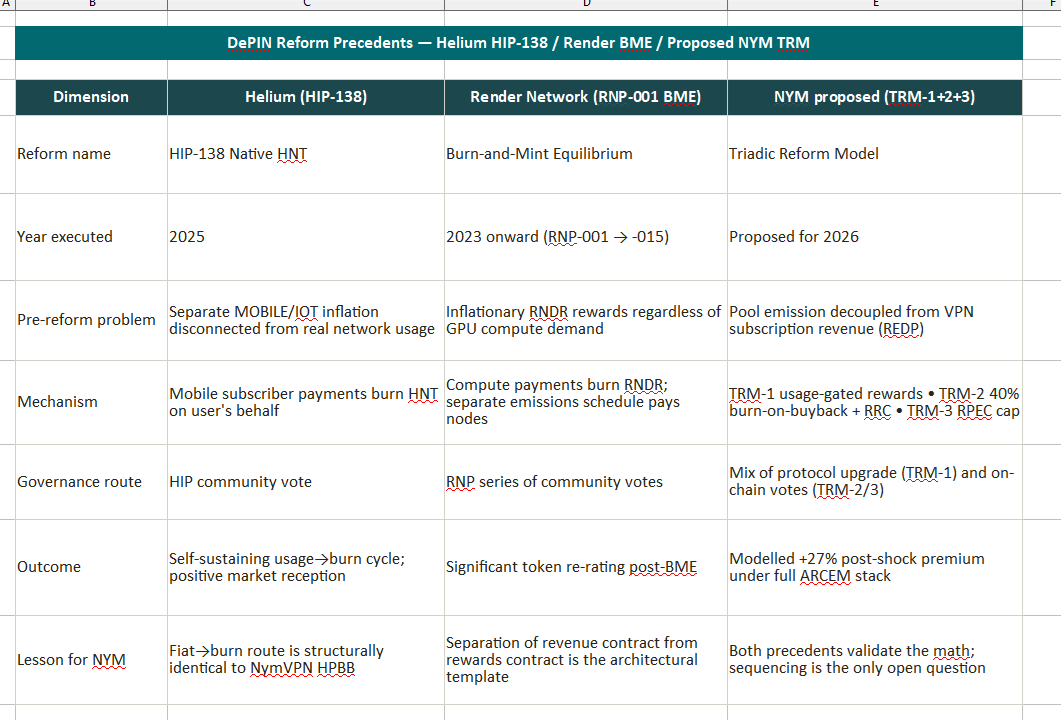
 Assumed — Reasonable approximation used where no public data exists