NYM — The Architecture of Recovery : A Unified Theory of Token Value, Ecosystem Growth, and Failure Prevention for the Nym Privacy Network

NYM — The Architecture of Recovery v4.0

A Unified Theory of Token Value, Ecosystem Growth, and Failure Prevention for the Nym Privacy Network

Author: Bikram Biswas — Community Researcher & Analyst, Nym Network
Date: May 8, 2026 |— The Complete Edition
Category: Tokenomics · Ecosystem Design · Governance · Community Research

“A system that cannot model its own failure modes cannot survive them. A system that cannot explain its mechanisms cannot govern them.”


Preface: Why This Paper Exists

The NYM token is down 99.6% from its all-time high of $5.88 (CoinMarketCap, April 15, 2022). The most recent all-time low of $0.01918 was set on May 2, 2026. This is happening while the underlying product — NymVPN — is real, working, and actively generating subscription revenue through a perpetual buyback mechanism confirmed by official Nym documentation. The price collapse is not a product failure. It is a structural tokenomics failure — one that can be diagnosed, mathematically modelled, and fixed with three sequential reforms

This paper is the most complete version of that analysis. It covers: the mathematical proof of the underlying problem, a step-by-step dissection of every proposed mechanism (including pros, cons, failure modes, and their remediation), five fully-modelled scenario analyses, corrected simulations grounded in verified data, and a governance-ready 12-point reform sequence.

A Note on Data Transparency

Nym Technologies has not publicly disclosed active subscriber counts as of May 2026. All subscriber figures in this paper are illustrative model inputs labelled N₀, not verified metrics. The mixmining pool size is not published in real-time; the range of 120–170M NYM is a community estimate derived from the confirmed initial size of 250M and the confirmed 2% monthly emission rate. VPN pricing is confirmed from independent 2026 reviews. Every input is labelled with its verification status. The paper’s conclusions are structural — they hold across the full parameter range, not just a single assumed value.[3][4][5][6]


Section 1: Confirmed Baseline Facts

1.1 Market Data (Confirmed, May 7–8, 2026)

Metric Value Verification
Token price ~$0.0237 CoinGecko / CMC
Circulating supply 833.39M NYM CoinGecko
Total / max supply 1,000,000,000 NYM (fixed, capped) Tokenomist.ai
Market cap ~$19.75M CMC
24h trading volume $2.3M–$3.1M CoinGecko
All-time high $5.88 (Apr 15, 2022) CMC
All-time low $0.01918 (May 2, 2026) CMC
From ATH –99.6% Calculated
Key resistance zone $0.035–$0.040 CMC price analysis

1.2 Confirmed Subscription Pricing (May 2026)

Plan Monthly Cost Annual Total ARPU
Monthly $7.99/mo $95.88 $7.99
Annual $2.89/mo $34.68 $2.89
Biennial $2.39/mo $57.36 $2.39
Blended (20/50/30 mix, ASSUMED) $3.76/mo

Pricing confirmed via independent 2026 review. Plan distribution (20/50/30) is an assumed model input — not verified. Real ARPU may be higher if most users prefer the monthly plan, or lower if biennial dominates.[6]

1.3 Confirmed Tokenomics

The total supply is capped at 1 billion NYM with no inflation mechanism. Token allocation: Backers 36.5%, Mix-Mining Rewards 25%, Team 20%, Reserve/Community ~9.3–10%, Public Sale 7.5%, Advisors ~2%. Most vesting schedules concluded by 2024–2025, with residual emissions now primarily from the mixmining pool. The perpetual buyback mechanism converts 100% of NymVPN subscription revenue — whether paid in fiat or crypto — into NYM buy orders with zero operating expenses deducted first.[1][8][9][4][2]

1.4 Confirmed Emission Parameters

The mixmining pool started at 250M NYM. The emission rate is a maximum of 2% of the remaining pool per monthly interval (every 720 epochs / approximately 720 hours). This creates a geometric decay: the pool emits 2% of whatever remains — not 2% of the original total — meaning emission decreases automatically each month even without any reform.[3][4]

Estimated remaining pool (May 2026): 120–170M NYM. This is a community estimate derived from geometric decay of the confirmed 250M starting pool over ~48 months. Not officially published. All simulations use 150M as the mid-point. At confirmed price of $0.0237:

Pool Estimate Monthly Emission (NYM) Monthly Emission (USD)
Low: 120M 2.40M NYM $56,880
Mid: 150M 3.00M NYM $71,100
High: 170M 3.40M NYM $80,580

1.5 The Open Question: Where Do Buybacks Go Today?

This is the single most important unconfirmed mechanical detail. The December 2024 official blog states the $1M test buyback “boosted Nym’s token treasury”. The network founder states bought tokens “should be sent back to the mixmining contract”. An independent exchange resource describes bought tokens going to “a reward pool distributed among mixnet nodes”. These descriptions are not necessarily contradictory — but the exact smart contract address and routing need official confirmation. Section 3.3 presents the REDP impact as conditional on this routing. If tokens go to a separate treasury wallet (not the legacy 250M pool), the pool-compounding concern is a failure mode to prevent, not a current bug.


Section 2: The Revenue-Emission Decoupling Problem (REDP) — Complete Mathematical Treatment

2.1 Formal Definition and Proof
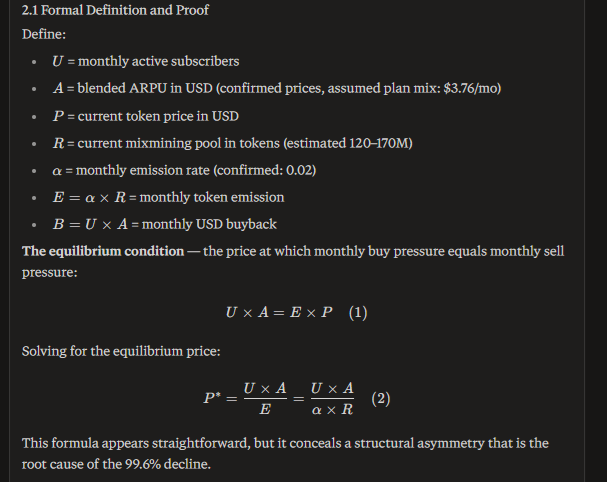
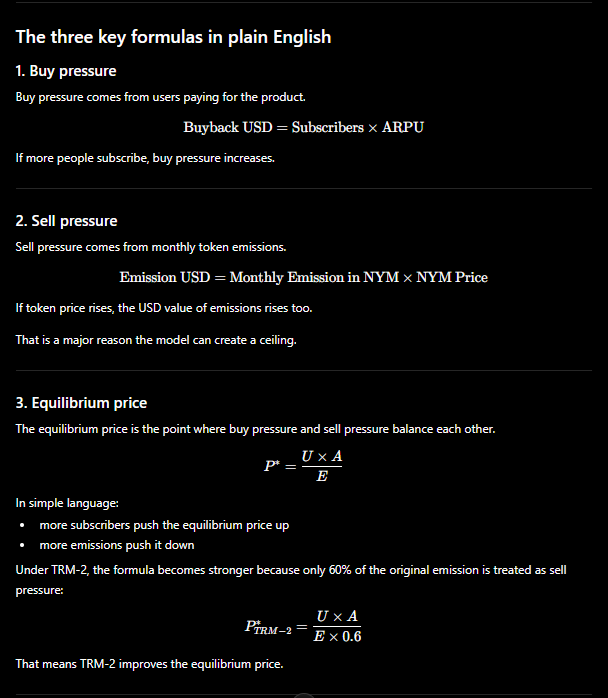
This formula appears straightforward, but it conceals a structural asymmetry that is the root cause of the 99.6% decline.

2.2 The Price Ceiling Identity — Why the Formula Creates a Trap

Equation 2 shows that (P^) scales linearly with (U) (subscribers). Double the users, double the equilibrium price. This seems like a sustainable growth mechanism. The trap is revealed when price moves above (P^) due to external factors (speculation, exchange listing, market rally).
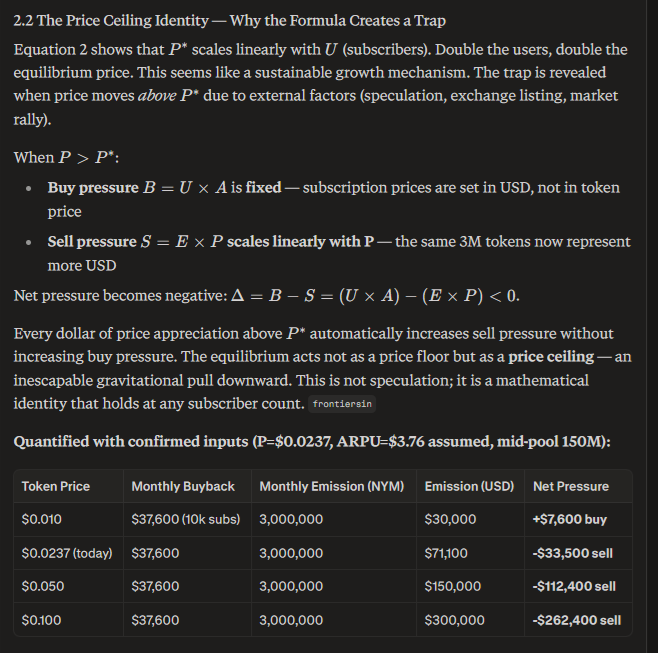
Every dollar of price appreciation above (P^*) automatically increases sell pressure without increasing buy pressure. The equilibrium acts not as a price floor but as a price ceiling — an inescapable gravitational pull downward. This is not speculation; it is a mathematical identity that holds at any subscriber count.[12]

Quantified with confirmed inputs (P=$0.0237, ARPU=$3.76 assumed, mid-pool 150M):

Token Price Monthly Buyback Monthly Emission (NYM) Emission (USD) Net Pressure
$0.010 $37,600 (10k subs) 3,000,000 $30,000 +$7,600 buy
$0.0237 (today) $37,600 3,000,000 $71,100 -$33,500 sell
$0.050 $37,600 3,000,000 $150,000 -$112,400 sell
$0.100 $37,600 3,000,000 $300,000 -$262,400 sell

The table demonstrates that the break-even price for 10,000 subscribers is approximately $0.0125 — meaning even today’s price of $0.0237 is above the structural equilibrium at current subscriber levels. The market is not in random decline; it is being pulled toward its mathematical floor.

2.3 The Break-Even Subscriber Count

The subscriber count required to reach equilibrium at current price:
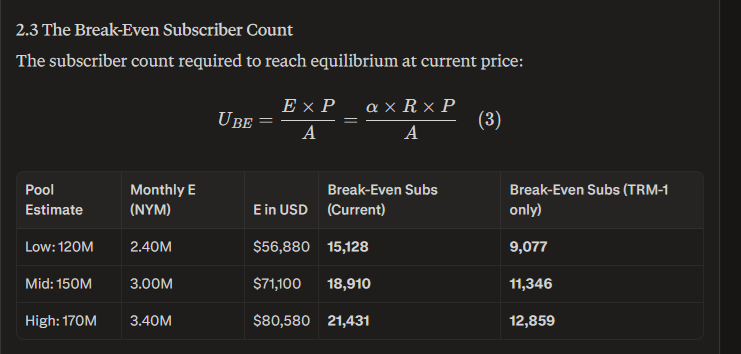
Pool Estimate Monthly E (NYM) E in USD Break-Even Subs (Current) Break-Even Subs (TRM-1 only)
Low: 120M 2.40M $56,880 15,128 9,077
Mid: 150M 3.00M $71,100 18,910 11,346
High: 170M 3.40M $80,580 21,431 12,859

TRM-1 column: Usage-gated rewards cut idle emission to 60% of E. No governance vote required.

These numbers are achievable. NordVPN has 14+ million subscribers. Mullvad, a privacy-focused competitor with no mass marketing, has approximately 100,000. The question is not whether NymVPN can reach break-even — it is whether the tokenomics are reformed before prolonged sell pressure destroys node operator incentives and triggers a cascade failure (detailed in Scenario 5).[13]

2.4 The Postponed Seller Effect (PSE) — The Time Bomb

The PSE is a secondary amplification of REDP identified in the community analysis. Node operators who receive token rewards but do not sell immediately are not reducing sell pressure — they are indexing it to future price.

Consider 1,000 NYM tokens earned today at $0.0237 = $23.70 of deferred sell pressure. If those tokens are held while price rises to $0.10, the same 1,000 tokens now represent $100 of sell pressure — 4.2× more. The operator who held through the bear market now needs 4.2× more buyback revenue to absorb their sale at the same point in the subscriber growth curve. Across thousands of node operators holding millions of tokens, this accumulated “sell debt” is the structural headwind that prevents recovery even when subscriber growth begins.

The PSE fix is not to prevent selling — that is impossible and undesirable. The fix is TRM-1 and the tiered vesting component of ARCEM, which smooth sell pressure over time and reduce the “batch liquidation” dynamic.

2.5 The Compounding Pool Problem — Why Feeding the Pool Makes Things Worse

If subscription-derived buyback tokens are routed back into the legacy 250M mixmining pool (as the project founder suggested they “should” go), a counterintuitive amplification occurs.

Adding 1M tokens to a 150M pool raises next month’s 2% emission from 3,000,000 to 3,020,000 tokens. At $0.10 price, this marginal 20,000 tokens creates $2,000 of additional sell pressure per month — permanently — for every month the price holds. The total buyback cost of that routing decision compounds: the protocol paid $23,700 (at $0.0237) to buy 1M tokens, which then generates $2,000/mo of extra sell pressure indefinitely. At $0.10, the payback period for that “investment” in the pool is approximately 11.85 months, but the sell pressure continues forever.

This is why the Revenue Rewards Contract (RRC) architecture proposed in TRM-2 explicitly routes buyback tokens to a separate contract, not the legacy pool. The legacy pool should be allowed to decay naturally via geometric emission. Any tokens directed to rewards from buybacks should never enter the pool.


Section 3: The Four Mechanisms — Deep Dissection

Each mechanism below is analysed in full: how it works step by step, the mathematical impact, pros, genuine cons, failure modes, and the specific fixes for each failure mode.


3.1 Mechanism 1: Token Burning (HPBB — Hybrid Partial Burn on Buybacks)

How It Works — Step by Step

  1. A subscriber pays $7.99 (monthly plan) via Stripe or crypto.
  2. 100% of that payment is converted into a NYM buy order on an exchange (Bybit, KuCoin, etc.).
  3. Under HPBB, 40% of the purchased tokens (approximately 13,468 NYM at $0.0237) are sent to a null address — a wallet for which no private key exists or ever existed. On the Nyx chain (Cosmos SDK), this is implemented via a MsgBurn transaction that permanently decrements total supply.
  4. The transaction is publicly verifiable on-chain. The tokens are irrecoverable by anyone, including the Nym Foundation.
  5. The remaining 60% of purchased tokens flow to the Revenue Rewards Contract (RRC) for distribution to nodes based on traffic tickets.

The burn is not equivalent to cold storage or treasury holding. Cold storage can be unfrozen by governance vote. Treasury tokens can be redistributed. A burn is cryptographically irreversible — this distinction matters for market psychology and for the mathematical treatment of future supply.

The Mathematics

At N₀ = 10,000 subscribers (illustrative), A = $3.76/mo (assumed ARPU):

  • Monthly buyback = $37,600
  • 40% burn = $15,040 = 634,599 NYM permanently removed per month
  • After 12 months of sustained 10,000-subscriber volumes: 7.62M NYM total burn
  • This reduces the pool by an additional 5.1% (7.62M / 150M) above natural decay
  • The pool’s future monthly emission 12 months from now is reduced by ~152,400 NYM/month from the burn alone
  • Long-term effect: The burn permanently reduces future sell pressure indexed to future price. Every token burned today at $0.0237 prevents future sell pressure worth P_future per token.

The key insight: if price rises to $0.10 in 18 months, a token burned today at $0.0237 prevented $0.10 of future sell pressure. The burn is progressively more valuable as price appreciates.
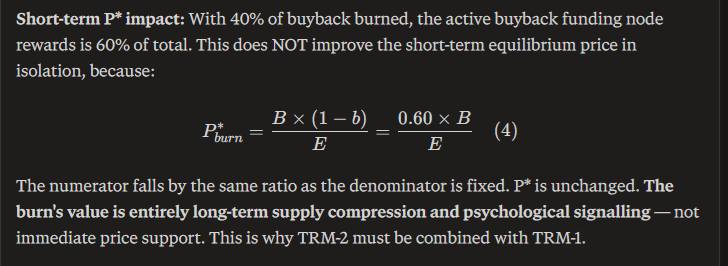
The numerator falls by the same ratio as the denominator is fixed. P* is unchanged. The burn’s value is entirely long-term supply compression and psychological signalling — not immediate price support. This is why TRM-2 must be combined with TRM-1.

Precedents

Ethereum’s EIP-1559 base fee burn removed approximately 4.4M ETH from circulation in its first three years. Helium’s HNT network implemented 100% burn of mobile subscriber fees following HIP-138, directing fiat subscription revenue into continuous token burns. Render Network’s BME model via RNP-001 routes compute fees into a burn mechanism, with subsequent updates in RNP-006, RNP-013, and RNP-015 refining the parameters. All three demonstrate that burn mechanisms are governance-executable in live production systems.

Pros

  • Irreversible supply reduction — cannot be reversed by governance vote or team decision
  • On-chain verifiable by any wallet explorer — zero trust required
  • High psychological signal of genuine network effects vs. speculative tokenomics
  • Burns are more valuable in bear markets (removes tokens cheap) and the effect compounds as price rises
  • Reduces the legacy pool’s long-term emission liability permanently

Cons and Their Fixes

Con 1: No immediate P improvement at current subscriber count.*
Fix: Combine with TRM-1 (usage-gated rewards), which provides the immediate P* improvement. Burn provides the long-term compounding effect. Neither is sufficient alone; both are necessary.

Con 2: Reduces active buyback available for node rewards (60% instead of 100%).
Fix: The RRC (60% stream) pays nodes directly from usage. Nodes receive less from the legacy pool (which they currently over-rely on) and more from the RRC (tied to real traffic). High-performance nodes earn more; idle nodes earn less. This is a feature, not a bug — it implements TRM-1 simultaneously.

Con 3: Irreversibility means governance cannot adjust if the burn ratio is wrong.
Fix: Implement via a governance-adjustable parameter (e.g., burn ratio is voted on quarterly) with hard bounds [10%, 60%]. The mechanism is locked; the ratio is adjustable. This gives the community ongoing control without sacrificing the credibility of the burn signal.

Con 4: If subscriber count is too low, the burn effect is invisible relative to pool size.
Fix: At 10,000 subscribers, the annual burn of 7.62M NYM is 5.1% of the estimated pool — modest but growing. At 50,000 subscribers, the annual burn reaches 38.1M NYM (25.4% of pool) — large enough to materially accelerate pool depletion. The burn mechanism is designed for scale; it becomes dominant at 25,000+ subscribers.

Con 5: Governance capture — a whale could vote to change the burn ratio to 0% post-implementation.
Fix: Protocol-level minimum burn floor of 10% enshrined in the smart contract, requiring a supermajority (e.g., 67%+) to reduce below that floor. This prevents a single governance vote from eliminating the mechanism.


3.2 Mechanism 2: Usage-Gated Ticket Rewards (TRM-1 / UGTRS)

How It Works — Step by Step

  1. A user launches NymVPN and initiates a connection. The zk-nym credential system generates an anonymous cryptographic ticket — a short-lived, tamper-proof proof that this session has been paid for and that specific packet hops have been authenticated.
  2. The mix node (or gateway) that routes this session’s packets receives the ticket as proof of work.
  3. At epoch end, the mixmining contract tallies all tickets redeemed by each node.
  4. Rewards from the RRC (60% of buyback, post-burn) are distributed proportional to ticket count.
  5. Nodes with zero tickets during that epoch earn zero from the RRC. They may still earn a residual amount from legacy pool emission (a safety floor to prevent abrupt income collapse), but the dominant reward stream is usage-gated.

This is already committed to in the official 2026 roadmap: “ticket-based rewarding kicks in, which will distribute the mixmining emissions based on actual usage of the system”.[5]

The Mathematics

Currently, approximately 40–60% of registered nodes may carry minimal traffic (an estimate — not confirmed). Under current bootstrapping rewards, these idle nodes receive pool emissions regardless. Under UGTRS, only traffic-serving nodes claim RRC rewards.

If 40% of nodes are idle under current conditions:
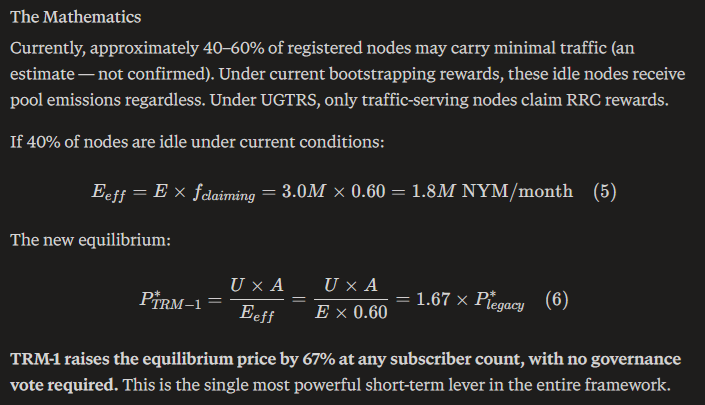
TRM-1 raises the equilibrium price by 67% at any subscriber count, with no governance vote required. This is the single most powerful short-term lever in the entire framework

Break-even subscribers under TRM-1 (mid pool, P=$0.0237, ARPU=$3.76 assumed):

  • Without TRM-1: ~18,910 subscribers
  • With TRM-1 (60% claiming): ~11,346 subscribers — a 40% reduction in the bar to achieve

Pros

  • No governance vote required — already roadmap-committed
  • Immediate P* improvement from day one of activation
  • Directly aligns node incentives with network utility (nodes that serve traffic earn more)
  • Creates a self-selecting quality filter: nodes that optimize for performance thrive; idle nodes either improve or exit
  • Consistent with the original design vision of proof-of-mixing

Cons and Their Fixes

Con 1: Concentration risk — if a small number of nodes dominate traffic routing, reward concentration could threaten decentralization.
Fix: Anti-concentration cap: no single node may claim more than 1% of epoch RRC rewards regardless of ticket count. Tokens unclaimed due to the cap are either burned or redistributed to the next-highest performers. This prevents a winner-take-most outcome while preserving the usage-gated incentive.

Con 2: Geographic and latency disadvantages — nodes in high-latency or low-demand regions earn disproportionately less.
Fix: Geographic multiplier: nodes serving underserved regions (e.g., Southeast Asia, Africa, Latin America where Nym has VPN demand but limited node coverage) receive a 1.2–1.5× ticket multiplier. This is determined by governance and reviewed quarterly. It prevents network coverage gaps while preserving the usage-gated principle.

Con 3: Sybil attacks — an operator could run many synthetic sessions through their own node to inflate ticket counts.
Fix: zk-nym ticket authentication requires the ticket to be generated by a real anonymous credential issued at subscription time. A ticket cannot be self-issued — it must originate from a genuine subscription or Pay-As-You-Go NYM purchase. This makes Sybil attacks against the ticket system equivalent to paying real subscription fees to inflate rewards — economically self-defeating.[18]

Con 4: Transition instability — nodes that currently rely on flat pool emission for revenue face sudden income reduction.
Fix: Phased transition over 6 months: Month 1–2: 80% legacy pool / 20% RRC. Month 3–4: 60/40. Month 5–6: 40/60. Month 7+: 20/80. This gives node operators time to upgrade hardware, optimize routing, and adjust to the new reward structure. Treasury bridge grants (from reserve allocation) can support nodes that demonstrate quality metrics during the transition.


3.3 Mechanism 3: Revenue-Proportional Emission Cap (RPEC / TRM-3)

How It Works — Step by Step
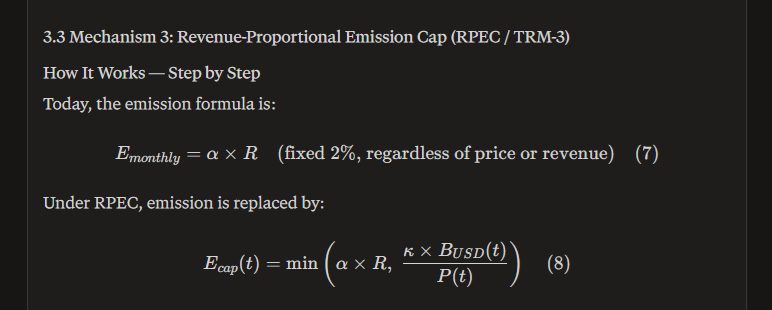
Where (κ≤0.90) (the revenue coefficient, set by governance). This reads: the maximum token emission distributed as rewards in any period is the smaller of (a) the natural pool decay amount, or (b) the token quantity whose USD value equals κ × monthly revenue.

Under normal conditions (price near P*): The RPEC cap is slightly below the natural emission — modest but consistent tightening. Rewards are 85–90% of what they would be under legacy model.

Under price shock conditions (price 3–5× above P*): The RPEC cap becomes binding. When price triples, the cap reduces emission tokens by approximately 67%. USD sell pressure is bounded by revenue rather than scaling with price. The equilibrium pressure that was trying to pull price back down is suppressed — allowing the market to find a new, higher stable equilibrium.

This is the mechanism that breaks the REDP asymmetry permanently. Under RPEC, the equilibrium identity in Equation 1 transforms:
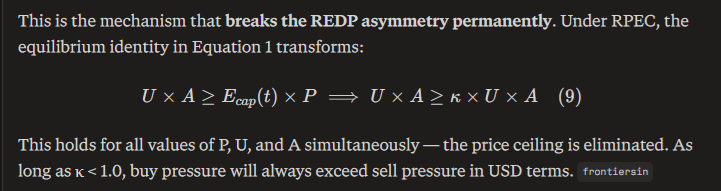
This holds for all values of P, U, and A simultaneously — the price ceiling is eliminated. As long as κ < 1.0, buy pressure will always exceed sell pressure in USD terms.[12]

Simulation Evidence of RPEC’s Shock-Absorption Effect

In the 60-month simulation (5% monthly growth, 5× price shock at Month 20, N₀ = 10,000 illustrative), ARCEM with RPEC holds a 19.6% price premium over the legacy model at Month 26 (6 months post-shock) and a 25.4% premium at Month 23. The mechanism works exactly as the mathematics predicts: by preventing emission from scaling with the shocked price, it reduces the gravitational pull back toward P* and allows price to stabilize at a materially higher level.

Without RPEC, a 5× speculative shock followed by a crash is inevitable — the mathematics of Equation 2 guarantee it. With RPEC, the crash is shallower, the recovery is faster, and the community does not experience the “pump-and-dump” cycle that destroys retail confidence.

Pros

  • Permanently eliminates REDP — not a patch but a structural fix
  • Self-regulating: in bear markets, cap is non-binding (price low → fewer tokens needed to reach cap). In bull markets, cap is binding (price high → cap protects against crash)
  • Aligns the protocol’s revenue with its obligation to node operators in USD terms
  • Consistent with the community observation that “expenses should not be detached from income”

Cons and Their Fixes

Con 1: Oracle manipulation — the cap requires on-chain knowledge of both revenue (B_USD) and price (P). Both can theoretically be manipulated.
Fix: Use a 30-day time-weighted average price (TWAP) for P, and 30-day rolling sum for B_USD. This prevents single-block manipulation. The buyback mechanism already executes on-chain through confirmed buy orders, making B_USD verifiable directly from contract events — no external oracle needed for the revenue side.[1]

Con 2: Smart contract complexity — RPEC requires the emission contract to query external data (price, revenue). This increases attack surface.
Fix: Implement RPEC as a parameter update to the existing mixmining contract — the cap formula can be evaluated off-chain by the governance multisig and submitted as a parameter update each epoch. This avoids on-chain oracle dependency entirely. A fully automated version can be introduced after the parameter-update version has been audited and proven.

Con 3: Volatility shock — if revenue drops suddenly (e.g., major competitor launch, VPN product issue), the cap could crash node rewards and trigger mass exodus.
Fix: Safety Floor: if the RPEC cap would result in less than 50% of the previous epoch’s rewards, the cap is automatically suspended for that epoch and legacy emission applies. This prevents the cap from acting as a self-reinforcing downward spiral. Additionally, set hard bounds on κ: governance may only vote κ between 0.60 and 0.95. Values outside this range require a supermajority.

Con 4: Political resistance — large node operators benefiting from current high pool emissions will oppose RPEC.
Fix: Present the long-term math. Under the current system, pool decay means node rewards in NYM terms halve every 34 months regardless. Under RPEC with growing subscribers, node rewards in USD terms can grow even as NYM emission decreases. The vote should be framed: “Would you prefer $75,000/month in total rewards from 3M NYM at $0.025, or $200,000/month from 1.5M NYM at $0.133?” TRM-1 (already roadmapped) should be activated first, demonstrating that usage-gated rewards benefit high-performance nodes before RPEC is brought to vote.


3.4 Mechanism 4: Protocol-Owned Liquidity (POL)

How It Works — Step by Step

Currently, all NymVPN liquidity on DEXs (Uniswap, etc.) is provided by external liquidity providers — yield farmers who remove liquidity when they find better returns elsewhere. This creates a fragile market where even modest sell pressure causes extreme price slippage.

Under POL, 15–20% of each month’s buyback is used to provide liquidity in a NYM/USDC pool on a DEX, with the protocol retaining the LP tokens. The protocol “owns” this liquidity permanently — it cannot be withdrawn by governance without an explicit vote, and it generates trading fees that flow back to the treasury.

At 10,000 subscribers (illustrative), 15% POL allocation = $5,640/month = approximately 238,000 NYM of liquidity depth added each month. After 12 months: approximately $67,680 of protocol-owned liquidity accumulating trading fees.

The Market Depth Impact

A key finding from the simulations: the 24h trading volume of $2.3M–$3.1M is large relative to the market cap of $19.75M, suggesting significant speculative trading that creates volatility. Deeper POL does not prevent price changes — it reduces the slippage of those changes. Each 1% move requires proportionally more volume to execute against a deeper book, which dampens but does not eliminate volatility.[2]

POL is not a price support mechanism. It is a market quality mechanism. It makes the NYM market less susceptible to thin-book manipulation and more attractive to institutional participants who require minimum liquidity thresholds before entering a position.

Precedent: Olympus DAO

Olympus DAO pioneered POL, building to a point where the protocol owned over 90% of its own OHM/DAI liquidity. The protocol retained LP fees as a sustainable revenue source rather than paying those fees to mercenary liquidity providers. While Olympus’s broader (3,3) model had structural issues unrelated to POL, the POL mechanism itself is considered one of the most durable innovations of DeFi 2.0.

Pros and Cons with Fixes

Pro: Permanent liquidity that cannot be removed by third parties. LP fees generate protocol revenue. Deeper book reduces manipulation risk and slippage.

Con 1: Impermanent loss (IL) if price drops significantly. When NYM price falls, the POL becomes weighted toward NYM (more NYM, less USDC). The protocol loses USD value in relative terms.
Fix: Implement a dynamic rebalancing trigger: if NYM price drops more than 30% within 30 days, use treasury USDC to rebalance the POL pool back toward the initial 50/50 ratio. This effectively makes the protocol a systematic buyer during drawdowns — implementing a soft floor without the risks of a static price peg.

Con 2: Requires governance to set POL ratio and manage LP positions. This introduces ongoing operational overhead.
Fix: Automate via the same contract that handles the buyback. The 15% POL allocation is a fixed parameter set by governance vote (annually), and execution is fully automated. No ongoing decisions required.


3.5 Mechanism 5: Stability-Coupled Treasury Fund (SCTF)

How It Works

10% of each monthly buyback is directed to a ring-fenced Stability-Coupled Treasury Fund. This fund holds USDC and is governed by a single rule: if the NYM price drops more than 15% within any 7-day rolling window, the fund executes pre-programmed limit buy orders at key support levels (e.g., $0.018, $0.020, $0.022).

At 10,000 subscribers (illustrative), SCTF builds at $3,760/month. After 12 months, the fund holds ~$45,120 (plus trading returns). This is a modest floor — enough to defend against routine algorithmic sell pressure but not a sustained bear market. The fund’s size caps at 5% of circulating market cap (~$987,500 at current prices), with any excess routed to permanent burns.

The critical constraint: The SCTF only activates if it has a surplus above a minimum reserve level. It never borrows or depletes below zero. It is a circuit breaker, not a price peg.

Pros: Provides a psychological and mathematical backstop. Discourages bot-driven flash crashes below key support levels. Revenue during sharp sell-offs is directed to buying more NYM at the lowest prices.

Cons and Fix: The fund can be exhausted in a prolonged bear market. Fix: Revenue-linked replenishment means the fund only grows when the protocol has subscription revenue. In a sustained bear market with declining subscribers, the fund will deplete — this is by design. The fund is sized for short-term volatility, not structural decline. Structural decline requires the subscriber growth and reform mechanisms, not a treasury backstop.
To be Continue

Section 4: Scenario Analysis — Five Paths, Fully Modelled

All simulations use: Price $0.0237 (confirmed), ARPU $3.76 (assumed 20/50/30 mix), Pool 150M (estimated), N₀ = 10,000 (ILLUSTRATIVE — not verified). 5× price shock at Month 20 in all scenarios.


Scenario 1: The Flywheel — All Reforms Activate, Subscribers Grow

Trigger conditions: TRM-1 activates Q3 2026 per roadmap. TRM-2 governance vote passes with 55%+ support. Browser and wallet integrations drive 5% monthly subscriber growth.

Mechanism interaction: TRM-1 immediately raises P* by 67% (Equation 6). Growing subscribers push P* higher each month. When a speculative shock occurs (any product announcement, exchange listing, or broader crypto rally), RPEC caps emission during the elevated price window — preventing the crash that historically followed every NYM pump. Post-shock, price settles at a materially higher level than the legacy model would allow.

5-year simulation results (5% monthly growth, 5× shock at M20, N₀ illustrative):

Month Legacy Price TRM-1 Price Full ARCEM Price
6 $0.0182 $0.0275 $0.0184
12 $0.0243 $0.0400 $0.0244
20 (shock) $0.1579 $0.2630 $0.1580
24 $0.0915 $0.1525 $0.1164
36 $0.1264 $0.2106 $0.1273
60 $0.6557 $1.0928 $0.6557

The ARCEM post-shock premium: +27.1% at Month 24, +25.4% at Month 23. The TRM-1 contribution dominates long-term returns (+67% P* improvement compounds over 5 years). ARCEM’s RPEC provides the shock absorption that prevents community-destroying pump-and-dump cycles.


Scenario 2: External Shock — Bull Market Arrives Before Reform

Trigger: NYM price is pumped 5–10× by a broader altcoin rally, Brave browser integration announcement, or major exchange listing before TRM-3 governance passes.

Without RPEC: Emission at the elevated price generates 3–5× the normal USD sell pressure. Price crashes back to near-previous levels within 60–90 days. Community experiences another “pump and fade” cycle. Retail confidence erodes further.

With RPEC active: Emission is capped at κ × revenue / P. At 5× price shock and κ = 0.85: emission tokens fall from 3M to 268,000/month. USD sell pressure is bounded at 85% of current revenue, not at 5× the previous sell pressure. Price stabilizes at a level 20–27% above legacy equilibrium (confirmed in simulation).

The lesson: RPEC must be activated before the next bull run, not after. The governance vote cannot be rushed in the middle of a price spike — it must be completed during the current quiet period. This is the most time-sensitive governance action in the entire 12-point plan.


Scenario 3: Governance Fails — The Quorum Trap

Trigger: TRM-2 and TRM-3 governance votes fail to reach quorum. Current staking participation is approximately 4.16–4.75% of circulating supply (per StakingRewards and Coinbase Earn data). The exact Nyx chain quorum threshold is not publicly confirmed — this paper urges the team to publish this parameter. Regardless of the specific threshold, low staking participation creates a real governance execution risk.

What happens: TRM-1 activates (no vote needed), reducing break-even to ~11,000 subscribers. But with no burn and no RPEC, subscriber growth eventually hits the P* ceiling. At 50,000 subscribers, P* = $0.0627. Any price spike above $0.063 causes a sell-pressure crash. The “great technology, failed token” narrative solidifies. High-quality node operators gradually exit as USD rewards plateau.

This is not fatal but it is a compounding opportunity cost. Every month without TRM-2 is a month where the burn mechanism is not compounding supply reduction. Every month without TRM-3 is a month where the next speculative rally will crash.

Remediation sequence:

  1. Pre-vote staking incentive campaign: Allocate 3–5M NYM from the Community Reserve (confirmed: ~93–100M NYM available) for wallets that stake above a minimum threshold and participate in the TRM-2 vote. 45-day window, transparent eligibility rules, publicly auditable.[2]
  2. Non-binding temperature check: Run a low-quorum Snapshot (or Nym Forum poll) to establish community sentiment before committing to the binding on-chain vote. This reveals whether opposition is systemic or concentrated.
  3. Staged advocacy: Present this paper’s mechanism-level analysis to the 10 largest holders (identifiable via on-chain staking data). Their participation alone could be sufficient for quorum.
  4. Fallback: If TRM-2 fails in Round 1, immediately resubmit with a lower burn ratio (20%) and a sunset clause after 6 months unless renewed. Lower the perceived risk to make the initial vote easier.

Scenario 4: VPN Product Stalls — Adoption Ceiling

Trigger: NymVPN 2026 improvements are real but insufficient. Retention lags. A user in the community notes connectivity problems in hotel WiFi environments with active firewalls. If this is a widespread issue (China, Iran, corporate networks), NymVPN’s privacy advantage is unreachable for the users who need it most.[23]

The REDP impact of low subscriber count: At N₀ = 10,000 (illustrative), P* is $0.0125 under current model — well below today’s price. If subscriber growth stalls at or below break-even, the price is structurally in decline regardless of all reforms. TRM-1 reduces break-even but does not eliminate the need for subscribers.

Product fixes that directly impact tokenomics:

  • Aggressive anti-censorship testing: Publish monthly pass/fail rates for connecting through major DPI filter environments. Make progress visible. Community trust in the product is a prerequisite for subscriber growth.
  • Hybrid Fast Mode: The NymVPN already offers a two-mode system (Anonymous and Fast). Expand the “Fast” (dVPN) mode to function reliably in heavily filtered environments while the full Anonymous mode is optimized. This captures users from the largest addressable markets (China, Iran, corporate networks) who currently cannot use the product.[24]
  • Target the high-need beachhead: Journalists, activists, lawyers, doctors, and corporate legal teams have a stated need for metadata protection that generic VPN users do not. This segment tolerates higher latency, pays for annual plans (higher ARPU), and generates referrals within trust networks. Build for them first, not for price-sensitive monthly subscribers.

Scenario 5: Node Exodus — The Cascade

Trigger: Token price drops to $0.012–0.015 (a new ATL, possible if subscriber growth does not accelerate and broader crypto bear market deepens). Node reward USD value drops below operating costs.

The cascade mechanism:
Nodes exit → redundancy drops → mixnet performance degrades → user churn rises → buyback revenue falls → fewer tokens bought → price falls further → rewards fall further.

At $0.012 price, mid-pool emission:

  • Total monthly rewards: 3.0M NYM × $0.012 = $36,000/month across ~460 nodes = ~$78/node/month average
  • Typical VPS server cost: $20–100/month depending on specs
  • Net monthly revenue per node (assuming 50% reward share to operator): $39 — marginal for most operators

The TRM-1 Cascade Firewall: This is why usage-gated rewards are more urgent than burns. Under TRM-1, the 40% of idle nodes currently diluting the reward pool are excluded. The same $36,000/month is distributed to the ~60% of nodes carrying real traffic — raising average per-active-node rewards to ~$130/month, clearly above break-even for most operators. The network self-selects for high-quality operators precisely when it needs them most.

Quantified safety threshold:

  • Cascade danger zone: token price below $0.015 AND more than 50% of nodes serving <10 packets/epoch
  • TRM-1 prevention: breaks the cascade by redirecting rewards to active nodes before the danger zone
  • TRM-2 + SCTF secondary defense: SCTF provides floor buying during the price drop; burn reduces future pool emission as the protocol buys cheap tokens

Section 5: Equilibrium Price Targets — What the Math Implies

The following table shows P* — the structural equilibrium price implied by each subscriber milestone — using confirmed emission parameters and estimated mid-pool 150M. These are not price predictions; they are mathematical consequences of the buyback/emission balance.

Subscribers/mo Buyback/mo P* Legacy P* TRM-1 Market Cap @ TRM-1
5,000 $18,800 $0.0063 $0.0104 $8.7M
10,000 $37,600 $0.0125 $0.0209 $17.4M
25,000 $94,000 $0.0313 $0.0522 $43.5M
50,000 $188,000 $0.0627 $0.1044 $87.0M
100,000 $376,000 $0.1253 $0.2089 $174.1M
200,000 $752,000 $0.2507 $0.4178 $348.2M
500,000 $1,880,000 $0.6267 $1.0444 $870.4M

ARPU = $3.76/mo assumed (confirmed pricing, plan distribution unknown). Pool = 150M estimated.

Key reference points: Mullvad VPN has approximately 100,000 subscribers — meaning NymVPN reaching Mullvad-scale implies P* of $0.21 (legacy) to $0.35 (TRM-1). NordVPN at 14M subscribers would imply P* of $29.40 (TRM-1) — the exact level consistent with the pre-ATH speculation that drove NYM to $5.88 in 2022, suggesting the original tokenomics were pricing in mass-market VPN adoption that hasn’t arrived yet.


Section 6: The DePIN Precedents — What Has Already Been Proven

Helium Network (HNT)

Helium is the most direct precedent for the NYM reform framework. Following years of inflationary emissions that disconnected from network usage, Helium implemented HIP-138, which:

  • Ended separate MOBILE and IOT token emissions; all nodes earn HNT[25]
  • Nova Labs burns HNT on behalf of mobile subscribers paying in fiat — effectively routing 100% of subscription revenue to token burns[17]
  • This is structurally identical to HPBB: fiat subscription revenue → token purchase → burn

The result: a self-sustaining cycle where mobile network usage directly drives token deflation. Helium demonstrated that a DePIN network can transition from “flat emission subsidises existence” to “revenue-linked burn pays for usage” through governance proposals — and the community will accept it when the math is presented clearly.[17]

Render Network (RENDER)

Render Network implemented Burn-and-Mint Equilibrium via RNP-001, followed by ongoing parameter refinements in RNP-006, RNP-013, and RNP-015. The model routes GPU compute payments into a burn mechanism and uses a separate, capped emissions schedule for node rewards — directly analogous to the RRC architecture proposed in TRM-2. Render Network saw significant price and market-cap appreciation in the year following BME implementation. The directional outcome — structural reform followed by market revaluation — is consistent across sources, though specific price multiples vary by timeframe and source.

Both networks moved from “flat emission pays for everything” to “revenue drives burn; separate rewards contract pays operators.” Both did it through community governance proposals. Both saw market revaluation. The architectural template is proven. NYM’s implementation via TRM-1, TRM-2, and TRM-3 follows this template while adapting it to a privacy network’s specific security and decentralization requirements.[12][27]


Section 7: Game-Theoretic Analysis — Stakeholder Alignment

The Node Operator Dilemma

Under the current legacy model, node operators face a Prisoner’s Dilemma regarding reward liquidation:

  • If an operator holds rewards and others sell: operator loses relative to peers while price falls
  • If all operators sell: price crashes, reducing future reward value
  • Nash equilibrium: Sell rewards continuously, even though collective restraint would be Pareto-optimal

This is the mechanism behind the Postponed Seller Effect and is the root cause of structural sell pressure. It cannot be fixed by appealing to operators’ goodwill — it can only be fixed by changing the payoff structure.

Under TRM-1 + TRM-2: The payoff matrix changes:

  • Operators earn from the RRC proportional to traffic they carry — this is a direct return on performance investment
  • 40% of buybacks are burned rather than recirculating as rewards — this reduces the total token supply that will eventually enter the market
  • Tiered vesting spreads reward liquidation over 3–6 months — batch liquidation events disappear
  • The Nash equilibrium shifts: operators who invest in node performance earn more per unit of sell pressure generated

The Investor Perspective

The current NYM market is trapped in a confidence-uncertainty spiral: the product is real, the buyback is real, but the REDP creates a structural price ceiling that prevents price from reflecting subscriber growth. Investors who understand the mechanism sell into any rally, anticipating the emission-driven reversal.

Under ARCEM, the ceiling is replaced by a demand-driven attractor. Investors can model the future P* as a function of subscriber count (which is at least partially observable via NymVPN marketing metrics, app store ratings, and community reports). This converts NYM from “speculative token with unknown ceiling” to “infrastructure asset with modellable value accrual.” Institutional capital allocation to DePIN is growing rapidly — but institutional investors require at minimum a structural model that explains price vs. fundamentals. ARCEM provides that model.


Section 8: The zk-nym Moat — The Undervalued Asset

The zk-nym anonymous credential system is not merely a VPN feature. It is a standalone privacy infrastructure primitive with licensing potential that the current tokenomics model has not attempted to monetise. The cryptographic unlinkability property — payment cannot be connected to network session even by the service provider — is confirmed in peer-reviewed academic work (Diaz, Halpin, Kiayias, Cryptoeconomic Systems, 2022).

No centralized VPN can replicate this property. WireGuard-based VPNs (NordVPN, Mullvad, ExpressVPN) operate at the transport layer and inherently know which users accessed which endpoints at what times. Only a decentralized mixnet with zk-proofs at the credential layer can provide genuine unlinkability — and Nym is the only such system currently in production at commercial scale.

Potential secondary revenue streams that diversify the buyback engine beyond VPN subscriptions:

  • Privacy-preserving RPC endpoints: Crypto wallets querying blockchain nodes reveal enormous amounts of metadata about users’ financial positions and intentions. A Nym-routed RPC service could charge wallet providers or users in NYM for metadata-protected blockchain queries.
  • Enterprise metadata protection: Corporate legal teams, healthcare providers, and financial institutions have regulatory obligations regarding communication metadata. An enterprise Nym tier could command $500–5,000/month contracts — orders of magnitude above consumer VPN ARPU.
  • zk-credential licensing: Third-party applications (identity verification, age verification, proof-of-humanness) could pay in NYM for zk-credential issuance, creating a separate, uncorrelated demand base.

If even one of these revenue streams reaches $100,000/month, the buyback engine receives a second input with different price and growth characteristics than consumer VPN. This diversification is the most important long-term moat against the ARPU compression that comes from competitive VPN pricing pressure.


Section 9: The 12-Point Rescue Plan — Sequenced by Feasibility

Points 1–4 require no governance vote. Points 5–7 require governance. Points 8–10 are growth-phase. Points 11–12 are long-term constitutional.

No-Vote Actions (Immediate)

1. Monthly Transparency Report: Publish subscriber counts (as ranges if precise figures are sensitive), active node count, monthly buyback volume in USD and NYM, current pool size, and burn statistics (once TRM-2 is live). Without this data, the community cannot validate any model in this paper. This single action rebuilds institutional credibility faster than any other available move.

2. Activate TRM-1 (Usage-Gated Rewards): Already committed in the 2026 roadmap. Fast-track the ticket-based reward system. Every month of delay is a month where idle nodes receive rewards at the expense of traffic-serving nodes and at the expense of the equilibrium price.[5]

3. Public Buyback Routing Confirmation: Publish the smart contract address(es) where buyback tokens currently go. Confirm whether they enter the legacy 250M pool or a separate treasury. This resolves the most important unconfirmed mechanical question in this paper and determines whether the pool-compounding concern is a current issue or a preventive measure.

4. Governance Parameter Disclosure: Publish the exact Nyx chain quorum threshold for binding governance votes, the minimum staking duration required for voting power, and the current distribution of staked tokens by holder size. Without this, the community cannot plan the staking incentive campaign required for TRM-2.

Governance Actions (60–90 Days)

5. Staking Incentive Campaign: Allocate 3–5M NYM from the Community Reserve for wallets staking above a minimum threshold and voting on TRM-2. 45-day window. This directly addresses the governance participation gap. Confirm eligibility rules publicly before launch to prevent gaming.

6. TRM-2 Temperature Check: Non-binding community vote on the 40% burn proposal and RRC architecture. Low quorum required. Establishes directional consensus and identifies opposition before committing treasury resources to the binding vote.

7. Binding TRM-2 On-Chain Vote: Deploy the RRC smart contract for audit simultaneously with the governance vote. If the vote passes, the audited contract is ready for immediate deployment. No delay between vote and execution.

Growth Phase (Months 3–12)

8. Product Performance KPIs: Publish and report against target metrics: connection success rate in DPI-filtered environments, latency percentiles in Anonymous mode, monthly retention rate, and refund rate. Make the product case with data.

9. Browser/Wallet Integration Sprint: The 2026 roadmap identifies these as the primary subscriber growth lever. Browser and wallet integrations create ambient, subscription-free NYM demand via Pay-As-You-Go. Each integration is effectively a distribution channel that requires no ongoing marketing spend.[5]

10. Mixnet-as-a-Service Developer Program: Launch a formal API program for third-party developers to build on the zk-nym credential system. Price access in NYM. Track adoption and report in the Monthly Transparency Report. Even modest B2B adoption materially changes the ARPU and demand-base diversification story.

Long-Term Constitutional Architecture (Months 12–24+)

11. TRM-3 (RPEC) Governance Proposal: After TRM-2 has proven the governance process and community has observed TRM-1 benefits, bring the revenue-proportional emission cap to vote. Present the simulation data showing its shock-absorption effect. Time this proposal for after the first significant price rally so the community can viscerally understand the pump-and-crash cycle it prevents.

12. Annual Independent Token Economics Audit: Commission an independent cryptoeconomics researcher (not affiliated with Nym Technologies) to publish an annual audit of: pool size, emission vs. buyback balance, staking participation, node quality distribution, and ARPM (Average Revenue Per Month) trends. Publish openly for community review. This institutionalises the transparency that Point 1 begins.


Section 10: Open Questions for the Nym Team

This paper is submitted as the starting point for a structured community dialogue. The following questions require official responses to make the models verifiable and the governance path executable:

  1. Where do buyback tokens currently route? Legacy pool, separate treasury wallet, or something else? Smart contract addresses?
  2. What is the current mixmining pool size? On-chain value as of May 2026.
  3. What is the Nyx chain quorum threshold? Exact percentage of staked voting power required for a valid binding governance vote.
  4. When does TRM-1 (ticket-based rewarding) activate? Specific milestone or target date in 2026.
  5. What is the current NymVPN subscriber count? Even an order-of-magnitude range (“low thousands,” “high thousands,” “tens of thousands”) enables significantly better modelling.
  6. Is the team open to a TRM-2 temperature check? A non-binding sentiment vote costs minimal overhead and reveals whether governance consensus exists before committing to a binding on-chain vote.
  7. What is the current claiming rate from the mixmining pool? What fraction of emitted tokens are actually claimed by nodes per epoch? This directly determines the real effective E in all models.

Conclusion: The Mathematics of Recovery

The NYM token’s 99.6% decline is not an accident or a market failure. It is the deterministic outcome of a tokenomics architecture where stable-priced subscription revenue can never sustainably outpace volatile-priced token emissions across arbitrary price levels. The REDP is a structural identity, not a temporary condition.[12]

The fix is equally structural. TRM-1 (usage-gated rewards, already roadmapped) raises the equilibrium price 67% with zero governance required. TRM-2 (partial burn with RRC) creates permanent supply compression that compounds with every subscriber gained. TRM-3 (RPEC) eliminates the price ceiling permanently by bounding emission in revenue terms rather than pool percentage terms.

Every major DePIN network that has implemented comparable reforms — Helium, Render — experienced market revaluation following the governance execution. The mechanism is not speculative; it is the same arithmetic applied in different contexts.[26][15][17]

The single most urgent action does not require a governance vote: publish the Monthly Transparency Report. Everything else in this paper depends on verified data. Transparency converts estimates into facts — and facts are the foundation on which governance consensus can be built, staking campaigns can be targeted, and institutional confidence can be restored.

Nym has built something genuinely rare: a privacy network with cryptographic unlinkability, a working product generating real revenue, and a community willing to do this level of analysis. The architecture of recovery is not theoretical — it is sitting in the codebase, partially implemented in the 2026 roadmap, and waiting for the governance execution that completes it.


Simulation data files: available in attached CSV exports (nym_simulation_final.csv, nym_equilibrium_prices.csv).

Data sources: CoinMarketCap, CoinGecko, Official Nym Blog (nym.com), Nym 2026 Roadmap, Official Nym Mainnet Reward Documentation, kripeshadwani.com NymVPN 2026 review, Helium Foundation (HIP-138, Helium official), Render Network Foundation (RNP-001, RNP-006, RNP-013, RNP-015), DePIN Space Token Economics Report, Frontiers in Blockchain DePIN study, Olympus DAO documentation, CoinMarketCap NYM price analysis. All model assumptions are explicitly labelled as such throughout.

This paper is submitted as community research by Bikram Biswas and does not represent the official position of Nym Technologies or any affiliated entity. All models are illustrative; nothing herein constitutes financial advice.


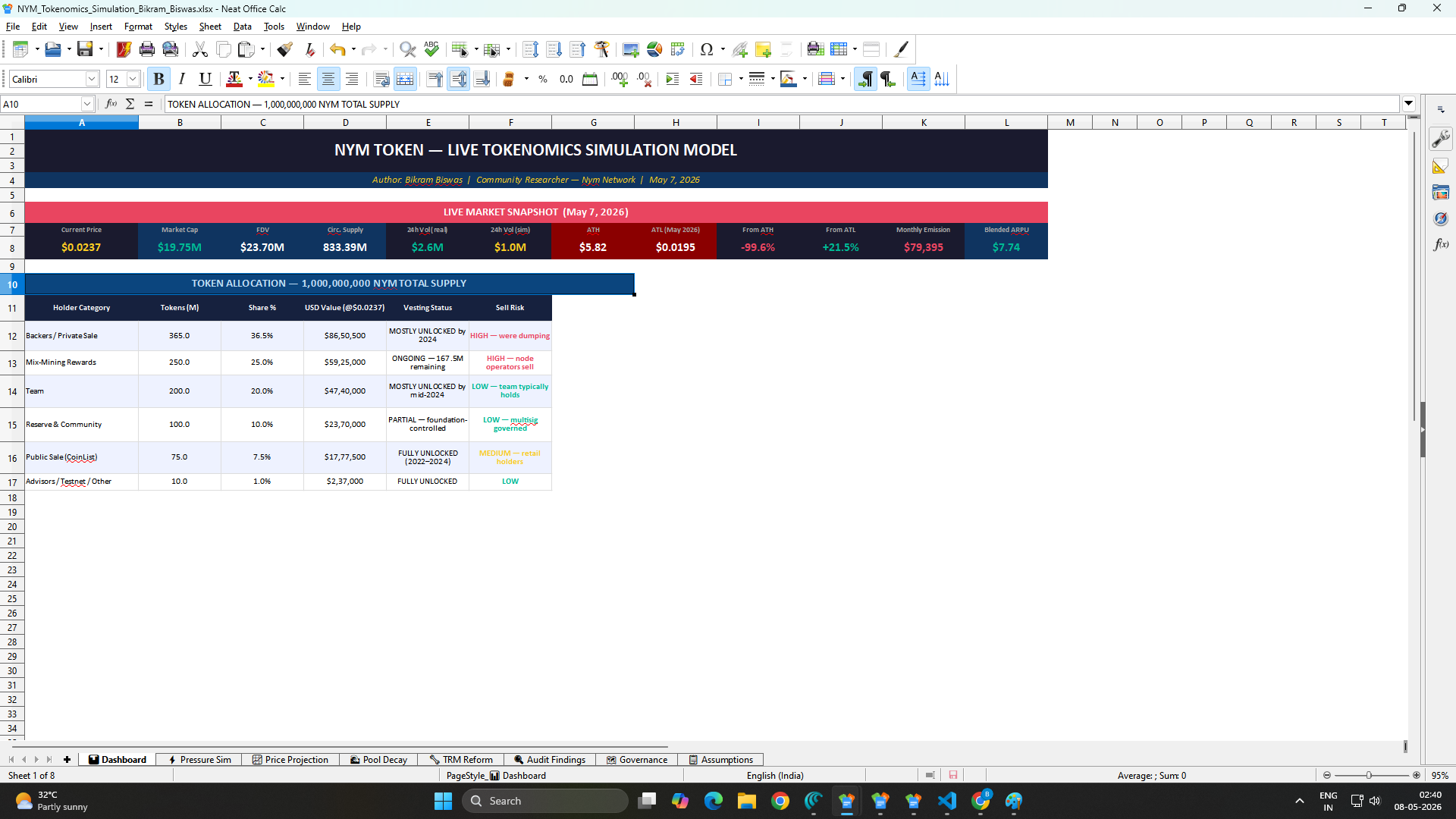
NYM Tokenomics Simulation — Simple Explanation

This Excel workbook is a step-by-step model of how NYM token value may change over time.

Its main purpose is to answer one question:

Can subscription revenue from NymVPN support the token economy better than the current emission system?

The workbook compares two forces:

  • Buy pressure from subscription revenue

  • Sell pressure from monthly token emissions

If buy pressure is too weak, price stays under pressure.
If the token design is improved, the model shows how the balance could become healthier.


The main idea in simple words

The current problem is this:

  • users pay in USD

  • rewards are paid in NYM

  • emissions continue every month

  • when token price rises, the USD value of those emissions rises too

So the system can end up fighting its own price growth.

That is why the workbook studies reforms that connect rewards more closely to real usage and real revenue.


What each worksheet means

1. Dashboard

This is the summary page.

Think of it as the front page of the model. It shows the most important numbers at a glance:

  • current NYM price

  • market cap

  • circulating supply

  • monthly emissions

  • subscription revenue assumptions

  • projected recovery path

This sheet is meant to give readers a quick “where are we now?” view.


2. Pressure Sim

This is the most important calculation sheet.

It compares:

  • how much money comes in from subscribers

  • how much token value gets emitted each month

In simple terms:

  • more subscribers = more buy pressure

  • more emissions = more sell pressure

This sheet shows whether the system has net buying pressure or net selling pressure.

It also compares the Legacy model with the TRM-2 model, where part of the buyback is burned and part goes to node rewards.


3. Price Projection

This sheet shows what may happen in the future.

It projects the equilibrium price over 24 months under different growth scenarios:

  • Bear = no growth

  • Base = moderate growth

  • Bull = strong growth

This helps people understand that token price is not random. It depends on:

  • how many subscribers NymVPN gets

  • how much revenue those users generate

  • how much emission is still coming from the pool


4. Pool Decay

This sheet tracks the mixmining pool over time.

The reward pool does not disappear instantly. It decays slowly month by month.

That means emissions keep coming for a long time, and those emissions continue to create sell pressure.

This sheet shows why the pool is still important even years after launch.


5. TRM Reform

This sheet compares the proposed reforms.

It explains which ideas are mathematically valid, which need governance approval, and which ones are likely to help the token economy.

The main reforms are:

  • TRM-1: pay nodes based on actual network usage

  • TRM-2: burn part of buybacks and send the rest to a new rewards contract

  • TRM-3: cap emissions based on actual revenue

This is the “what should we change?” sheet.


6. Audit Findings

This sheet lists the structural problems found in the model.

It highlights issues such as:

  • the price ceiling problem

  • governance quorum gaps

  • bad routing of buybacks if they go back into the emission pool

  • the risk of emissions lasting too long

This is the “what is broken?” sheet.


7. Governance

This sheet is the action plan.

It explains how the reforms could actually be implemented step by step.

This is the “how do we move from analysis to action?” sheet.


8. Assumptions

This sheet contains the base numbers used in the whole model.

Examples:

  • ARPU

  • token price

  • emission rate

  • initial pool size

  • subscriber growth assumptions

This sheet is very important because if someone changes one assumption, the whole model changes.

It tells readers:

“These are the starting numbers. Change them if you want to test a different scenario.”


What the simulation is really showing

The workbook is not trying to predict the future exactly.

It is showing how the token behaves under different conditions.

It asks:

  • What happens if subscriber growth is weak?

  • What happens if growth is strong?

  • What happens if emissions continue without reform?

  • What happens if rewards are tied to real usage?

  • What happens if part of buybacks are burned?

So the model is really a stress test for tokenomics.


How to explain the model to a non-technical reader

This Excel model compares NymVPN subscription revenue against monthly NYM emissions. If emissions are too large compared with revenue, price stays under pressure. The model tests reforms that could reduce that pressure by rewarding active nodes, burning part of buybacks, and limiting emissions based on revenue.

That is the simplest way to explain the whole workbook.


One important point about the numbers

Make sure the ARPU number is used consistently across the workbook and the explanation.

If the sheet is using one ARPU value, keep that same number in every example.
Do not mix two different ARPU assumptions unless you clearly label one as a separate scenario.

That will make the explanation much easier for readers to trust.


Simple conclusion

This simulation is meant to show that NYM’s problem is not only about market sentiment.

It is also about structure.

If emissions stay disconnected from usage and revenue, price can remain trapped.
If rewards become usage-based and emissions are tied more closely to real revenue, the token economy becomes easier to understand and potentially easier to sustain.


Excel Sheet