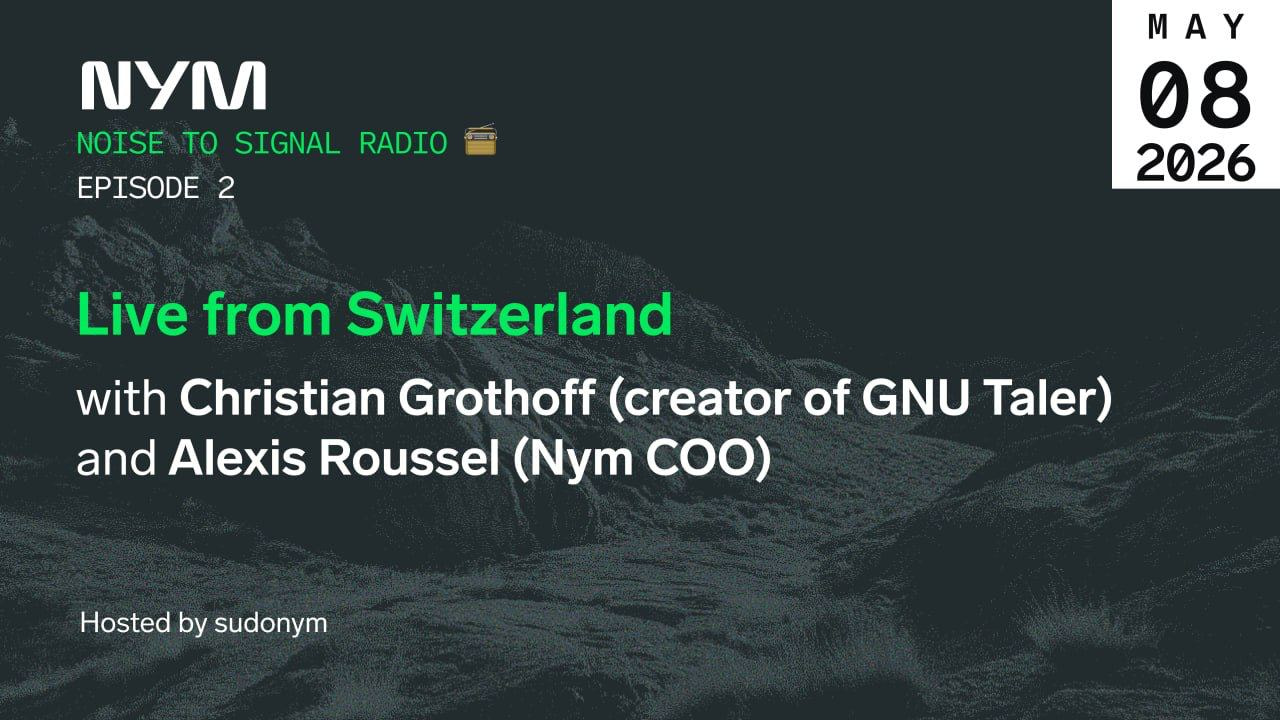
 Noise Signal Radio #2 - GNU TALER, CBDCs & The Future of Payments with Christian Grothoff
Welcome to the second episode of Noise Signal Radio - a show where we cut through the noise and talk about what matters in privacy, free and open-source technologies, and human rights. This episode was born by occasion: after a guest lecture on anonymity at Bern University of Applied Sciences, we grabbed the opportunity to chat.
@sudonym was joined by Alexis Russell (COO of Nym) and Christian Grothoff (professor of computer science, co-founder of TALER Systems, and co-maintainer of GNU TALER).
Big thanks to everyone who joined live!
 What is GNU TALER?
Christian gave the elevator pitch:
“Three core principles - free software, anonymous spending for customers, and income transparency for merchants. Only you should know where you spend your money. But the person receiving money must be transparent so taxes are paid and the government can build schools and universities.”
Asymmetric privacy is the key innovation: customers pay in complete privacy, merchants can be audited. It’s a compromise - but a good one.
Already integrated into NymVPN. In the Nym checkout flow, TALER sits in the “cash section” alongside physical cash - the OG privacy technology. Nym also built a BTC Pay Server plugin for TALER, so any shop running BTC Pay can accept Swiss francs via TALER.
 The Problem with Current Payment Systems
Christian didn’t hold back. Mastercard and Visa aren’t just expensive - they’re a surveillance and sovereignty issue.
“Look at TrackFin - the NSA program for surveillance on SWIFT and payment systems. That’s from the Snowden slides. They’re using this to influence our politics.”
The cost problem: Small businesses pay 2-3% in card fees (sometimes losing money on small transactions). Brazil’s PIX system? Free. Europe is at a massive competitive disadvantage.
“If you look at the German automotive industry - they decided it was cheaper to lobby against electric vehicles than to change. Now Germany has no more car industry. The same thing is happening with payments.”
The sovereignty problem: A French lawyer on the International Criminal Court was sanctioned by the US - and can no longer buy groceries in Europe because all banks depend on Mastercard/Visa.
“So much for our sovereignty. Our courts can’t make decisions anymore without being afraid they might be sanctioned.”
 CBDCs - The Train Wreck Coming?
Christian explained what CBDCs (Central Bank Digital Currencies) actually are - and why the current European proposals are deeply flawed.
Two types of CBDC:
- Wholesale (banks settling with banks) - already exists, nobody cares
- Retail (normal citizens having central bank liability) - the problematic one
The ECB’s online digital euro proposal: Basically just another bank account… with a 3,000 euro cap (while deposit insurance covers 100,000 euros at commercial banks). Businesses can’t use it at all. It adds crazy complexity without any value.
“I asked them - what about the liability? If I hack your digital euro account and drain your commercial bank account, what happens? They don’t know.”
The offline digital euro proposal (mythical full anonymity): Christian warned this is impossible.
“There’s a theorem that says if you want to prevent double spending, you need to go online. If you think you can prevent people from copying data - talk to the film and music industry. They would love to buy your technology.”
His investment advice:
“If the European Central Bank actually comes out with an offline digital euro - sell your euros. Somebody will copy it and do billion-spending.”
And the kicker: The ECB is spending 1.3 billion euros on a project where even they admit they’re “searching for the use case.” Meanwhile, public support is non-existent.
“They asked people what feature they wanted most from a CBDC. The highest ranking answer was privacy - which is exactly what they’re not giving.”
 Asymmetric Privacy - The Optimal Model
Christian cited a paper by economist Katrin Trinh (whom he later told about TALER’s existence - she didn’t know it had been built). She modeled three economies:
- Full surveillance - people transact less (paying with data is a disincentive)
- Full privacy - investors can’t verify returns, accounting becomes impossible
- Asymmetric privacy - customers private, merchants transparent - optimal for welfare
“The European Central Bank picked the two suboptimal models. Economists, I tell you.”
 Is the EU Corrupt? Not Exactly - It’s Complicated
Christian addressed a common skepticism: can you trust EU-funded projects like TALER or Nym?
“First of all, ‘the EU’ doesn’t exist. You have different departments staffed by different people. Some love privacy, some hate it. It’s not monolithic - certainly not like the Trump administration.”
His experience with EU funding (NGI program):
“They gave us money to build what we said we’d build. They’ve never suggested anything against our values. They actually helped us - put us in touch with people at the ECB, with the Digital Markets Act team working on the Apple case. They were supportive.”
The real guarantee: Everything is open source.
“You can look at what we’re actually doing. If you find anything where we’re not doing our best for privacy - send us a patch.”
 TALER’s Roadmap - When Can You Use It?
Current status:
- Working in Switzerland (Biel, with Netspon regional currency)
- Partnership with Magnet Bank in Hungary (targeting January 2027)
- Plans for a synthetic CBDC - a financial institute that offers central bank money without speculative investment
Global ambitions:
“We got an invitation from the Embassy of Sierra Leone to talk to the Central Bank of Africa. Something in Africa might happen before the euro.”
European rollout:
TALER needs approximately 3 million euros to create a financial institute and apply for a license from BaFin (German regulator). Timeline: 9-24 months depending on the regulator. Then passporting across the EU.
“If a VC is in the room - contact me. You don’t need to put up the entire three million. We take smaller amounts too.”
 TALER + Nym - A Natural Fit
Alexi asked: Does TALER need Nym for network-level privacy?
Christian’s answer:
“Need is a strong word. You could use Tor or another VPN. But the combination makes sense. Having a checkbox that says ‘all TALER wallet interactions go over Nym’ - that’s great. We don’t look at IP addresses. 200 milliseconds of extra latency is fine for payments.”
Alexi added a bigger vision: CBDCs serious about privacy should run on Nym - protecting both individual privacy and the system’s sovereignty from foreign surveillance.
 Q&A Highlights
Q: What do CBDCs look like technically? (HelloWorldXY32)
Christian: “Some are on permissioned blockchains (IBM Hyperledger). Some are database-oriented (PIX, China). Some try offline secure hardware (won’t work). TALER is unique - free software, self-custody tokens, federated.”
Q: What’s TALER’s pitch to small European businesses?
- Lower fees (small businesses pay 2.5% vs big ones 0.5%)
- Free software - no vendor lock-in
- Privacy makes payments easier (no multi-factor authentication)
- Instantly final - no chargebacks, no fraud disputes
- Less compliance burden (no PCI DSS, no GDPR data to manage)
Q: Microtransactions?
“Yes - publishers can sell articles for 5-10 cents. Existing systems can’t because of per-transaction fees. TALER does 25,000 transactions per second on a single server.”
Q: Teaching vs building TALER - what do you like more?
“There are days where I love both and days where I hate both. I don’t like grading. I don’t like fundraising - dental work or fundraising? I don’t know. But the best thing is that I can mix and match: teaching in the morning, business in the afternoon.”
Q: What will the next generation of Visa/Mastercard look like?
Christian showed off a payment ring one of his employees uses - “the ring of Sauron you can use to pay.” Alexi predicted a federated future: “Like Mastodon but for money.”
Christian’s closing thought:
“Microsoft said Linux is a cancer. Now half the data centers run on GNU/Linux. It doesn’t kill the other business model - Microsoft is still around. But it can take a significant bite. That’s what we should aim for.”
 Timestamps
- 00:03:12 — What is GNU TALER? The elevator pitch
- 00:07:52 — The problem with Mastercard/Visa (surveillance, sovereignty, fees)
- 00:10:08 — TALER integrated into NymVPN + BTC Pay Server plugin
- 00:16:38 — CBDCs explained (wholesale vs retail)
- 00:23:44 — The offline digital euro is impossible (cap theorem)
- 00:28:31 — Asymmetric privacy: the optimal economic model
- 00:34:27 — Real-world TALER deployments (Netspon, Franc Paysant)
- 00:37:32 — Will TALER become the digital euro?
- 00:46:40 — EU funding & the NGI program
- 00:50:21 — EID, age verification, and forced identification
- 00:56:43 — Bitcoin vs TALER: the triple-entry accounting debate
- 01:07:29 — TALER roadmap: 3 million euros, BaFin license, passporting
- 01:19:47 — Teaching vs building TALER
- 01:21:15 — Pitch to small European businesses
Watch the full recording:
YouTube Link
Huge thanks to Christian Grothoff for the brilliant conversation - and to Alexis for co-hosting. If you’re a VC interested in the future of payments, reach out to Christian!
Next episode of Noise Signal Radio: Stay tuned!
