I’ve been exploring some ideas around censorship-resistant publishing and how something Nym-like could support identity-free web hosting in the future.
I know the Nym team has said that hidden services aren’t currently on the roadmap, and what I’m describing isn’t a request or expectation - just a conceptual extension of what could be possible.
In short, the post outlines a design for a “reverse-Nextcloud” model where publishers could push content anonymously into a mixnet-backed publishing layer, taking advantage of Nym’s incentive system, traffic analysis resistance, and privacy-preserving payments.
I’d love to hear thoughts, critiques, or pointers on whether anything like this has been discussed before, or if others see potential (or pitfalls) in approaching anonymous publishing this way.
I’m not sure if I understand your question correctly, but I currently read it as: you’re suggesting defining a dedicated Nym application protocol and URI scheme (similar to gemini:// or gopher://), so that content could eventually be addressed as something like nym://nym.address instead of (or in addition to?) https://… URLs in the browser.
If that’s what you meant, my concern is that it would clash with one of the core requirements I set for this design: low friction for readers, ideally loads in a normal browser.
A gemini:// / nym://-style approach usually implies special clients, extensions, or at least extra setup on the reader’s side, which is exactly the kind of friction I’m trying to avoid for the default UX.
But maybe I’m misunderstanding your idea or you’re thinking of nym:// more as an additional “power user” layer beneath the browser-facing HTTPS entrypoint.
I’d love to hear a bit expanded version of what you have in mind with nym://nym.address and how you see readers actually accessing that in practice.
Have you checked out NymShare? Instead of downloading all sorts of files, one would use the same scheme as a standalone browser, to access nym://nymaddress. I guess a custom version of NymShare could be done, which acts as a text or MarkUp reader. Simply said, keep it simple for developers and users.
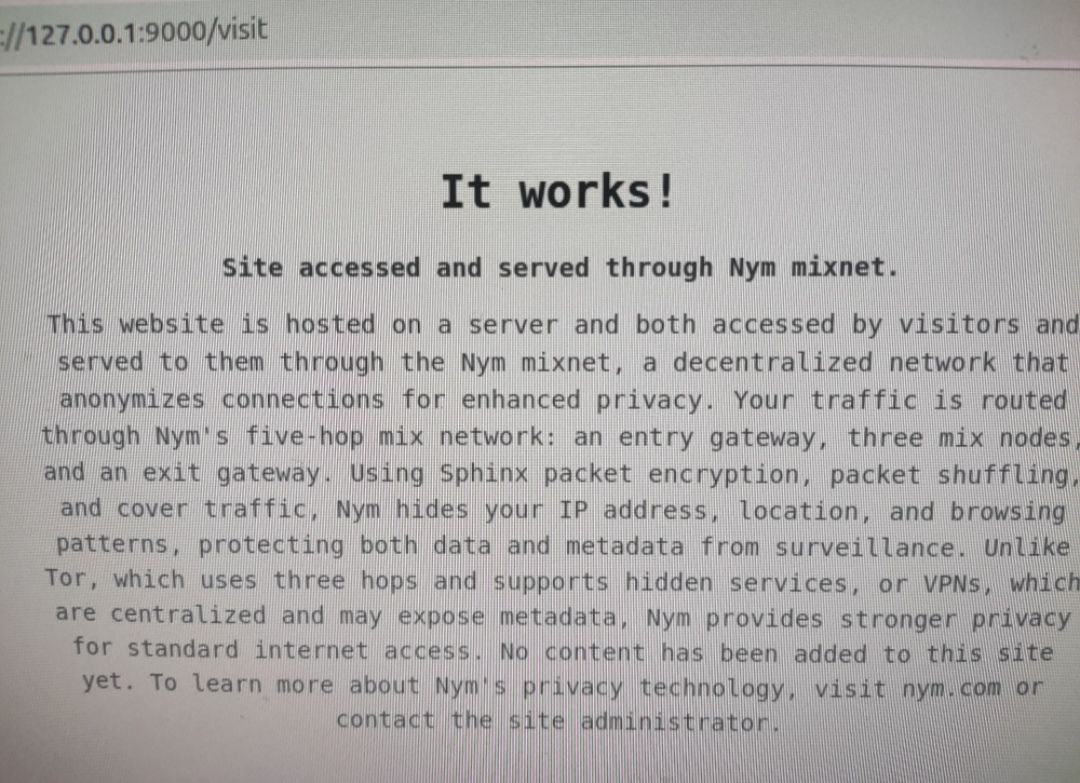
I use the Nymshare approach to serve a page, using a local mini browser to fetch it anonymously, I have no other photos and this one is from telegram channel that I had post it.
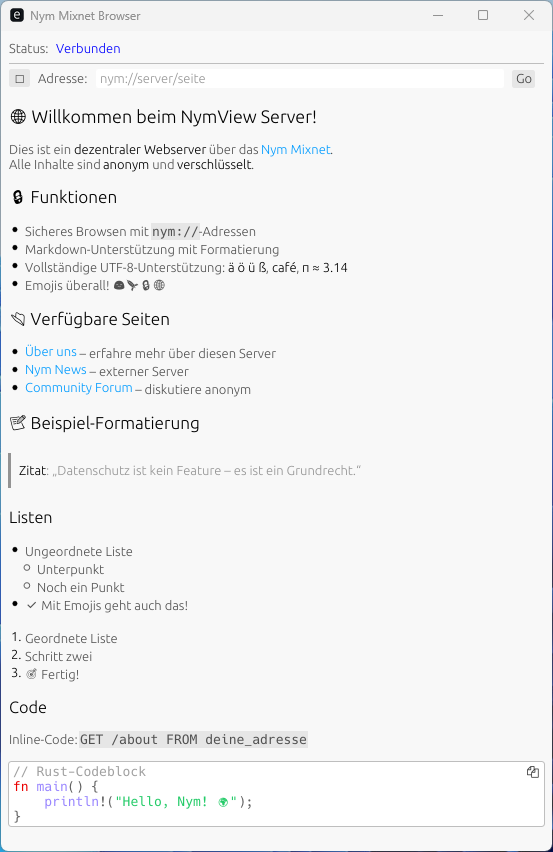
@XRoot I am currently working with two friends on a Rust MarkDown Server and Client for the Nym Mixnet, inspired by your photo. Tests have shown with some previous html tags that it works with the Nym Mixnet. But we changed to MarkDown language, to have a clean page viewing system, without graphics or sound, like Gopher or Gemini. We will call it NymView.
First, the website loader scans the project folder for all .html files, reads their contents, and stores them in a HashMap, using the lowercase filename (minus the extension) as the key (for example, index.html becomes “index”).
Second, the Nym mixnet client listens for incoming messages. When a request arrives at the listener client, it checks whether the message specifies an endpoint. If no endpoint is provided, the server returns the contents of index.html by default. If the message includes an endpoint such as, contact.html, about.html the server looks up the corresponding page key and returns that HTML file’s content. Otherwise, it responds with a simple 404 “Page Not Found.”
That’s the entire flow like NymShare, and it already behaves like a lightweight web server just running over the Nym mixnet instead of the traditional internet. From what I can tell, anything that can be built on top of Tor can also be built on top of Nym, what we really need is for more people to explore the possibilities and get interested..
Back in the old keybase days, when Nym was brand new, a lot of discussions like this happened, because the Nym programmers participated too. Nowadays, wheter here or at other (Nym forums) you don’t have those kind of discussions anymore, as one can see when looking at the subject of threads. People are mostly end users or promoters but don’t try out new thing or explore aspects of given programs. Same at the tor forums.
Thank you very much, XRoot. I now have to do the localization into English. Once done I will send you via PM a download link, for testing etc. .png image support is added as well, because I expect people like to have that feature and via the Nym Mixnet page loading is fast. The only thing I will leave out is a bookmark toolbar/browser, to keep
the UI clean. I for myself will store anonymous nym:// URLs anyways in an encrypted seced file, for copy / pasting.
 Tests have shown with some previous html tags that it works with the Nym Mixnet. But we changed to MarkDown language, to have a clean page viewing system, without graphics or sound, like Gopher or Gemini. We will call it NymView.